To be privately owned
CastleSchweina
Marienthaler Castle
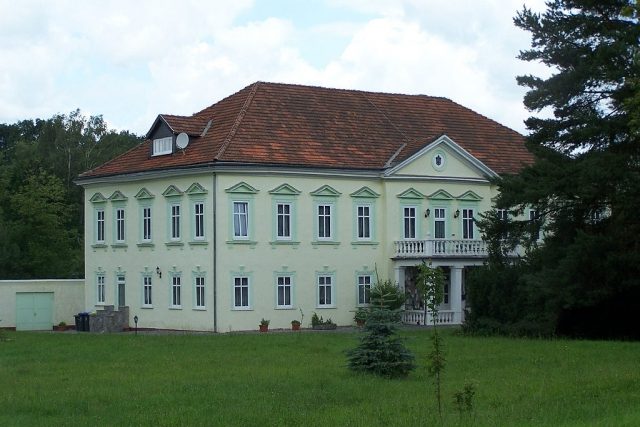
The Marienthaler Schlösschen is a listed building in the municipality of Schweina in the Wartburgkreis and is located in the southern part of the village.
The castle was designed as a two-story, strictly symmetrical, classical building with a three-axis central section. The outbuildings contained functions necessary for the estate, and at some distance from the castle there was also a 16th-century smelter and a copper hammer.
The area south of Schweina belonged in the Middle Ages to the settlement of Wenigenschweina (first mentioned in 1330). In the late 15th century, an estate was established there, which belonged to the Lords of Rexrodt. Around 1558, Claus von Wechmar bought the estate, probably commissioning the construction of a castle-like manor house in the Renaissance style. The Prussian Colonel Ludwig Anton von Wechmar (1712–1787) – a hussar general of Frederick the Great during the Seven Years' War – was born in the castle. The estate was offered for sale in 1716 and came into the possession of the von Fischern family, based in Liebenstein. Since this family owned their own properties in Liebenstein, the old castle fell into disrepair due to structural damage and neglect. Only an heir, the Meiningen forester Friedrich von Fischern, invested in the preservation of the buildings from 1800 onwards. In 1808, a side building was completed as a new construction. On the advice of the involved architects, the old manor house was also demolished in 1812 and replaced by a new building.
The von Fischern family belonged to the landed gentry in the Duchy of Saxe-Meiningen and was entrusted with the administration of the ducal forests by the regent, Duchess Louise Eleonore, in 1815. The constant absence from their estate in Wenigenschweina led to the decision to lease the estate for a longer period. The Ducal Meiningen Finance Chamber took over the estate in 1833 and renamed it. At the request of the now reigning Duke Bernhard Erich Freund, it was renamed Marienthal, along with its associated fields, after his wife Marie (of Hesse-Kassel).
The property adjacent to the Marienthaler Schlösschen had been the site of a copper smelter since the 16th century, located about 500 meters south on the banks of the Schweina. This operation was acquired in 1853 by the Ruhla industrialist Andreas Ziegler and a business partner. Within a few years, a sprawling factory complex for the manufacture of knives, small ironware, and brassware was built along the course of the Schweina river. A successor to the company founders acquired the Marienthaler Schlösschen as a residence in 1892. In the surrounding area, further industrial enterprises were established up to the edge of Schweina, and a small factory workers' settlement named Marienthal was built on the valley edge.
After reunification in 1990, most of the up to 100-year-old factory buildings were demolished, and the area around the castle now represents an industrial wasteland.
Friedrich Fröbel in Marienthal+
From 1851, the small castle, which also included a park area with walking paths and ponds located in the meadow valley, housed the pedagogue Friedrich Fröbel and an educational institution founded by him on the upper floor of the main building. The already 70-year-old Fröbel died on June 21, 1852, in the Marienthaler Schlösschen; he was buried in the Schweina mountain cemetery. Under his successor, the educational institution continued to exist in the main building of the castle until 1890.
Take Mobile History with you
You are reading this text for free. Premium adds what matters on the road: descriptions read aloud, sites found through your camera, whole regions taken offline.
- Every description, including the ~17,700 Premium sites
- Audio guide: have descriptions read to you on location
- AR finder: see sites through your camera, with distance and bearing
- Unlimited saved sites
14 days free, then from €2.99 a month. Cancel anytime.
Source: Wikipedia · Licence: CC BY-SA 4.0
This description draws on the facts documented in the linked Wikipedia article; Wikipedia content is licensed under CC BY-SA 4.0. Wording and editing: Mobile History.
Location: 50.8138, 10.3315