Parish church
MonasteryBedburg-Hau
Marienstift Bedburg - St. Markus Schneppenbaum
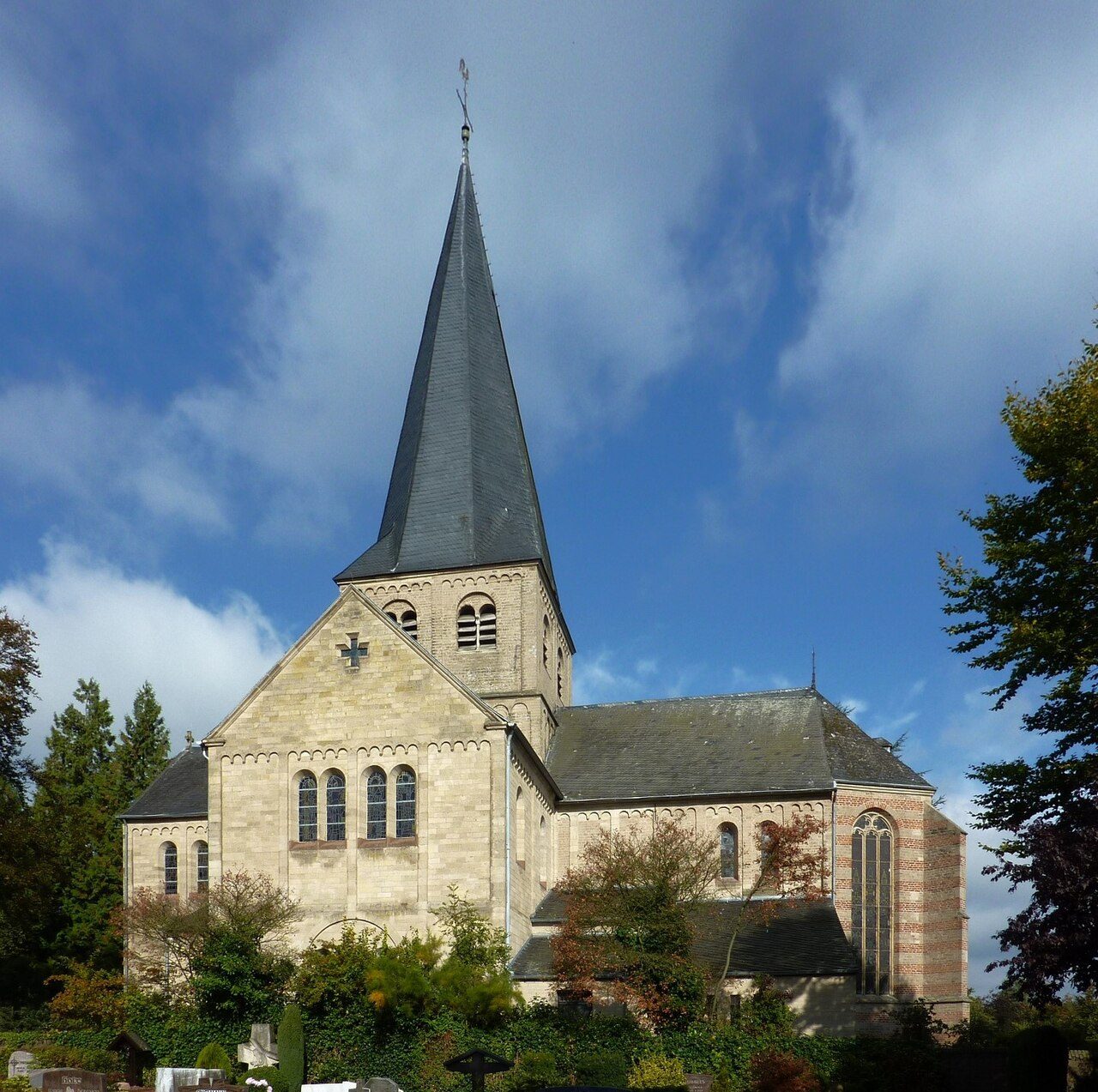
The Marienstift Bedburg, now known as St. Markus in Schneppenbaum, is a historic monastery located near Kleve in North Rhine-Westphalia. Originally founded in the 12th century, it served as a significant spiritual center and is now a Roman Catholic parish church, showcasing a remarkable architectural evolution and a rich history.
History+
Count Arnold I of Kleve initiated the foundation of the Bedburg Abbey before 1138. It adhered to the rules of the Premonstratensian Order, which had been recently established by Norbert of Xanten. The abbey church served as the burial site for the Counts of Kleve until the early 14th century. Around 1270, Bedburg transformed into a regulated convent for women, and in 1519, it became a regulated canonesses' foundation. In 1604, the convent relocated to Kleve, leading to the progressive decay of the monastic buildings in Bedburg. The secularization occurred in 1802. Since 1804, the former abbey church has been used as the parish church of St. Markus for the community of Schneppenbaum.
The abbey church, whose construction began around 1130, was originally a Romanesque cruciform structure with a crossing tower. In the mid-15th century, a Gothic east apse was added. Following the relocation of the abbey in 1604, the structure fell into disrepair, resulting in the demolition of most of the monastic buildings and the church in 1774, with only the tower and the east wing remaining. Between 1900 and 1902, the missing parts of the church were reconstructed in Neo-Romanesque forms.
Location+
The Marienstift Bedburg – St. Markus Schneppenbaum is situated in the city of Kleve in the federal state of North Rhine-Westphalia, Germany.
On site+
Today's St. Markus Church houses several notable furnishings. The stained-glass windows were designed by Joachim Klos between 1965 and 1968, while the glass panels of the three choir windows date from 1903 by the Josef Mencke Goch company. A Vesperbild, depicting the lamenting Mary holding the body of her son, is possibly attributed to Master Arnt von Kalkar. The organ, a slider chest instrument with 50 stops across four manuals and pedal, was built by the organ building company Breil (Dorsten) in 1968 and expanded in 1980. The key actions are mechanical, and the stop actions are electric.
Nearby+
- Haus Rosendal (castle, approx. 1374 m away)
- Haus Gansward (fortified house, approx. 3596 m away)
- Schloss Moyland (castle, approx. 3626 m away)
- Herrenhaus Ten Berge (manor house, approx. 3914 m away)
Take Mobile History with you
You are reading this text for free. Premium adds what matters on the road: descriptions read aloud, sites found through your camera, whole regions taken offline.
- Every description, including the ~17,700 Premium sites
- Audio guide: have descriptions read to you on location
- AR finder: see sites through your camera, with distance and bearing
- Unlimited saved sites
14 days free, then from €2.99 a month. Cancel anytime.
Location: 51.7631, 6.1858