The church can be visited
ChurchSalzwedel
Marien Church
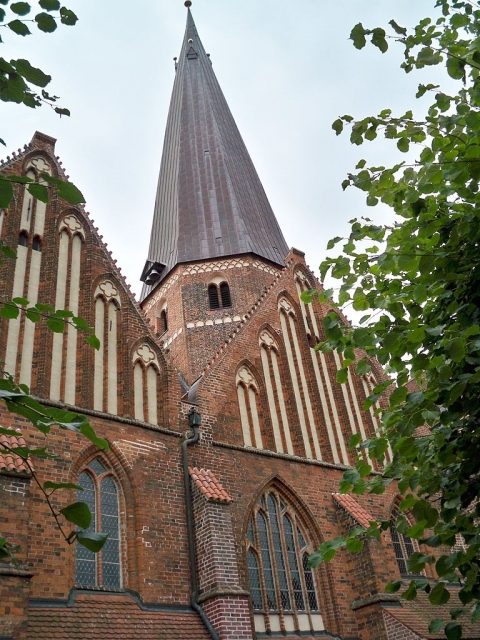
The Protestant St. Mary's Church (Marienkirche) is the largest church in the city of Salzwedel in the northwest of Saxony-Anhalt. It is of Romanesque origin but is attributed to Brick Gothic.
The first St. Mary's Church was built around 1150 as a Romanesque fieldstone church. This makes it, along with St. Lawrence's Church (Lorenzkirche), the oldest church foundation in Salzwedel. After 1200, this hall church was demolished. Only a 2.70-meter high tower stump with a round footprint remained.
The new representative church was conceived as a three-aisled brick basilica on a cruciform plan. The nave was vaulted. The new tower had an octagonal footprint above the tower stump and was built 40 meters high from brick. On top of it was a lean-to roof. In 1233, Salzwedel's Old Town was first mentioned in a document. St. Mary's Church was then an archdeaconry church and the main parish church of the Old Town.
From the mid-14th century, the church was converted into a five-aisled basilica in the Gothic style. The work stretched over 200 years. The lean-to roof was replaced by a spire, making the tower, at 80.3 meters high, the second-highest church tower in the Altmark. The spire already showed a curvature early on, which persists to this day. A document about a tower repair in 1496 was found in the tower head. A west hall at the height of the nave was built, so that the tower base stood inside the nave. The High Choir was extended. The church received 28 side altars. Since 1550, the building envelope has remained largely unchanged.
In 1510, a three-part carved wooden altar was installed in the choir. Parts had already been made in 1480. In 1522, a bronze baptismal font, made by Hans von Köln in Nuremberg, was installed. In the course of the Reformation, presumably in 1522, the parish of St. Mary's Church became Evangelical-Lutheran. In 1581, an organ gallery and a sandstone pulpit were installed.
In 1752, a Baroque organ by Joachim Wagner was installed. However, he died before completing the work. The organ was replaced in 1913 by an organ from the company Furtwängler & Hammer with 62 stops, which was unplayable for a long time and was re-inaugurated on Easter Monday 2007. St. Mary's Church suffered no direct war damage in World War II. In 1972, the spire was damaged by a hurricane, causing numerous of the lead plates then used to fall off, allowing moisture to penetrate the tower for a long time. In 2003, the renovation of the spire was completed. At the same time, the peal of bells could be completed, after bells had to be surrendered for weapon production during both World Wars.
In 2006, a component tempering system was installed for thermal building preservation. Geothermally generated heat is continuously supplied to the masonry through the plinth.
Architecture and Furnishings+
St. Mary's Church is a five-aisled brick basilica. The side aisles have stepped gables. The spire is covered with copper. The base of the tower inside the church is the only preserved part of the original church. It is accessible. Its walls are about three meters thick.
The walls of the High Choir are white with black ribs. The carved wooden altar stands in the High Choir. It is eight meters high and over six meters wide, making it the largest carved altar in the Altmark. With 30 relief figures and 22 sculptures in 31 fields, it depicts scenes from the lives of Mary and Jesus, some of which were created after copper engravings by Martin Schongauer. Part of the choir stalls, created around 1360, is preserved. Also from this time is a Christ window, located in the choir. Another stained-glass window dates from the 16th century. In the choir are a richly decorated wooden lectern from the 13th century and an eagle lectern from the 15th century, a Levite's seat from the 14th century, and a Margrave's seat from the 16th century, like the Levite's seat a triple seat. At the entrance to the High Choir is a triumphal cross group in its original arrangement. The rest of the church interior is also painted white, but has red ribs in the main nave and red-black striped ribs in the side aisles. In the nave are life-sized stone figures on the impost platforms of the former Romanesque basilica. Remains of old wall paintings are present. The Renaissance baptismal font in the southern side aisle includes a baldachin attached to the vault and a grille that surrounds the baptismal font. The baptismal font itself is heated.
Above the bridal portal is a 19th-century stained-glass window depicting the Annunciation of the birth of Jesus by the Archangel Gabriel. The peal consists of six bells. The youngest bell is called "Shalom". The furnishings of St. Mary's Church include a silver-gilt Gothic communion chalice from the mid-15th century and a silver-gilt host vessel from the early 14th century.
Organ+
In the Baroque organ case by Joachim Wagner from 1749 is an instrument by the organ building company P. Furtwängler & Hammer from 1913. The organ has 61 stops and three extensions on three manuals and pedal. The actions are electropneumatic. The instrument was last extensively restored in 2005 by Christian Scheffler (organ builder).
Usage+
Services are held in the church weekly and on holidays. In addition, there are exhibitions on religious themes. An annual concert series consists of concerts for solo organ, with solo vocals, or with other instruments.
Surroundings+
St. Mary's Church is located on a square in Salzwedel's Old Town, partly lined with 150 to 300-year-old lime trees. Historic half-timbered houses surround the square. The streets around St. Mary's Church are paved with cobblestones. South of the church is the Kluhs, a former tithe barn of the parish, which has been used as a church café and community event venue since its renovation. In Salzwedel's Old Town, there are two other medieval churches: St. Lawrence's Church (Lorenzkirche) and the Mönchskirche.
Take Mobile History with you
You are reading this text for free. Premium adds what matters on the road: descriptions read aloud, sites found through your camera, whole regions taken offline.
- Every description, including the ~17,700 Premium sites
- Audio guide: have descriptions read to you on location
- AR finder: see sites through your camera, with distance and bearing
- Unlimited saved sites
14 days free, then from €2.99 a month. Cancel anytime.
Source: Wikipedia · Licence: CC BY-SA 4.0 · Image: http://commons.wikimedia.org/wiki/File:Marienkirche_von_Norden.jpg?uselang=de
This description draws on the facts documented in the linked Wikipedia article; Wikipedia content is licensed under CC BY-SA 4.0. Wording and editing: Mobile History.
Location: 52.8494, 11.1491