The church can be visited
ChurchDresden-Hosterwitz
Maria am Wasser Church
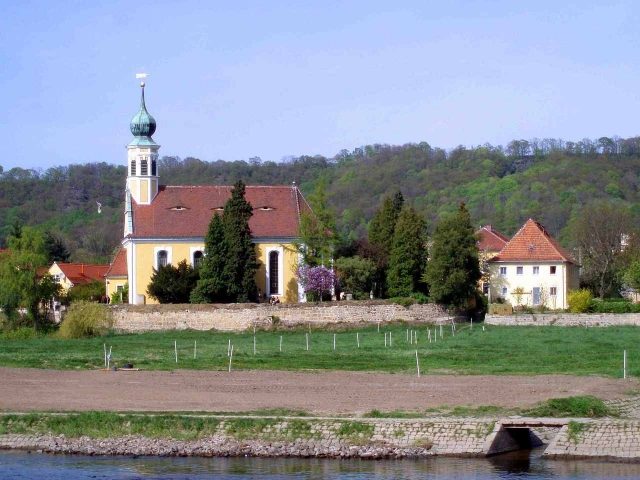
Maria am Wasser is an Evangelical-Lutheran church in the Hosterwitz district of Dresden. With its exterior, reminiscent of South German Baroque sacred architecture, it is completely untypical for the Dresden region. The churchyard, at 1,500 square meters, is one of the smallest cemeteries in the city. The Maria am Wasser church and its churchyard are listed as historical monuments and were part of the UNESCO World Heritage site of the Dresden Elbe Valley from 2004 to 2009.
Predecessor and New Building
In Hosterwitz, originally a church village located about 10 kilometers from Dresden, there is said to have been a wooden church shortly after Christianization around 1200. A pastor of Hosterwitz is first mentioned in documents around 1406. At that time, the church was set up as a sacred building only for pre-Reformation mass services.
According to tradition, the current church building goes back to Dionysius von Carlowitz, who had it built at his own expense in 1495 as a late Gothic hall church. Around 1500, the church was christened "Maria am Wasser". At that time, the building was a simple rectangle, lower and shorter than the present church. The church had no galleries and only a few windows. It was mainly used as a fishermen's and boatmen's church and was a place of pilgrimage until the Reformation.
Baroque Reconstruction 1704
By the end of the 17th century, "Maria am Wasser" no longer met the demands of the time. Under Pastor Christoph Rüdinger, who served in Hosterwitz from 1680 to 1724, the Baroque reconstruction of the church was decided. From 1698, the congregation and church fathers collected funds for the reconstruction, estimated at 1700 thalers. On August 26, 1702, the robber gang led by Lips Tullian broke into the church, where the collected money was stored, and stole not only the income but also valuable church equipment. In addition, the men demolished parts of the church. The gang was only caught in 1714 and executed the following year.
Due to the robbery, the reconstruction planned for 1704 stalled, as about 1000 thalers were still missing even after collecting the church debts. They had to be borrowed in 1704 and were subsequently repaid by 1732. In 1704, the reconstruction of the church began, during which it received its approximate current form. The altar area was added, the church tower received its onion shape influenced by southern Baroque buildings, and possibly the attached sacristy also dates from this period. The church tower flag bears the year 1741, as extensive roof and tower renovations took place in that year. In 1774, the interior of the church was significantly redesigned; the altar was moved to the newly added choir area, and the pulpit, which had previously been on the south side of the church, was attached to the altar. Parts of the altar were lost in the process. The church roof was re-covered in 1790; further restoration work on and in the church took place in 1822 and around 1900, including painting the altar in color and installing new colored stained-glass windows. The Hosterwitz church received a wooden baptismal font from 1786 in 1930.
Maria am Wasser from 1945 to Today
During the bombing of Dresden in February 1945, "Maria am Wasser" remained undamaged, but was hit by an incendiary bomb three months later and slightly damaged. From 1972 to 1973, the interior of the church was restored and the original bright white color scheme was reinstated.
In August 2002, the "Maria am Wasser" church was submerged under about 2 meters of water for several days during the Elbe flood. On August 31, 2003, the church, restored with donations and by numerous helpers, was re-consecrated. Since 2006, the "Maria am Wasser" church has been part of the Community of the Cross of Nails. The Cross of Nails is located to the left of the altar on the north wall of the church.
Today, the sacred building is a popular wedding church. Services and concerts are held regularly. The "Maria am Wasser" church, together with the Pillnitz Vineyard Church, serves the Evangelical-Lutheran Parish of Dresden-Hosterwitz-Pillnitz. A sacred building of similar name is the Catholic chapel "Maria am Wege" – the former private chapel of the Wettins – which is located not far from the boatmen's church in the Pillnitz district.
Building Description+
Exterior
The exterior of the church is simply kept in a yellow tone with white accents. The main entrance to the church is on the north side through a segmental arch door, above whose frame there is a frieze with a keystone. The frieze shows oak branches, the keystone has the inscription "JESUS" and a colored crown above it. An older entrance through a round arch door was located on the southern Elbe side and is bricked up.
The corners of the church are framed with simple pilaster strips that run into a strong main cornice. On the west side of the church, above a gable, is the octagonal bell tower in rustic Baroque forms with a cavetto and a subsequent onion dome. Three of the four bells of the Hosterwitz church were cast by Rincker in 1993. The tower is topped by a weather vane. Up to the weather vane, the church is 27 meters high.
Interior
The interior of the church is topped by a flat ceiling over a high cove and strong cornice. The space is occupied by two-story galleries on the north and south sides, dating from the first half of the 18th century. They are built on sturdy, simple columns. The balustrades are divided into rectangular fields.
In the west, there was originally also a two-story gallery. The Grabner organ stood in the second gallery, and the so-called "glazed chairs," the prayer rooms of the plantation owners, were installed in the first. A double outdoor staircase led to the first gallery of the west wall. In 1863, the church received a larger organ, for which the prayer rooms were demolished. The new single-story organ gallery dates from 1863 and now occupies the west side. The outdoor staircase was demolished in 1896, and a small vestibule was added to the west of the church. In the east, opposite, stand the altar and baptismal font. The church offers seating for 382 worshippers.
Altar and Pulpit
The altar was created in 1644 by Conrad Buchau († 1657) from sandstone. It was moved to the choir in 1774 and connected to the wooden pulpit, which until then had been on the south side of the church. In the process, the central part of the altar, which probably depicted the crucifixion, was destroyed. Until the renovation in 1930, larger parts of the Buchau altar were preserved, such as the relief of Jonah being spewed out by the whale. It is now located on the northern church wall in the altar area. A high relief depicting the Last Supper scene is preserved in the predella of the Buchau altar. Around 1900, Cornelius Gurlitt also counted the crowning Christ figure with the banner of faith as part of an older altar. Further figures, such as the seated evangelists Mark and Matthew, were located near the gable above the pulpit. This is two meters wide and seven meters high. The pulpit basket is divided into uniform fields. Statues of Simon Peter and John were located on consoles next to the columns framing the pulpit.
The portico pulpit altar was renovated and partially renewed in 1930. In the process, the figures of the altar, except for the crowning Christ, were removed. The keystone of the former pulpit door with the year 1774 is now in the sacristy.
Baptismal Font
The old baptismal font of the church probably dates from around 1500. The basin has a diameter of 53 centimeters and a height of 30 centimeters and is designed in Gothic form with tracery. The stem supporting the basin is about 50 centimeters high. The baptismal font has not been used since 1860, but after its restoration, it is now back in the church.
In 1930, the church received an Empire-style baptismal font, which a sculptor named Dost had created in 1796 for the church in Lichtenstein. There, the baptismal font was still in use at the end of the 19th century and was later discovered in another church by the State Office for Monument Preservation, restored, and moved to Hosterwitz. The baptismal font still in use today stands on gilded lion claws and shows putti heads on the baptismal basin.
Windows
The church has lateral basket-arch-like windows with deep reveals, which refer to the original layout before the reconstruction. They were provided in 1774 with a strong, now white-painted frame with a keystone.
The three windows in the altar area have deep reveals internally, but externally they do not differ in shape from the other windows. The two large stained-glass windows are dated to 1896. A small window painting in one of the choir windows dates from 1555 and depicts the Crucifixion.
Organ
The first mentioned Hosterwitz organ was a small portable instrument around 1635. In 1680, under Pastor Gottfried Rüdinger, a new organ was commissioned from organ builder Christian Grabner, who completed it by 1682. In the following years, repairs to the instrument were necessary, which had been damaged especially after the church reconstruction in 1704. The organ, which had 8 stops for the manual and 3 for the pedal, was played until 1863. In 1862, the congregation commissioned a new organ from Urban Kreutzbach, which replaced the old Grabner organ in 1863.
The Kreutzbach organ "shows 82 pipes in 8 fields, and in total it has 970 pipes for 18 registers." In 1917, the tin pipes had to be handed over for melting down and were replaced by zinc pipes in 1926.
The Elbe flood in August 2002 severely damaged the organ. In 2004, it was restored by the organ building and restoration workshop Rainer Wolter, and the facade was reconstructed. It was re-consecrated in a service on Easter Monday 2004.
Church Decorations and Tombs
In the altar area on the north side is a painting of the Hosterwitz pastor Gottfried Rüdinger, created in tempera colors and overpainted with oil after Rüdinger's death in 1680. It is surrounded by an elaborate wooden frame, "painted green and gold, laurel garlands, over which vine tendrils lie." Below the painting is a sandstone drapery with an upper festoon, containing Rüdinger's life data.
West of the painting, next to the sacristy door, is a tombstone of a Bohemian exile who died in Hosterwitz in 1660. Further west, a memorial plaque for Lieutenant Colonel Georg Wilhelm Trosche is immured. The simple bronze plate contains the life data of Trosche, who was buried in the old Frauenkirche in 1694 and was reinterred in the crypt of the Hosterwitz church after its demolition.
On the south side under the galleries is a stone with the inscription "AS 1638". This is the tombstone of the Pillnitz castle preacher Abraham Steinbach, who died in 1638 and was buried in the "Maria am Wasser" church.
In the altar area on the south side stands the tomb of Pastor Rüdinger's first wife, Rosina Rüdinger, who died in 1641 at the age of 28. The 80-centimeter-wide and 173-centimeter-high sandstone slab shows Jesus on the cross and a kneeling woman at its foot, with her hands placed on the cross.
Not preserved are the pictorial representation of the resurrected Jesus, created by Heinrich von Dörnberg (1831–1905), and a Gethsemane scene by Johann Traugott Noack.
Churchyard+
A cemetery at the church probably existed since the first Hosterwitz church was built. Since around 1500, the "old churchyard at the church" was demonstrably used by the villagers as a burial site. Access to the churchyard is from the north side of Kirchgasse through two round gates.
From 1734, due to a shortage of grave sites, only members of the electoral court and pastors of the parish were allowed to be buried in the churchyard. A second cemetery, laid out west of the church in 1734, was abandoned in 1867 due to frequent floods and secularized in 1896. Since 1870, burials in Hosterwitz have mainly taken place in the third cemetery not far from Keppschloss.
Many of the sandstone graves in the churchyard are no longer preserved today or are illegible due to ivy growth. One of the most artistically significant graves is the sandstone tomb for the silver page Christoph Ferdinand von Brandenstein, who drowned in the Elbe in 1788. The "roughly effective work" shows a weeping boy on a mighty column with an inscription tablet, leaning with his right arm on a vessel from which water flows. His left hand holds the torch of life into the water.
A curiosity, the so-called "Schnuff-Stein" (Schnuff Stone), is located on the southwestern outer wall of the churchyard. During a stay in Hamburg, the composer Carl Maria von Weber and his wife acquired a capuchin monkey from sailors, which he named Schnuff Weber and had by his side in Hamburg and later in Dresden. Especially in Dresden, he caused a stir with his pet. The sculptor Joachim Zehme dedicated an epitaph to the tame monkey, a reproduction of which is now hidden on the wall of the Hosterwitz church. Separate signposts guide interested visitors to the stone.
Take Mobile History with you
You are reading this text for free. Premium adds what matters on the road: descriptions read aloud, sites found through your camera, whole regions taken offline.
- Every description, including the ~17,700 Premium sites
- Audio guide: have descriptions read to you on location
- AR finder: see sites through your camera, with distance and bearing
- Unlimited saved sites
14 days free, then from €2.99 a month. Cancel anytime.
Source: Wikipedia · Licence: CC BY-SA 4.0 · Image: http://commons.wikimedia.org/wiki/File:Maria_am_Wasser_in_Hosterwitz.jpg
This description draws on the facts documented in the linked Wikipedia article; Wikipedia content is licensed under CC BY-SA 4.0. Wording and editing: Mobile History.
Location: 51.0148, 13.8568