Museum
CastleKrummhörn - Pewsum
Manningaburg Castle
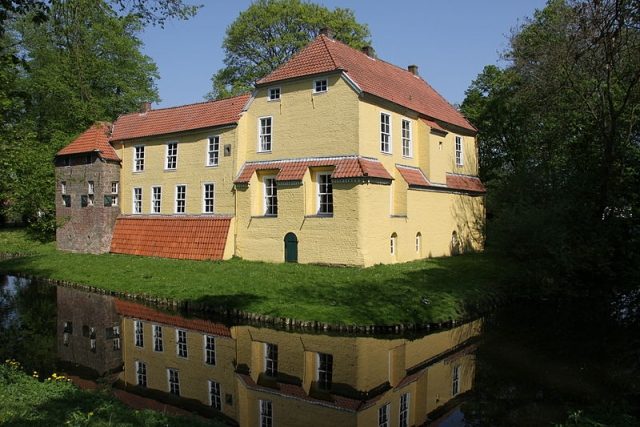
The Manningaburg in Pewsum, surrounded by a wide moat, was originally a chieftain's seat of the East Frisian Manninga family, who were also lords of Lütetsburg, Jennelt, and Westeel. In 1565, Hoyko Manninga sold the lowland castle and the Pewsum mill to Count Edzard II of East Frisia and his wife Katharina of Sweden. Only the outer bailey of the original castle complex remains.
The local chieftains of the Manninga family had the castle built in the 15th century. The Manninga are said to have originated from the Beningamannen association of Emsigerland. Pewsum was probably the family's oldest ancestral seat. It is still unclear who built the castle in Pewsum. A Dedeke to Pewsum first appears as a chieftain in documents in 1404.
In 1458, Poppo Manninga rebuilt the Pewsum Castle. It was probably Fokko Manninga who, around 1530, commissioned the construction of the splendidly furnished New Castle directly next to this building. Its two towers subsequently also served as beacons. The entire building complex, consisting of the old outer bailey and the new upper castle, was enclosed by three moats. After Fokko's death, his son Hoyko Manninga inherited in 1540. He continued the expansion of Pewsum Castle. However, his father had already left him a large mountain of debt, which Hoyko, considered extravagant, significantly increased. Gradually, he had to sell off the old family property to pay his creditors. Already in 1540, he sold his Jennelt lordship to his relative Christoph von Ewsum, in 1560 the house Asinga in Warffum (Groningen Province), in 1560 and 1562 more land in Visquard, as well as lands in Jennelt that still belonged to him. In 1565, he was finally forced to sell the castle and the lordship of Pewsum for 80,000 guilders to Katharina of Sweden, the wife of the then sovereign, Count Edzard II.
The new owners often stayed at the castle. From 1611, it was the residence of their daughters, Countesses Sophia († 1630 in Pewsum) and Maria, later Duchess of Braunschweig-Lüneburg-Danneberg. They established the tradition of distributing "castle bread" to the poor of the Pewsum and Woquard communities, a tradition maintained until the First World War.
During the Thirty Years' War, Count Peter Ernst II von Mansfeld, in 1623 the later Field Marshal Dodo von Knyphausen, and in 1644 the Hessian General von Eberstein resided in the castle.
In the 17th century, the East Frisian princes often stayed here with their guests (including the Great Elector during his journey to the Netherlands in 1634). In 1669, the castle was extensively renovated. After that, its decay began. The lack of money of the East Frisian princely house Cirksena made urgently needed repairs impossible. Especially the building fabric of the upper castle suffered. In 1716, it finally had to be demolished. After the death of the last native prince, Carl Edzard, the castle came into the possession of the Prussian King Frederick II. He wanted to sell it for demolition, but abandoned this plan because the bids for the complex seemed too low to him.
In 1859, the castle came into private hands. Today, only the lower castle, the core of the castle complex from 1458, remains. The gatehouse with Dutch influence dates from around 1550. The outer bailey (with stable building) and the upper castle (the palace) from the 16th century were already demolished in the 18th century.
In the 20th century, Cornelia, the sister of Hermine Heusler-Edenhuizen, ran a children's home in the castle from about 1920-1930. During the National Socialist era, the Gauleiter school Weser-Ems was housed in the castle. In March 1935, the first one-year leadership course with 40 participants began there, in which the foundations "for the leadership of the political soldier" were to be laid. During the Second World War, the building served as a military hospital. Subsequently, displaced persons were quartered there.
In 1954, the "Heimatverein Krummhörn e. V." bought the castle with the help of the Norden district and the Ostfriesische Landschaft. The complex was on the verge of decay at that time, so the association first had to extensively renovate the castle. In 1980, the municipality of Krummhörn took over the castle. Currently, the castle houses a museum and the registry office, where about 100 couples are married annually.
Architectural Description+
Of the former complex, only the outer bailey remains today. It is surrounded by a wide moat. The foundation walls of the castle built by Poppo Manninga in 1458 are still preserved in the west and south wings of the outer bailey. The north wing was built around 1550 according to Dutch models with alternating sandstone and brick bands, the so-called "Specklagen" (bacon layers).
Museum+
The museum is a member of the Museumsverbund Ostfriesland (East Frisia Museum Association). It deals with the history of castle building in East Frisia and Groningerland. On display are remnants of the ornaments of the former Pewsum castle complex, as well as models of other castles in East Frisia that no longer exist today. Another focus of the permanent exhibition is the history of church building in East Frisia and religiosity. Changing exhibitions complement the program.
Take Mobile History with you
You are reading this text for free. Premium adds what matters on the road: descriptions read aloud, sites found through your camera, whole regions taken offline.
- Every description, including the ~17,700 Premium sites
- Audio guide: have descriptions read to you on location
- AR finder: see sites through your camera, with distance and bearing
- Unlimited saved sites
14 days free, then from €2.99 a month. Cancel anytime.
Source: Wikipedia · Licence: CC BY-SA 4.0 · Image: http://de.wikipedia.org/wiki/Datei:Manningaburg1199.jpg
This description draws on the facts documented in the linked Wikipedia article; Wikipedia content is licensed under CC BY-SA 4.0. Wording and editing: Mobile History.
Location: 53.4357, 7.0951