Local government
CastleGuntersblum
Leininger Castle
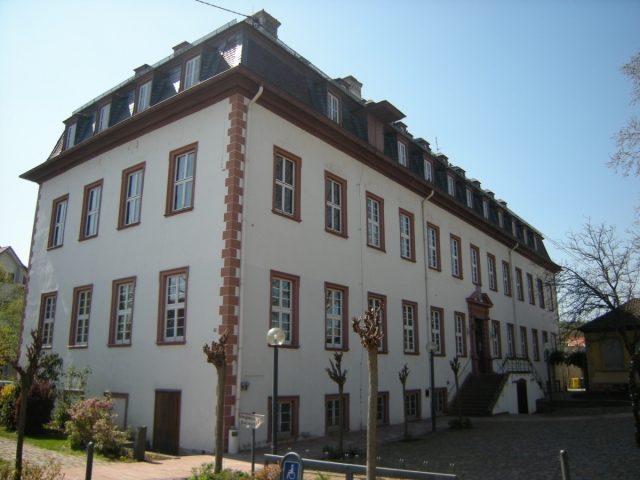
The Leininger Castle in Guntersblum, Rheinhessen, is a castle with a significant history. Today it is considered a cultural monument.
The consequences of the Palatinate War of Succession led the local rulers of the County of Leiningen-Dagsburg-Falkenburg to choose Guntersblum as their residence. The choice of location for their residence in Guntersblum ultimately fell on the Moser estate (today partly the Homburger Hof), whose owner possessed large parts of what was then Guntersblum. Jacob von Campoing, who was also the hereditary and proprietary lord of Mettenheim, finally bought the estate on March 22, 1704, for 6,000 guilders. The location chosen was at the edge of the property, directly next to the former village ditch, which is now the Guntersblum Promenade.
In 1708, the shell of the then residence was finally completed. The financing by the over-indebted House of Leiningen-Dagsburg-Falkenburg was made possible by the wife of the builder Carl Ludwig von Leiningen-Dagsburg-Falkenburg, the Imperial Countess Anna Sabina von Nostitz, a lady-in-waiting to Electress Anna Sophie of Denmark and Norway, the mother of Augustus the Strong. The construction contract was carried out with her savings. However, shortly before the interior decoration was to proceed, her husband died in the Great Northern War in 1709.
On November 17, 1717, Anna Sabina von Nostitz finally sold the entire former Moser estate, including the new castle, for 16,500 guilders to the Palatinate Electorate's Privy Councillor, Chief Master of the Hunt, and Senior Bailiff Karl von Venningen. The reason for this was her husband's death eight years earlier and her consequently low income, which she needed to maintain her accustomed high standard of living. After that, the castle sank into insignificance at the lordly level.
Only 70 years later, in 1787, Count Wilhelm Carl von Leiningen-Guntersblum brought the castle back under the rule of the Leiningers. Under his leadership, the castle was significantly renovated and expanded. From then on, it served as accommodation, initially for members of the comital family, before more and more local Guntersblum residents stayed overnight in the castle.
In 1833, the Leiningers finally sold the castle to the Guntersblum municipality for 4000 guilders. Even then, however, the building was somewhat too large for the municipality. Only when the administrative effort grew did the many rooms of the castle finally meet the needs of the municipal administration. On December 31, 1834, the building was officially inaugurated as the new town hall.
Location+
The castle is located in the center of Guntersblum. A few hundred meters to the northwest is the Protestant church, and only a few hundred meters to the north is the second Guntersblum castle, today's Schlossgut Schmitt. This was also the location of the old Guntersblum town hall before it was demolished in 1834 as part of the move to Leininger Castle.
Layout+
When the castle was built, there was a large castle square in front of it. However, as the first Guntersblum kindergarten and the St. Viktor's Church of the Catholic community were built over the years, the castle square became smaller and smaller. Today, the castle square features a fountain and a parking lot. After the First World War, a castle road was built, leading towards the Guntersblum Kellerweg. The Alsheimer Straße, one of Guntersblum's main streets, is designated as a play street at the height of Leininger Castle.
Current Use+
Since 1835, the castle, located at Alsheimer Straße No. 29, has been used as the town hall of the local municipality of Guntersblum. Furthermore, since 1972, additional administrative tasks of the Guntersblum Verbandsgemeinde have been carried out in the castle. In the basement, there is a generously designed event cellar.
Take Mobile History with you
You are reading this text for free. Premium adds what matters on the road: descriptions read aloud, sites found through your camera, whole regions taken offline.
- Every description, including the ~17,700 Premium sites
- Audio guide: have descriptions read to you on location
- AR finder: see sites through your camera, with distance and bearing
- Unlimited saved sites
14 days free, then from €2.99 a month. Cancel anytime.
Source: Wikipedia · Licence: CC BY-SA 4.0 · Image: http://schloesserrundschau.de/pfalz/schloesser/bingen12.html
This description draws on the facts documented in the linked Wikipedia article; Wikipedia content is licensed under CC BY-SA 4.0. Wording and editing: Mobile History.
Location: 49.7953, 8.3452