Local government
CastleButzbach
Landgrafen Castle (Butzbach)
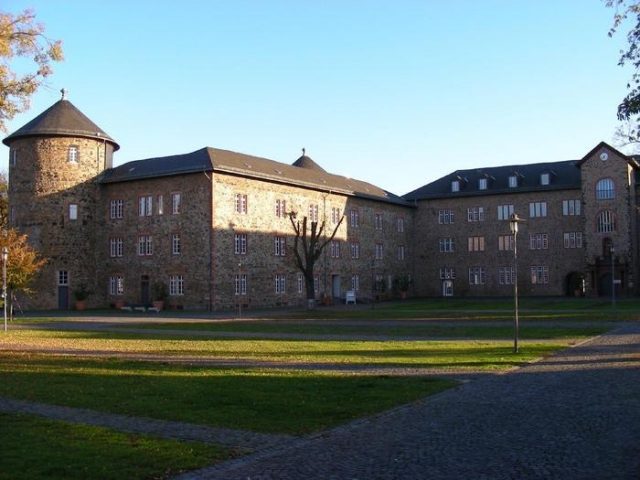
The Landgravial Palace is a palace complex in Butzbach, Wetteraukreis in Hesse.
Both castles in Butzbach, both the Landgravial Palace and the Solms Palace, were built on the site of an earlier castle complex on the southeastern edge of Butzbach's old town. The town was first mentioned in a document in 773. It arose near the remains of a Roman fort at a crossroads of several ancient roads, including the Wine Road and the Lange Hessen. It is not certain whether this moated castle in an urban location (town castle) dates back to the minor nobility of Buetsbach, vassals of the Lords of Hagen-Münzenberg, mentioned in 1243, or was built later by the Falkensteiners, who inherited from the Münzenbergers.
In 1321, Philipp IV von Falkenstein was granted town rights for the settlement and had fortifications built. With the extinction of the Falkensteiners in 1418, Butzbach fell to the Lords of Eppstein, half to "von Eppstein-Münzenberg" and half to "Eppstein-Königstein". Subsequently, the property was further divided. Still in the 15th century, the Münzenberg line sold a quarter to the County of Katzenelnbogen, which fell to Hesse in 1479, and another quarter to Count Otto von Solms-Braunfels. The Königstein line sold a quarter to Solms-Lich in 1479, and their last quarter only in 1595 to Hesse-Marburg.
The parts of the medieval castle formerly incorporated into the city wall were probably largely dilapidated by this time. Around 1462, Werner von Eppstein-Münzenberg had a large granary built next to the southern gate of the city wall, which came into the possession of the Counts of Solms in 1479. They had it representatively rebuilt and supplemented with a defensive round tower in the style of the time. The resulting Solms Palace subsequently served as an official and widow's residence.
Incorporating a late medieval core building, the Landgraves of Hesse-Darmstadt had a palace built at the beginning of the 17th century. The architect was probably Jakob Wustmann, who had also supervised the renovation of the Darmstadt Residence Palace. It served Landgrave Philipp III of Hesse-Butzbach as a residence from 1609–1643, but with the death of the Landgrave, it reverted to the main line of Hesse-Darmstadt. The art-loving Landgrave had numerous wall paintings and stucco decorations applied inside, and an observatory was also set up in the attic of the new wing. Twice, in 1621 and 1627, the astronomer Johannes Kepler was a guest here.
During the conversion into a Chevauleger barracks from 1817, the palace lost its magnificent furnishings. In 1898, the palace was converted into an infantry barracks and received the name Schloss-Kaserne (Palace Barracks). From 1951 to 1992, the barracks were used by the United States Army. After the withdrawal of troops and the conversion, the palace is now used for civilian purposes, with the Butzbach town hall located in the right wing.
Layout+
The Landgravial Palace is an originally two-winged building, depicted in this form in Matthäus Merian's town view around 1655. The east wing has a late medieval core and incorporated two older (probably late 15th century) round towers. These now received loopholes for the placement of cannons. The east wing was built after a fire in 1603 in the years 1609/1610. A polygonal tower, which towered over the complex, was attached, but it was demolished at the beginning of the 19th century. With the renovation in 1609/1610, the south wing (New Building) was probably added in place of the older moat, although this also contains an older pointed arch portal on the ground floor. The baroque portal with double columns on wide consoles and allegorical figures still points to the once magnificent furnishings of the building. In the gable field there is a Latin building inscription with the year 1610.
The west wing was only built with an extensive barracks expansion in 1935/36 and is not a listed building. However, the ballroom to the west of the complex from 1633/34, which was converted into a riding hall in 1818, is a listed building. The former pleasure garden with statues and water features, which was located east of the palace, is no longer preserved.
Source Text: Wikipedia
Take Mobile History with you
You are reading this text for free. Premium adds what matters on the road: descriptions read aloud, sites found through your camera, whole regions taken offline.
- Every description, including the ~17,700 Premium sites
- Audio guide: have descriptions read to you on location
- AR finder: see sites through your camera, with distance and bearing
- Unlimited saved sites
14 days free, then from €2.99 a month. Cancel anytime.
Source: Wikipedia · Licence: CC BY-SA 4.0
This description draws on the facts documented in the linked Wikipedia article; Wikipedia content is licensed under CC BY-SA 4.0. Wording and editing: Mobile History.
Location: 50.4329, 8.6747