Vineyard
ManorHeppenheim
Kurmainzer Amtshof Manor
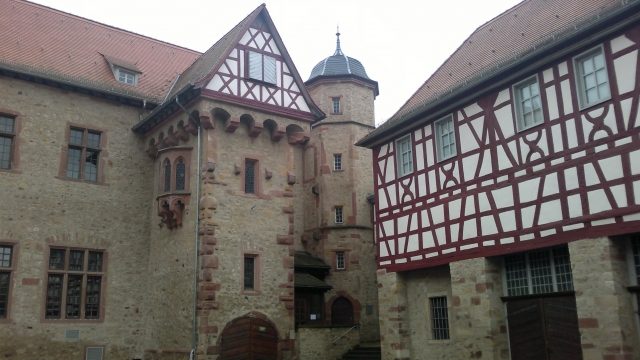
The Kurmainzer Amtshof is one of the castles and palaces of Hesse and is located in Heppenheim in the Bergstraße district below the Starkenburg castle ruins.
In the late 14th century, the building was constructed in the form of a pentagon from quarry stone and half-timbering in a late Gothic defensive style and further supplemented. The Kurmainzer Amtshof was located in the Upper Electorate of Mainz.
After the Thirty Years' War, the complex was abandoned as an Amtshof and restored in a simplified manner in 1693.
On December 11 and 12, 1948, delegates of liberal party groups from the western occupation zones gathered in the Amtshof (first in the Kurfürstensaal, later in the Winzerstube) and founded the nationwide FDP party. Here, the later Federal President Theodor Heuss was elected as the first party chairman of the FDP. A bronze plaque with the likeness and a quote from Theodor Heuss at the entrance gate to the inner courtyard of the Amtshof commemorates this event. The reason for choosing Heppenheim as the founding place was the city's historical connection to liberalism: as early as 1847, leading liberals (the so-called "Heppenheim Conference") met here to prepare for the National Assembly in Frankfurt's Paulskirche.
Architecture and Expansion+
The south front of the building is occupied by the main building, the Palas, and is two-story with rectangular windows facing the courtyard. The chapel tower projects strongly into the courtyard. On the upper floor there is a Gothic choir. In the 18th century, the gable of the gabled roof was restored in half-timbering. The polygonal stair tower forms the western end of the Palas towards Amtsgasse.
The wall paintings on the upper floor with angels holding coats of arms date from the 15th century, and angels with musical instruments can be seen in the chapel choir.
A connection between the Palas and the Kelterhaus on the courtyard-side upper floor is established by a wall with a battlement. The Marstall on the north side with an open staircase to the courtyard side dates from the 16th century.
Current Use+
Today, the buildings are predominantly used by the Winzergenossenschaft (winegrowers' cooperative). The large ballroom ("Kurfürstensaal") is used by the city for receptions, but also for meetings of the city parliament. The "Kurfürstensaal" and the preceding "Wappensaal" can also be rented. In the southern part of the building is the restaurant "Winzerstube". In the Marstall (called "Eulenburg") and in the former Zehntscheuer on the first floor, there used to be a youth hostel. This eastern part now houses the municipal museum, where original exhibits from the founding of the FDP can also be seen. In addition, the Ostdeutsche Kultur- und Heimatstuben with the Schönebach Stube are housed in the Amtshof. The former Kelterhaus on the north side, which was built in 1610 using the western fortification wall, can now be used as a "Weinkosthalle" (wine tasting hall) for events.
Take Mobile History with you
You are reading this text for free. Premium adds what matters on the road: descriptions read aloud, sites found through your camera, whole regions taken offline.
- Every description, including the ~17,700 Premium sites
- Audio guide: have descriptions read to you on location
- AR finder: see sites through your camera, with distance and bearing
- Unlimited saved sites
14 days free, then from €2.99 a month. Cancel anytime.
Source: Wikipedia · Licence: CC BY-SA 4.0 · Image: Jörg Heldt
This description draws on the facts documented in the linked Wikipedia article; Wikipedia content is licensed under CC BY-SA 4.0. Wording and editing: Mobile History.
Location: 49.6423, 8.6449