Home to several federal government
CastleKoblenz-Altstadt
Electoral Palace Koblenz
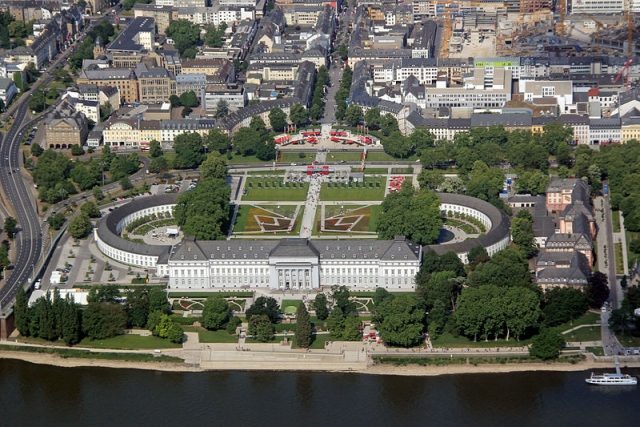
The Electoral Palace in Koblenz was the residence of the last Archbishop and Elector of Trier, Clemens Wenzeslaus of Saxony, who had it built at the end of the 18th century. Later, the Prussian Crown Prince and later Emperor Wilhelm I resided here for several years as the Rhenish-Westphalian military governor.
Today, the palace houses various federal authorities. It is one of the most important palace buildings of French early classicism in Southwest Germany and, alongside Wilhelmshöhe Palace in Kassel, the Prince-Bishop's Palace in Münster, and Ludwigsburg Residential Palace, it is one of the last residential palaces built in Germany immediately before the French Revolution.
Construction
The old residence, Philippsburg Palace in Ehrenbreitstein, had become in need of renovation and was not representative enough for the new archbishop, who came from a Saxon-Polish margravial and royal family. Therefore, a new representative building became necessary. The Estates, who were reluctant to accept the necessity of a new building, could only be persuaded to approve funding after lengthy discussions. The Electoral Palace was finally built from 1777 to 1793 on behalf of the Archbishop and Elector of Trier, Clemens Wenzeslaus of Saxony, in the new Koblenz district of Neustadt. The initial architect was the Parisian architect Pierre Michel d’Ixnard, who had already planned several buildings in Southern Germany.
After criticism of his palace plans, an expert opinion was obtained from the Parisian Academy of Architects, which confirmed this criticism. D’Ixnard was dismissed, and the Frenchman Antoine-François Peyre the Younger was then commissioned with the new building plans, which envisioned a much simpler and smaller structure. The palace in its current appearance is attributed to Peyre.
The plans for the interior design and furniture up to 1787 came from François Ignace Mangin, and Henckel was hired as court stucco artist. Johann Andreas Gärtner from Dresden, among others, was entrusted with the local construction management; he built the fortress arsenal (today's Reichenspergerplatz) in Koblenz, which was damaged in World War II and subsequently cleared. His son, Friedrich von Gärtner, born in Koblenz, built, among other things, the Ludwigskirche, buildings on Ludwigstrasse, and the Feldherrnhalle in Munich. Among the artists involved in the palace construction were the Mainz sculptor Johann Sebastian Pfaff and the painter Januarius Zick.
On November 23, 1786, Elector Clemens Wenzeslaus of Saxony and his sister Maria Kunigunde of Saxony, Princess-Abbess of Essen, moved into the new palace. In the same year, it was connected to the new electoral water pipeline from Metternich. A year later, the new theater was opened not far from the palace. Alarmed by the outbreak of the French Revolution, the previously reform-minded Elector Clemens Wenzeslaus halted all reforms and introduced a stricter regime. He offered a refuge to emigrants and fleeing members of the French court related to him (Clemens Wenzeslaus was the uncle of French King Louis XVI) – especially in Schönbornslust Palace outside the gates of Koblenz. Thus, Koblenz became a center for French royalists.
French Occupation until 1814
Due to the advance of the French Revolutionary Army in the First Coalition War, Elector Wenzeslaus had to flee his territory permanently on October 7, 1794. Two weeks later, Koblenz was captured by the French under General François Séverin Marceau. The Electorate of Trier was at an end and was largely annexed to France in 1801. The interior decoration of the residential palace could therefore never be completed. The Elector had the movable furnishings loaded onto ships and transported to Augsburg before his flight, where they became part of the furnishings of the prince-bishop's residence. After the death of Clemens Wenzeslaus, some of it was auctioned off. However, large parts from the representative rooms of Koblenz Palace passed into the possession of the Kingdom of Bavaria. These pieces are still preserved today in Johannisburg Palace in Aschaffenburg, Nymphenburg Palace in Munich, the Munich Residence, the Landshut City Residence, and the New Residence Bamberg. After the Elector's flight, the Electoral Palace temporarily served as a military hospital and from 1815, after it came into Prussian possession, as a barracks.
Under Prussian Rule
From 1823 to 1842, the Electoral Palace was the seat of various Prussian authorities and courts. Until 1911, the ground floor housed the official residence of the High President of the Prussian Rhine Province, who then moved to the newly built High Presidency building next to the palace. The main guardhouse of the city of Koblenz was located in the head of the southern circular wing until 1918.
From 1842 to 1845, the interiors were altered by Johann Claudius von Lassaulx according to designs by Friedrich August Stüler, as the building became the official residence of the Prussian royal family for their stays in the Rhineland.
Between 1833 and 1852, an optical beam telegraph of the Prussian telegraph line Berlin-Cologne-Koblenz stood on the belvedere of the southern palace wing. It was the final station 61 of the system, and the palace also housed the telegraphic expedition office and rooms for the administration of the western parts of the telegraph line.
From 1850 to 1858, Prince Wilhelm, later Emperor Wilhelm I, served here as Prussian military governor for the Rhine Province and the Province of Westphalia, with his wife Augusta. She initiated the creation of the Kaiserin-Augusta-Anlagen (Rhine promenades), later named after her. Empress Augusta visited the palace and the city of Koblenz, her "Rhenish Potsdam," annually until a few weeks before her death in January 1890.
World War Era
The palace remained a frequent destination for the royal Prussian family until the outbreak of World War I. On August 16, 1914, at the beginning of the war, it briefly served as the seat of the Grand Headquarters and Emperor Wilhelm II. From October 25, 1923, to February 9, 1924, supporters of the Rhenish Republic under "Minister President" Josef Friedrich Matthes occupied the Electoral Palace.
On March 24, 1935, an oval Thingstätte was inaugurated on the forecourt of the Electoral Palace under Mayor Otto Wittgen in a so-called "Thingstätte consecration" or "Volkswerdungsfeier" (people's becoming celebration). The Thing movement was launched in 1933 as a propaganda tool but was discontinued in 1936 due to lack of effectiveness. It was intended to connect with the Germanic popular and judicial assemblies, called Thing. Thing plays were to be held in front of large audiences in the Thingplätze.
The oval Thingplatz at the Electoral Palace consisted of 16,000 terraced basalt columns and offered space for 20,000 people. The area around the Thingplatz accommodated another 80,000 people. A crypt was built at one end, in which an eternal fire burned in a basalt block. Over a hundred workers worked in two shifts at the site from June 8, 1934.
During construction, there was a dispute between Wilhelm Michels, the propaganda leader of the Gau Koblenz-Trier responsible for the construction, and the city administration. The Prussian state, as owner of the palace, approved the transport of excavated earth through the palace rooms, which were rented by the city of Koblenz as a museum. Michel initially refused to sign a contract stating that the Free State of Prussia would cover any damages as agreed. This was only done after the managing directors of the theater company intervened, who, although subordinates of Mayor Otto Wittgen, defended Michels. The resulting damage to the building was nevertheless not fully repaired until 1936. From about 1936, the Koblenz Thingstätte primarily served for May 1st celebrations. It was destroyed in an air raid in 1944 and later filled with rubble from the city.
Reconstruction and Use after 1945
During the air raids on Koblenz in World War II, the palace complex was destroyed down to its outer walls in 1944. From 1950 to 1951, it was rebuilt externally according to old plans, with modern interior design in the style of the 1950s. Only in the central building were the representative staircase, the vestibule, the guard hall (now called "Spiegelsaal" or "Kurfürstensaal"), and the garden hall reconstructed. The guiding principle was the classical state of the original construction period. This also applied to the restoration of the garden areas, especially the palace square. The only remaining historical room is the antechamber to the no longer existing palace church in the northern head building of the main building. The circular buildings were rebuilt in simple modern forms and retained only the floor plan of the original construction period. Initially, the building served as the seat of the Allied Security Office.
In 1946, the state of Rhineland-Palatinate became the owner of the building as the legal successor to Prussia. However, it sold it to the Federal Republic of Germany in 1960, which has been the owner ever since. During the last restoration in 1998, instead of the previous exterior color scheme in ochre/blue-red, which was common for Prussian garrison and fortress buildings and palaces, that of the 18th century was restored – white-grey for the wall surfaces and grey for the architectural elements. Today, the former residence is used as an office building for various federal authorities (e.g., Federal Agency for Real Estate Tasks, which also manages the palace, Main Customs Office, BAAINBw, Federal Audit Office) and is therefore only publicly accessible during special events.
Federal Horticultural Show 2011
The city of Koblenz was awarded the Federal Horticultural Show 2011. The area around the palace was used as one of the exhibition spaces. By opening the palace, an axis was created from the new Koblenz Stadtmitte train stop via Schlossstrasse through the palace itself to the Rhine. The entire complex was equipped with a variety of plant species, water features, fountains, radial step systems, and seating walls. It thus reflects the splendor of the rulers who once resided here. The garden behind the palace regained its appearance based on historical Lenné models and was designed in terraces towards the Rhine. In 2009, a 100-meter-wide seating staircase was built on the Rhine bank behind the palace. During the construction of the underground car park in front of the palace, an early Roman artisan settlement was discovered in October 2008.
During the BUGA Festival 2012, the palace was one of the venues for Lichtströme. The artist group "Casa Magica" showed a mapping, the imagery of which consisted of magnetic resonance tomography scans.
Building+
Exterior
The palace building consists of a rectangular main building (Corps de logis), which extends in a north-south direction parallel to the nearby Rhine bank, and two semicircular circular wings on the west side facing the city, which frame the large palace forecourt. The main building, characterized by a horizontal articulation, has 39 axes. Of these axes, five each are designed as side risalits. In the middle of the facade facing the city, an eight-column portico extends to the height of the building. On the Rhine side, a central risalit is formed, fronted by six columns and topped by a relief by the sculptor Sebastian Pfaff. It depicts the allegory of the Rhine and Moselle, the electoral coat of arms, lions as a symbol of dominion, and symbols of the secular and spiritual power of the Archbishop and Elector of Trier. The lower circular wings, rebuilt with two stories in the 1950s, are unarticulated.
The simple and sober building was constructed as a residence and city palace. However, due to its location on the Rhine bank and the interior layout, it is conceived both as part of the Rhine landscape and as a building that incorporates or considers the surroundings in its rooms. From the city, the ideal path leads at ground level through the vestibule and garden hall into the palace garden on the Rhine bank. The rooms on the south and east sides offer a magnificent view of the Middle Rhine Valley. The inclusion of the landscape goes back to the builder's wish. The generously proportioned forecourt situation created by the circular buildings has older precedents, e.g., in the St. Peter's Square colonnades in Rome, the New Palace in Bayreuth, and Schwetzingen Palace. With the commissioning of French architects, the architectural orientation towards German or Franconian Baroque, which was previously common in Koblenz, ceased.
In the garden behind the palace, there is a sandstone sculpture created by Johann Hartung in 1854, depicting the allegory of "Father Rhine and Mother Moselle."
Interior Decoration
A competition was launched in 1951 for the artistic decoration of the rebuilt palace, with the northern staircase intended to resemble the former design as closely as possible. Accordingly, the north wall of the staircase on the first floor was again executed as a round niche. The space, which before the destruction of the palace was occupied by a 19th-century pewter cast figure, was filled by a sculpture by Emil Krieger entitled "Kore." The sculptures on the pedestals of the staircase in the entrance hall, "Europa on the Bull" by Otto Rumpf and "Horse and Rider" by Werner Meurer, were also created by the artists with reference to the lion sculptures previously positioned there. In the niches of the southern passage hall on the ground floor are allegorical murals by Rolf Müller-Landau. The niches in the east wall of the grand staircase on the first floor were designed by the painter Edvard Frank; in the northern side room of the garden hall on the ground floor are two paintings by the painter Edgar Ehses. A mosaic signed with E. K. was affixed to the south wall of the staircase in the main building. This was most likely created by the artist Eugen Keller. "The selection of the competition commission was characterized by the effort to ensure a uniform design, including the color scheme. Despite all references to the former furnishings and consideration of the palace's architecture, these works nevertheless bear witness to an artistic problem from their own time."
Take Mobile History with you
You are reading this text for free. Premium adds what matters on the road: descriptions read aloud, sites found through your camera, whole regions taken offline.
- Every description, including the ~17,700 Premium sites
- Audio guide: have descriptions read to you on location
- AR finder: see sites through your camera, with distance and bearing
- Unlimited saved sites
14 days free, then from €2.99 a month. Cancel anytime.
Source: Wikipedia · Licence: CC BY-SA 4.0 · Image: http://de.wikipedia.org/wiki/Datei:Koblenz_im_Buga-Jahr_2011_-_Luftbilder_01.jpg
This description draws on the facts documented in the linked Wikipedia article; Wikipedia content is licensed under CC BY-SA 4.0. Wording and editing: Mobile History.
Location: 50.3556, 7.6022