Administration department
ResidenceTreves
Electoral Palace (Treves)
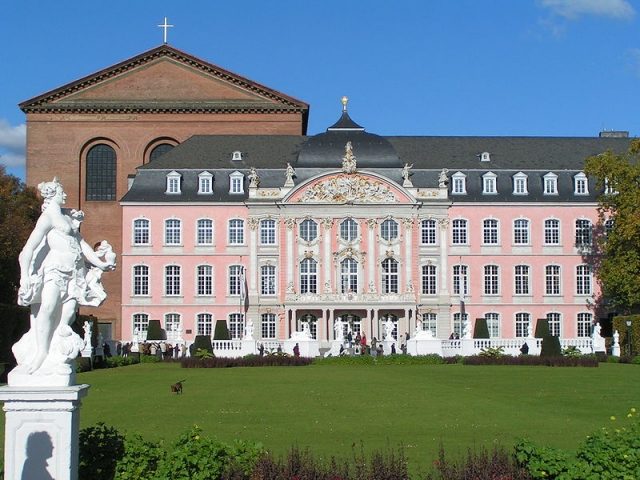
The Electoral Palace in the city of Trier was the residence of the Electors of Trier, i.e., the Archbishops of Trier, from the 17th century until 1794. The Renaissance and Rococo building was partially built on the footprint of the Roman Basilica of Constantine. In the 19th century, the west wing of the palace was demolished to rebuild the Basilica on its ground. The building was severely damaged in World War II. Subsequently, the utility buildings, the so-called Lower Palace, were completely demolished, with the exception of the Red Tower and a portal.
After the expropriation of the Electors under Napoleon, the Electoral Palace was used as a barracks by French and Prussian troops in the 19th and early 20th centuries. Today, the building houses various authorities. Parts of the north wing are used by the Protestant community, while parts of the south wing serve representative purposes.
The Palace Garden to the south of the palace has been open to the public as a park since the early 20th century.
Excavations have shown that the footprint of the Electoral Palace was already built upon in Roman antiquity. Only a few remains from the time before Constantine the Great are still preserved.
Under Constantine the Great, the grounds of the Electoral Palace were built with several buildings of the palace complex, which was erected around the imperial throne room (i.e., the Palastaula or Basilica of Constantine). During excavations, Roman mosaics were found in two rooms – located in the inner courtyard of the Electoral Palace.
Construction and Use under the Electors of Trier+
From about the year 1000, the Bishops of Trier used the symbolic Palastaula of the Roman emperors (Basilica of Constantine) as a castle. The ancient building was provided with battlements during this period, and its northern apse (semicircle) was converted into a keep.
Several centuries later, the building no longer met the changed needs and current taste. Elector Johann VII von Schönenberg (1581-1599) began planning a castle in the Renaissance style. For this purpose, he had residential houses around the Basilica demolished to gain space for the new building.
From 1615 to 1676, under his successor, Elector Lothar von Metternich (1599-1623), work began on a castle in the Late Renaissance style, which was named St. Petersburg after Peter, the patron saint of Trier. A complex consisting of an "Upper" and "Lower Castle" was planned: a four-winged Upper Castle was to be built around an almost square inner courtyard and house the residential and representative rooms. To the north, the Lower Castle with the utility rooms and a second inner courtyard was to connect.
Work began with the Upper Castle. It was built on and into the Basilica of Constantine, which was partially demolished for this purpose. Originally, it was allegedly planned to completely demolish the ancient building, but the Roman brick construction was so resistant that the execution became unexpectedly expensive; it was then decided to leave the west side and the north apse of the Basilica standing and integrate them as outer walls into the castle construction. Since the floor of the ancient building was lower than the ground level of the 17th century, the east and south walls did not have to be completely removed. The lowest brick layers were left standing (now visible again in the Basilica) and the area was filled up. However, the west wing of the castle was only to occupy about one third of the width of the Basilica. The remaining width would be added to the inner courtyard of the castle.
After the foundation stone was laid in 1615, the north wing was completed and the east wing begun by Metternich's death in 1623. Only under Elector Philipp Christoph von Sötern, Metternich's successor, was the castle completed. In addition, the construction of the Lower Castle began. Already in the 1620s, a portal had been started in the west, also in the Renaissance style. However, construction work then came to a standstill for several years when the Elector was imprisoned by the Habsburgs for political reasons during the Thirty Years' War from 1635 to 1645. Only after Sötern's release was the Lower Castle completed. It comprised two narrow, long wings in the west and east, which directly adjoined the palace. To the north, a wall enclosed the inner courtyard. In 1647, the Red Tower was completed, a mighty square chancellery and archive building in the northwest of the Lower Castle. Only under the next Elector, Karl Kaspar von der Leyen, was the construction of the castle finally completed.
However, the new building was little used. Already in 1629, the Electors had moved their residence from Trier, which had become insecure during the Thirty Years' War, to Koblenz.
Only Elector Johann Philipp von Walderdorff moved back to Trier, though without giving up the Koblenz residence. In 1756, he commissioned Johannes Seiz, a student of Balthasar Neumann, to convert and extend the south wing of the palace in the Rococo style of the time. The sculptural work was undertaken by Ferdinand Tietz, who had worked under Balthasar Neumann in Würzburg, among other places. The new, pink south wing was to protrude beyond the existing castle on both sides. A central avant-corps (a building section projecting over its entire height) was erected, and on both sides, corner avant-corps were to further subdivide the long wing. However, the project was never fully completed: to the west, the wing was only shortened – without a corner avant-corps – and only extended to about the west wall, i.e., the old basilica wall.
The interior of the pink south wing was also designed in the Rococo style. On the upper floor, a central hall (avant-corps) was set up, to which a representative staircase leads up on the west side of the main entrance. The staircase was also executed by Seiz and Tietz.
The Electoral Palace served as the residence of the Electors until 1794.
Changes and Use Since the Expropriation of the Electors+
In 1794, French revolutionary troops occupied Trier. From 1803, the French occupation used the Electoral Palace as a barracks.
When the Protestant Prussians conquered Trier, they had no interest in returning the residence to the Catholic Elector. They also used the Electoral Palace as a barracks for their troops until their withdrawal from Trier in 1918. Around 1830, the Red Tower was raised by one floor.
Furthermore, King Friedrich Wilhelm IV decided that the Basilica of Constantine should be restored to its Roman state and handed over to the Protestant community of Trier – which had no church of its own until then. From 1841 to 1862, the Basilica was rebuilt under Carl Schnitzler to its original state as an imposing hall space and has been used by the Protestant community since 1856.
The consequences for the Electoral Palace were far-reaching: the west wing had to be completely demolished, which reduced the inner courtyard and caused it to lose its symmetrical architecture – since then, the rebuilt basilica wall, in reddish stone matching the Roman bricks, rises abruptly in the west. The Rococo south wing was also affected and shortened to the west. Initially, it was allegedly planned to remove the wing so far that the entire south facade of the Basilica would be freestanding again. However, this would have required demolishing the Rococo staircase as well. It was already considered so artistically valuable at that time that an architectural compromise was sought: the west front of the Basilica was only partially exposed; the Electoral Palace was shortened by several meters, but the staircase was preserved. However, it was probably also decisive for the decision that the final solution also maintained a certain symmetry of the south wing and, above all, preserved the "central" avant-corps of the south wing. A complete exposure of the Basilica's west front, on the other hand, would have required a partial demolition of this building part (see photo of the inner courtyard). The south wing was originally shortened in a smooth cut, so that its west side ended in an unadorned triangular gable and thus additionally differed from the east side with its hip roof. This inequality was only resolved at the beginning of the 20th century, when the upper floors of the west side were further shortened and a hip roof was also installed here.
However, a few underground rooms remained, especially a wine cellar located under the Basilica. They were excavated in the 20th century together with other wall remains under the Roman building and are now accessible to pre-registered groups from the Basilica.
After World War I, Trier was again occupied by the French. The Electoral Palace remained a barracks until the end of the occupation in 1930.
In World War II, the Electoral Palace was severely damaged. The two wings of the Lower Castle were almost completely demolished. Only the Red Tower and the St. Petersburg Portal remained. A new building was erected behind the portal, which is wider than the footprint of the former Lower Castle west wing and thus partially extends into the former inner courtyard. The remaining footprint of the Lower Castle remained undeveloped and today forms Willy-Brandt-Platz with a modern fountain symbolizing the historical phases of Trier.
In 1955, the Trier District Government moved into the buildings of the Upper Castle. Since the dissolution of the district governments in Rhineland-Palatinate in 2000, it has been the seat of the Supervisory and Service Directorate.
Guided tours through parts of the building, which belongs to the state of Rhineland-Palatinate, and its inner courtyard are possible. Parts of the south wing are also used for events. The Rococo hall on the 1st floor, accessible via the preserved staircase, can accommodate up to 190 people and is sometimes used for chamber concerts and representative events with a smaller audience. It can also be rented. – Open-air concerts and the Trier Short Film Festival take place in the inner courtyard once a year.
A part of the north wing, accessible through a small portal in eclectic style, is available to the Protestant church community. A memorial plaque for Caspar Olevian, who was instrumental in founding a Protestant community in Trier, is therefore affixed to the outer wall of the wing. Inside the north wing, the Caspar-Olevian-Saal was named after him, which serves as a community hall for the Protestant church. Sunday services are often held here in winter to save heating costs for the huge hall of the Basilica. In addition, the north wing houses the access to the Basilica's organ.
The building with the Petersburg portal, on the footprint of the former Lower Castle, and the Red Tower are also used by the authorities. Since 1968, when it received a baroque roof lantern again, the Red Tower has served as the bell tower for the Basilica.
Palace Garden+
To the south of the Electoral Palace, there was a park during the time of the Electors. In 1761, the Ferdinand Tietz Fountain, which stands in the park again today (video of the rotating fountain), was first mentioned here. When Trier was occupied by French troops in 1794, the park was converted into a public square. During the use of the Electoral Palace as a barracks, the area to the south up to the Imperial Baths was used as a parade ground.
At the beginning of the 20th century, the city of Trier tried to develop the area into a public park. However, the project initially encountered financial problems. Only through the whimsical donation of Franz Weißenbach from Trier did it receive funds in the early 1930s to create the park, which still bears the name "Palace Garden" today. In 1936/37, a park was again laid out on the parade ground.
Near the Electoral Palace today is a park section with a non-accessible lawn, flowerbeds in front of the main entrance of the south wing, and a water feature in front of the eastern south wing (at the Rheinisches Landesmuseum). The lawn is bordered on both sides by a hedge and trees and is thus visually separated from the water basin. The most famous view of the Electoral Palace today – from the south, with the Basilica behind it – therefore only shows the former central part of the south wing, largely concealing the modern asymmetry of the building. Replicas of the Tietz sculptures stand in the park; the originals can be seen in the Simeonstift Municipal Museum next to the Porta Nigra. Since the Tietz Fountain was rediscovered in 1940, it has also been integrated into the northern park.
Further south, adjacent to the Imperial Baths, there is a wide lawn, which is only loosened up by a simple fountain at the south end. Since it is open to the public, it is mainly used today by younger Trier citizens and visitors as a leisure area for meetings and partly also ball games. In recent years, however, there have been problems with drug crime in the evenings.
To the west of the lawn, on a path, stands a monument made of two upright concrete slabs, which is awarded to cities for their 2000th anniversary. To the east, behind trees, rises the medieval city wall; it was not removed in the 19th century at the Palace Garden because it was welcomed by the Prussians as a border and shield for the then parade ground. A memorial plaque for Franz Weißenbach as the founder of the park is embedded in the city wall.
To the east of the Electoral Palace are lawns, a children's playground, and ball game fields directly on the city wall. Despite its location, however, this area is not typically referred to as the "Palace Garden."
Take Mobile History with you
You are reading this text for free. Premium adds what matters on the road: descriptions read aloud, sites found through your camera, whole regions taken offline.
- Every description, including the ~17,700 Premium sites
- Audio guide: have descriptions read to you on location
- AR finder: see sites through your camera, with distance and bearing
- Unlimited saved sites
14 days free, then from €2.99 a month. Cancel anytime.
Source: Wikipedia · Licence: CC BY-SA 4.0
This description draws on the facts documented in the linked Wikipedia article; Wikipedia content is licensed under CC BY-SA 4.0. Wording and editing: Mobile History.
Location: 49.7531, 6.6438