Restaurant
CastleSankt Martin
Kropsburg Castle
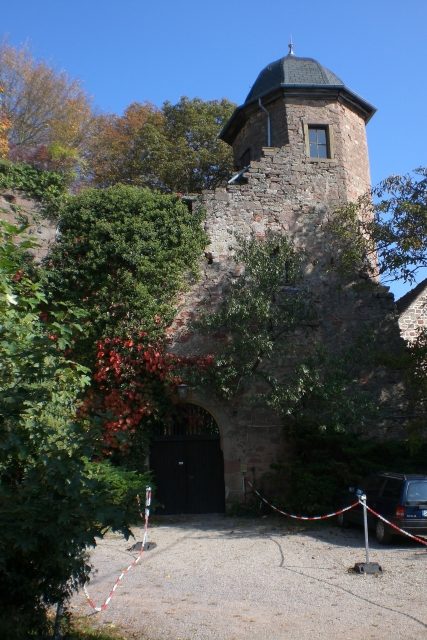
The Kropsburg, also known as Kropfsegg, is located in the municipality of the South Palatinate wine-growing community of St. Martin in the district of Südliche Weinstraße (Rhineland-Palatinate).
Before its destruction in 1689, the spur castle was, among other things, the seat of the highest barons of the Empire, the Knights of Dalberg. A successor building erected in 1771 by a Dalberg descendant in the courtyard of the lower castle from the ruins was operated as a restaurant. This restaurant is now closed and the castle is no longer accessible. However, there is a newer restaurant in the outer bailey.
The Kropsburg is located at the fault line between the Palatinate Forest in the west and the Rhine Plain in the east. The hilly transition between the two geological formations is the Palatinate wine region Weinstraße. The castle rises south of St. Martin on a foothill of the Hochberg, only 250 m high; this belongs to the Haardt mountain range, which forms the eastern edge of the Palatinate Forest.
The castle can be reached on foot and by bicycle from St. Martin and by car from the town of Edenkoben, which has a connection to the A65 motorway (Ludwigshafen–Karlsruhe).
The construction of the Kropsburg dates back to the Staufer period and is dated to around 1200; at that time, a whole ring of castles was built to shield the Imperial Castle Trifels, located about 20 km away. Similar to the Hambacher Schloss to the north and the Rietburg to the south, it offered a wide view of the Rhine Plain.
Initially, the Kropsburg was the seat of a ministerialis. Later, it was inherited among the descendants of the feudal tenants and thus became a Ganerbenburg with several owners simultaneously, who expanded it into an upper and a lower castle. After the end of the Staufer dynasty in the second half of the 13th century, it came into the possession of the Prince-Bishopric of Speyer; this granted it as a fief to various noble houses (von Kropsberg, von Ochsenstein, von Odenbach, among others). In 1441, the Dalberg family became owners, whose representatives served as administrative officials for southwestern German bishops.
In 1522, the castle chapel St. Aegidius is mentioned in a document, for which Georg von Schwalbach, cathedral custos and vicar general of the Diocese of Speyer, approved the storage of the Blessed Sacrament. Likewise, the chaplain of St. Martin received permission to also serve as a pastor there.
While the Kropsburg survived the turmoil of the Peasants' War and the Thirty Years' War in the 16th and 17th centuries almost unscathed, it was completely and definitively destroyed in 1689 during the War of the Palatine Succession by French troops.
In 1771, Jakob Amandus von Dalberg built a new stately residence on the ruins of the lower castle. After redesign and modernization, it was later operated as a restaurant until it was closed. The new restaurant built on the site is known for its panoramic view over the Rhine Plain.
Take Mobile History with you
You are reading this text for free. Premium adds what matters on the road: descriptions read aloud, sites found through your camera, whole regions taken offline.
- Every description, including the ~17,700 Premium sites
- Audio guide: have descriptions read to you on location
- AR finder: see sites through your camera, with distance and bearing
- Unlimited saved sites
14 days free, then from €2.99 a month. Cancel anytime.
Source: Wikipedia · Licence: CC BY-SA 4.0 · Image: http://de.wikipedia.org/wiki/Datei:Kropsburg.JPG
This description draws on the facts documented in the linked Wikipedia article; Wikipedia content is licensed under CC BY-SA 4.0. Wording and editing: Mobile History.
Location: 49.2962, 8.0959