Hotel
Restaurant
CastleBonn - Ramersdorf
Ramersdorf Castle
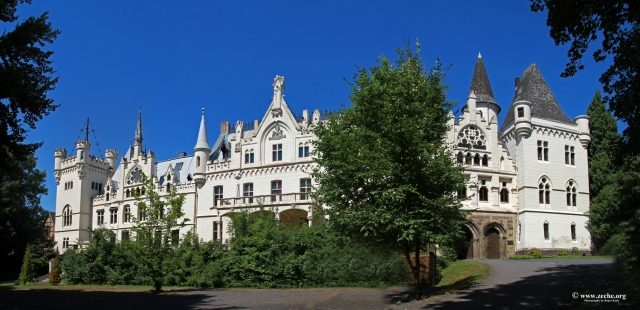
The Teutonic Commandery of Ramersdorf in Ramersdorf, a district of the Bonn borough of Beuel, was founded around 1230 and existed as a commandery of the Teutonic Order until its secularization in 1803. Subsequently, the buildings and properties preserved in Ramersdorf passed into changing private ownership. After a fire in 1842, the entire complex was rebuilt in the Neo-Gothic style. A citizens' initiative succeeded in preserving the building in the early 1970s during the construction of the motorway junction of the A 59 and A 562.
The place where the commandery was built is first mentioned in documents in the 9th century. The Bonn Cassius Abbey had possessions in Ramersdorf, and Heisterbach Abbey also received rent and tithes there.
The Ramersdorf Commandery was one of about 300 commanderies of the Teutonic Order that emerged in Europe between 1200 and 1300 in connection with the Crusades. The founding charter of the Ramersdorf house is lost. Therefore, the exact year of its foundation is not known, nor are the specific circumstances that led to its establishment. The St. George's Chapel, which is still preserved today and originally belonged to the commandery, was built between 1220 and 1230. From this, it can be concluded that the other historical commandery buildings were erected at the same time. Count Heinrich III von Sayn and his wife Mechthild are the most likely founders of the commandery. The first written document mentioning the commandery dates from 1254.
The most important task of the commandery was to provide economic services for the Teutonic Order. After the Crusades and the loss of significance of the Teutonic Order State, these tasks ceased. The Ramersdorf Commandery lost its convent and became a noble residence, where the Komtur (commander) as the sole representative of the Order managed the extensive possessions. During the 18th century, the judge of the Löwenburg district also resided in the commandery buildings.
After Secularization
After secularization, the buildings of the Ramersdorf Commandery came into the possession of the Duchy of Berg and, with Napoleon, passed to the Grand Duchy of Berg. In 1807, the latter sold the buildings to Joseph zu Salm-Reifferscheidt-Dyck. The prince did not live in Ramersdorf but at Schloss Dyck. For a long time, only an administrator inhabited the complex. Salm-Reifferscheidt-Dyck's stepdaughter, Baroness von Francq, took over the building, which had by then been transformed into a castle, along with all associated properties in 1861. In 1881, she sold the commandery to Rudolf Herberz, a merchant from Uerdingen. Three years later, Baron Albert von Oppenheim acquired the castle.
Today
In 1940, the castle and park were sold to the Deutsche Reichsbahn, and the inventory of the commandery was auctioned off. The buildings survived the Second World War without damage, although the German Wehrmacht had established an ammunition depot near the castle.
After the war, the commandery initially housed service groups of former German prisoners of war, conscripted by the British occupation forces. After the withdrawal or dissolution of these service groups, the Deutsche Bundesbahn established a training center in the commandery. From 1967, the castle initially stood empty, increasingly fell into disrepair, and was threatened with demolition during the construction of the motorway junction of the A 59 and A 562. A citizens' initiative succeeded in preventing these plans and saving the castle.
In 1978, the Federal Property Office found a buyer. The renovation of the building extended over a period of three years. Since then, the commandery has housed a permanent exhibition of furniture from various centuries and an antique shop. In addition, a hotel and a restaurant with a cafe were established in the former "English wing". The city of Bonn offers the possibility of civil weddings in the rooms of the commandery on selected dates.
Structure+
The convent of a Teutonic Order commandery included a varying number of knight brothers under a Komtur. For Ramersdorf, the number twelve is mentioned in literature. In addition to the brothers, there were also half-brothers at the Ramersdorf Commandery. A document from 1300 records the entry of a half-brother named Hermann von Dorflur, who donated part of his possessions to the Ramersdorf house.
About twelve to fifteen commanderies were organized in a bailiwick, headed by the Landkomtur. The Order as a whole was led by the Grand Master, to whom some commanderies and bailiwicks were directly subordinate. This also applied to Ramersdorf until 1371. After that, the commandery was incorporated into the Bailiwick of Alden Biesen.
Komturs+
The Komturs of the Ramersdorf Commandery in the 13th and 14th centuries were mostly sons of Rhenish nobles, ministeriales, and urban patricians.
One of the most important Komturs in Ramersdorf was Eberhard von Virneburg. Before he took office in the Rhineland in 1328, he had already held the highest offices in the service of the Teutonic Order in Prussia. After being Komtur in Marienburg from 1298 to 1304, he took over the office of Oberstspittler (Chief Hospitaler) in 1309, who was one of the Grand Commanders of the Order.
Ramersdorf Komturs+
- Werner (1251–1254)
- Simon de Gandavio (of Ghent) (1264–1270)
- Bertold (1282)
- Gerard von Runkel (1285–1291)
- Gerard von Westerberg (1291–1296)
- Robbo von Drachenfels (1304–1324)
- Eberhard Hardevust (1326)
- Eberhard von Virneburg (1328)
- Walram von Tomberg (1338–1341)
- Simon van der Tempel (1352–1359)
- Diderich von Winterscheit (1358)
- Johann called Jhesus (1366)
- Hendrik van Leeuwen (before 1371)
- Diederik van Gemert (1444)
- Arnold von Reeck (1450)
- Franz von Reuschenberg (1533–1539)
- Johann von Goer (1539–1547)
- Heinrich von Reuschenberg (1551–1556)
- 1572–1580 Vacancy
- Edmond von Reuschenberg (1580–1591)
- Johann von Reuschenberg (1591–1610)
- Johann von Eynatten (1610)
- Johann Raitz von Frentz (1610–1612)
- Hendrik von Kolf von Vettelhoven (1612–1631)
- Wilhelm von Metternich zu Müllenark (1631–1638)
- Edmond Godfried Freiherr von Bocholtz von Orey (1638–1649)
- 1649–1661 Vacancy
- Ferdinand von Rolshausen zu Butgenbach (1661–1663)
- 1663–1669 Vacancy
- Bertram Wessel von Loe zu Wissen (1669–1671)
- Wilhelm Dietrich von Kolf von Vettelhofen (1672–1677)
- Rutger Kaspar von Schöller zu Schöller (1677–1682)
- Friedrich von Renesse (1682–1683)
- Heinrich Theobald von Goldstein (1685–1690)
- Heinrich Schenck von Nideggen (1691–1697)
- Johann Wilhelm von Kesselstadt (1697)
- Bertram Anton von Wachtendonk (1699–1707)
- Johann Hermann Spies von Büllesheim (1707–1715)
- 1715–1719 Vacancy
- Johann Josef van der Noot (1719–1721)
- Johann Kaspar von Hillesheim zu Ahrental (1721–1729)
- 1729–1738 Vacancy
- Caspar Anton von Belderbusch (1749–1751)
- Franz Theodoer von Rump zu Crange (1751–1753)
- Lothar Franz von Horneck zu Weinheim (1755–1757)
- Ferdinand Josef von Haecke (1757–1758)
- 1758–1761 Vacancy
- Karl Ernst von Voit zu Salzburg (1761–1762)
- Franz Johann von Reischach (1762–1767)
- Franz Nikolaus von Kolf zu Vettelhoven (1767–1770)
- Theodor Franz de Croix d’Heuchin (1770–1771)
- Heinrich-Johann von Droste zu Hülshoff (1771–1776)
- Josef Franz von Schaesberg (1776–1778)
- Heinrich August Marschall von Ostheim (1778–1784)
- Fredrich Wilhelm von Bentinck (1784–1794)
- Wilhelm Eugen de Wal (1794–1809)
Possessions+
The actual endowment of the Ramersdorf Commandery is unknown. A number of endowments in the 13th century are documented. However, the number of donations already decreased in the second half of that century.
One endowment from this period took place in 1254. In that year, Abbot "Gottfried von Siegburg" transferred to the commandery, into the hands of Brother Werner, the then Komtur, abbatial fiefs in Birgel and Muffendorf, which until then had been in the possession of the knight "Theoderich von Muffendorf". Siegburg Abbey proved to be a patron of the commandery in general. Its Abbot Dietrich I gave the house a tithe in 1266, which the convent of the Premonstratensian nunnery of Schillingscapellen, located on the Vorgebirge, held. Two years later, the widow of the knight "Heinrich von Breitbach", upon her son's entry into the Teutonic Order, gave his entire paternal inheritance, along with a farm near the village of Breitbach, to the house in Ramersdorf. At the end of the 13th century, the commandery received two further donations: On December 31, 1297, two brothers, Simon, the former parish priest of the church in Hamm belonging to Bonn's St. Cassius Abbey, and "Johann von Hunefe" (Honnef) gave all their goods to the convent in Ramersdorf, subject to usufruct for life. Two years later, on November 20, 1299, the Bonn spouses Harpern and Aley stipulated that their fields in Bursdorf should belong to the commandery after their death under certain conditions.
However, endowments were not the only way for the commandery to acquire property. In addition, fields, vineyards, and forests came into the possession of the institution through purchase, exchange, enfeoffment, and lease.
Further possessions of the commandery were located in Hersel, Küdinghoven, Oberkassel, Oberpleis-Bellinghausen ("Bellenkusen"), Ollheim ("Olme" or "Olmene"), Ramersdorf. Archbishop Dietrich of Cologne gifted the lordship and village of Hersel to Landkomtur Iwan von Cortenbach in the 15th century as a reward for his services against the Hussites.
Building History+
Of the original 13th-century building complex, the "cores of the rising wall section", the double gate system with driveway and pedestrian gate, and the St. George's Chapel, transferred to the Old Cemetery in Bonn in 1846/1847, are preserved in the current building.
The earliest depiction of the buildings dates from the 16th century. A detailed picture is provided by an engraving by Romeyn de Hooghe, created around 1700.
Buildings
De Hooghe's engraving reveals four building sections: gate, courtyard, main building, and chapel.
Gate
Access to the buildings was through two passages built of trachyte, a large round-arched gate and a smaller pointed-arched gate next to it. "The leaf capitals of the columns supporting the round torus and the round rod placed in the apex of the pointed-arched passage date this portal to the latest Romanesque period," the time when the commandery was built.
Courtyard
Through the entrance, visitors entered a courtyard. On its north side stood the chapel, while on the west side were two smaller buildings erected at different times and the eastern narrow side of the main building. A wall ran along the east side, in front of which a small building stood in the courtyard.
Main Building
The main building was an elongated structure with a rectangular floor plan. It extended from east to west, was two-story, and around 1700 featured cross-bar windows, which were probably added to the building some time after its construction. In the middle of the south side was a projecting bay-like structure with three window axes. Next to it stood a tower, probably for the staircase. On the western narrow side was a small single-story building and on its north side another annex. Opposite the north side of the main building were single-story farm buildings, whose western wing is identified as a coach house by the large entrances.
Chapel
St. George's Chapel was built as a three-aisled hall church. It is 14.20 m long and 7.70 m wide. The chapel included a tower, which was located on the south side, close to the side choir.
19th Century Reconstruction
As a result of secularization, the commandery, which had already undergone several changes, was converted into a castle complex in the 19th century. In 1842, the Baroque wing was altered, "and from the same period date the retaining, embankment, and terrace walls with turrets."
The connecting building and the monumental "Bergfried" (keep) with a round staircase on the southeastern wing were added in the 1860s according to plans by Edwin Oppler. In 1885, Wilhelm Hoffmann expanded and revised the existing complex in Gothicizing forms, inspired by Drachenburg Castle. The current castle courtyard with its fountain system also originated at this time. The "English wing" was added as a brick building towards the end of the 19th century.
"The colored ceiling paintings and wall paneling, completely preserved in many rooms, are a significant example of the decorative art of Historicism."
Exterior Area+
Under the direction of Wilhelm Hoffmann, a park was laid out in the exterior area of the castle towards the end of the 19th century. It boasts a valuable collection of rare conifers.
A Neo-Gothic gate system was erected in 1884 as an entrance to the park. A coat of arms adorns the upper arch field. In the lower part of the coat of arms, two crowns flank an anchor. In the upper part, a star is placed, above it the protective mask of a knight's armor with a helmet plume and ribbons.
The gatehouse built behind the gate system is now in private hands and, after being neglected for many years, has been stylishly restored.
The remaining parts of the park are now intersected by motorways.
The Commandery Cross+
A wayside cross, which is now located on an access road to the castle, belonged to the exterior area of the commandery. The cross must date from the second half of the 17th century.
In the land register of the Vilich mayoralty, to which Ramersdorf belonged, the cross is referred to as the "Kommendekreuz" (Commandery Cross) in 1858. It is dedicated to Gottfried Freiherr von Bocholtz von Orey. From May 20, 1642, to September 2, 1649, he was Komtur in Ramersdorf. In 1658, he became Landkomtur of the Bailiwick of Alden Biesen.
The inscription on the cross reads:
"EMVNT GOTTFRI/ED FREIHERR VON/BOCHOLTZ VOREY HE/RR ZV GRANVILLE, TEV/TSCHEN ORDENSRITER/COMMENTHVR ZV MAS/TRICHT LANDCOMMEN/THUR DER BALLEY ALDE/BIESEN, FREYHERR ZV GEME/T, GRAVERODE VND S.PET/ERS FOVREN DEN APRILIS"
Above the inscription is a quartered coat of arms. In fields 1 and 4, the Teutonic Order cross can be seen, in fields 2 and 3, three lion heads – the Bocholtz coat of arms.
Take Mobile History with you
You are reading this text for free. Premium adds what matters on the road: descriptions read aloud, sites found through your camera, whole regions taken offline.
- Every description, including the ~17,700 Premium sites
- Audio guide: have descriptions read to you on location
- AR finder: see sites through your camera, with distance and bearing
- Unlimited saved sites
14 days free, then from €2.99 a month. Cancel anytime.
Source: Wikipedia · Licence: CC BY-SA 4.0 · Image: http://www.zeche.org/
This description draws on the facts documented in the linked Wikipedia article; Wikipedia content is licensed under CC BY-SA 4.0. Wording and editing: Mobile History.
Location: 50.7253, 7.1605