The remains of the castle can be visited
CastleHerzberg am Harz - Pöhlde
King Palatinate Pöhlde
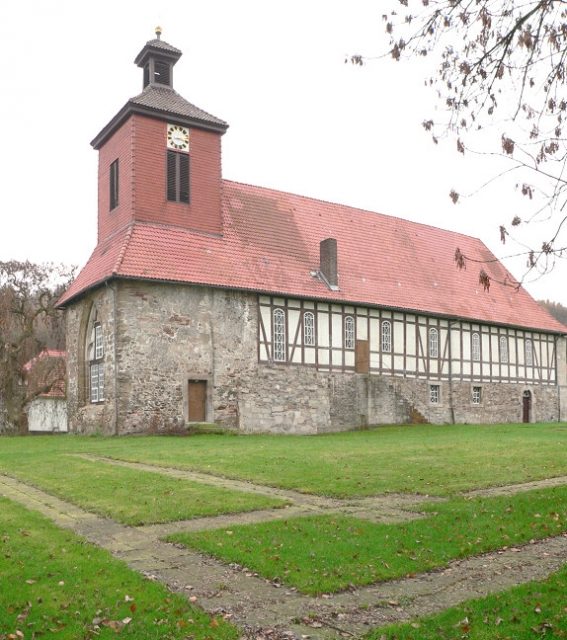
The Pöhlde Palatinate was a medieval royal palatinate in Pöhlde in Lower Saxony, which existed as a palatine foundation together with a monastery. The remains of the complex are located in the current village center on the grounds of the church built in 1668. Excavations in the 1960s and 1970s unearthed the foundations of the palatinate and monastery. The palatinate gained further significance because it was frequently visited by German kings at Christmas and was considered one of the Christmas palatinates. It was conveniently located at the intersection of important long-distance routes, including the Fastweg over the nearby Rotenberg.
Excavations+
Between 1964 and 1974, archaeological investigations and excavations were carried out over an area of 1700 m² next to the present church and in the rectory garden. The foundations of the palatinate complex, with remains of oven systems and cellars, were uncovered. The complex included at least twelve buildings, whose wall lines partially overlap and superimpose, suggesting several construction phases. There are also differences in building techniques and materials, such as the use of gypsum and clay. Especially the lowest and thus oldest building parts were constructed as dry stone walls in opus spicatum technique. The largest building was a hall measuring 9.5 × 22 meters, whose function was apparently representative. The building complex of the palatinate was bordered in the north by a sole ditch and in the south by a 1-meter thick wall in opus spicatum technique. The wall foundations uncovered during the excavations, which still had a height of up to 80 cm, were covered with earth again after the work for protection. The foundations of the former cloister of the monastery are now represented by stone slabs in the lawn. Cultural layers with traces of an older settlement phase were found under the wall lines. The excavated ceramic and metal finds could be dated to the period of the 2nd to 4th centuries, which suggests the existence of a Germanic settlement in Pöhlde.
The Pöhlde Palatinate is one of the five palatine complexes in present-day Lower Saxony (Werla, Goslar, Dahlum, Grona). It was located at the intersection of major traffic routes. While the Fastweg ran in an east-west direction and crossed the Rotenberg, two north-south traffic routes intersected it here.
The palatinate originated from a manor of the Liudolfings, which Matilda the Saint had received from her husband Henry I in 927. After his death, she asked her son Otto I to convert the manor into a collegiate church. King Otto I signed a document on May 16, 952, stipulating that the monastery to be built next to the palatinate should be erected as a monastic abbey. It was settled by Benedictines. The palatinate and monastery buildings were located around the present church and in the rectory garden. There was a connecting passage between the palatinate and the monastery church. The palatinate was frequently visited by subsequent emperors, especially by Henry II. 27 visits are documented in writing. Because these often took place at Christmas, the Pöhlde Palatinate received the name "Christmas Palatinate". Ekkehard I, Margrave of Meissen and Duke of Thuringia, was murdered on April 30, 1002, by Siegfried II, Benno of Northeim and Henry II of Liesgau, and Udo of Katlenburg in the Pöhlde Palatinate because he claimed the German throne. Antipope Gregory VI visited Henry II in the Pöhlde Palatinate at Christmas 1012 to obtain his recognition.
The monastery church of the palatine foundation suffered destruction in the Peasants' War in 1525 and subsequently lost its importance. The present church was built on its foundations in 1668.
Relationship to the Pöhlde Hillfort+
The specific relationship between the palatine complex and the Pöhlde Hillfort on the Fastweg on the Rotenberg, about 500 meters away, is not precisely known. According to legend, Henry the Fowler is said to have received the news at the Pöhlde Hillfort in 919 that he had been elected the first Saxon king of the East Frankish Empire. Therefore, the fortification was named "King Henry's Bird Sanctuary". According to archaeological investigations, it was a sporadically visited refuge castle and not a permanent seat of power. The reliefs of hollow ways from the castle down to Pöhlde are still visible in the terrain today.
Take Mobile History with you
You are reading this text for free. Premium adds what matters on the road: descriptions read aloud, sites found through your camera, whole regions taken offline.
- Every description, including the ~17,700 Premium sites
- Audio guide: have descriptions read to you on location
- AR finder: see sites through your camera, with distance and bearing
- Unlimited saved sites
14 days free, then from €2.99 a month. Cancel anytime.
Location: 51.6133, 10.3092