To be privately owned
CastleSalzhemmendorf - Lauenstein
Knabenburg
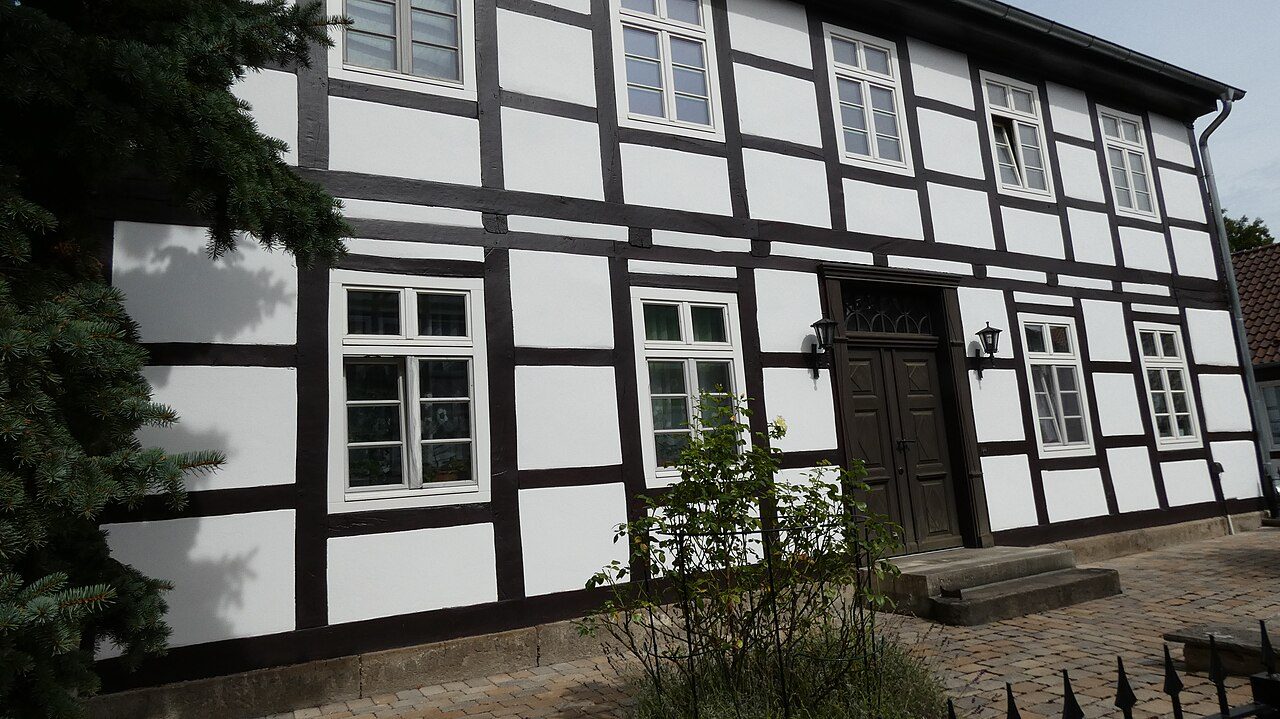
Knabenburg, also known as Knapenburg, is the name of an estate in Salzhemmendorf in the Weserbergland Schaumburg-Hameln Nature Park. The listed complex, which stands in historical contexts spanning centuries with the local outwork, Lauenstein Castle, and numerous noble families, recently gained particular significance due to its approximately 4000 square meter plot: Here, the owner Ernst Rudorff, who died in 1916 and is considered the founder of nature conservation in Germany, worked. The location of the ensemble can be found at Im Flecken 48 in Lauenstein.
In the park-like green area, which directly borders the churchyard of the former St. Annen Chapel, there is a three-part building group consisting of two-story half-timbered wings under shingle-covered slate roofs, protected by Solling plates named after the Solling region. The group, erected at the beginning of the 18th and beginning of the 19th centuries, consists of a manor house and two farm buildings erected for agricultural purposes, grouped at right angles around a courtyard open on one side. A staircase was added here in 1840 as a connection.
The name "Knabenburg" was derived from the fact that, according to the inheritance register of Homburg House, members of the knighthood who lived in the lower Börde of the Eschershausen district were called "Homburg boys."
After numerous changes of ownership, mostly noble families and, especially after the Thirty Years' War, bourgeois owners, the preserved manor house was erected in 1724 during the time of the Electorate of Hanover, the farm buildings during the so-called French period in 1812, and during the time of the Kingdom of Hanover in 1840.
When the centuries-old oak avenue at the foot of the Krähenberg behind the Knabenburg was to be felled for land consolidation in 1886, the Berlin composer Ernst Rudorff, who frequently used the Knabenburg as a summer residence in the late 19th century, bought the entire avenue from the magistrate in Lauenstein on the spur of the moment to save the trees from felling. This action "represents one of the earliest civil society nature conservation actions."
In the early 1980s, the entire estate, which had been used for living, as a museum, and for agriculture, was put up for sale by the then owners from the House of Gottberg.
Take Mobile History with you
You are reading this text for free. Premium adds what matters on the road: descriptions read aloud, sites found through your camera, whole regions taken offline.
- Every description, including the ~17,700 Premium sites
- Audio guide: have descriptions read to you on location
- AR finder: see sites through your camera, with distance and bearing
- Unlimited saved sites
14 days free, then from €2.99 a month. Cancel anytime.
Location: 52.0775, 9.5547