The remains of the Abbey can be visited
MonasteryDüren - Gürzenich
Schwarzenbroich Abbey
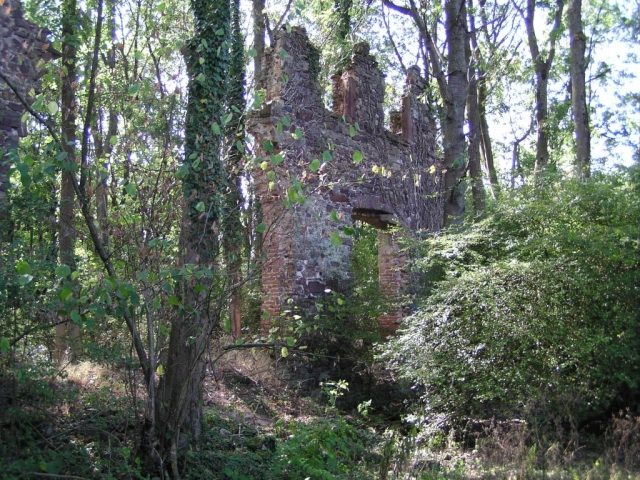
Kloster Schwarzenbroich is a ruin in the forest between Gürzenich and Schevenhütte in the district of Düren, North Rhine-Westphalia, in the area of today's municipality of Langerwehe. The Canons Regular of the Order of the Holy Cross, OSC, lived in the monastery.
The monastery was located at the foot of the Knosterberg. Today, only the heavily overgrown wall remnants, up to 6 m high, can be seen there. In the Middle Ages, the locality was called Matthiasthal, because in 1340, Werner von Merode is said to have seen the Apostle Matthias appear here. He is said to have urged him to build a monastery at that spot. The pilgrimage route, which led from Düren via Gürzenich, Derichsweiler, Schevenhütte to the well-known pilgrimage site of Kornelimünster, passed directly by the monastery.
Archbishop Walram of Cologne granted permission for the construction of the monastery on February 16, 1340, which was subsequently settled by canons of the Order of the Holy Cross. The founder endowed the monastery with large revenues, for example, the patronage right over the parish of Mariaweiler. In the 15th century, the wealth of the monastery had greatly increased, as the Canons Regular were predominantly recruited from the sons of the wealthy Rhenish nobility and brought land and other assets with them upon entering the order. The monastery now also owned a number of large farms and vineyards in the surrounding area.
Therefore, the monastery church could be rebuilt. It was consecrated on April 14, 1429. In the 16th century, the monastery was extensively renovated. In 1712, the monastery church was rebuilt after the destructions of the Thirty Years' War. In the turmoil of the French Revolution, all Canons Regular had to flee to the right bank of the Rhine in 1794, specifically to Schönrath, possibly today Cologne-Höhenhaus. 13 canons returned. In 1802, the monastery was dissolved by the French. The Antwerp altarpiece of the parish church of St. Martinus in Langerwehe is said to originate from Kloster Schwarzenbroich.
On September 2, 1803, the monastery was put up for auction at a valuation of 30,950 francs. On March 1, 1804, Schwarzenbroich was acquired by Gerhard Melchior Urbach from Dürwiß and Johann Georg Stoltenhoff from Eschweiler for the price of 30,500 francs. The new owners extracted vitriol salts and alum from the iron-rich peat and moor soil.
On the evening of March 24, 1835, the bells in Echtz rang a fire alarm, as the monastery buildings and church in Schwarzenbroich were in flames and severely damaged. The damaged buildings were not repaired. The entire complex was sold a year later to the Count (today: Prince) of Merode. Thus, after 496 years, the monastery returned to the hands of the founding family, who are still the owners today. The ruin complex was a popular excursion destination until World War II. During the Battle of Hürtgenwald (1944), the remaining ruins were destroyed down to their foundations.
Miscellaneous+
In addition to pastoral care in Mariaweiler, the Canons Regular also worked in the hospital or infirmary in Geich near Langerwehe. Remnants of the monastery library are scattered across various libraries. The monastery is the setting for the historical crime novel "Mönchsgesang" by Günter Krieger.
Take Mobile History with you
You are reading this text for free. Premium adds what matters on the road: descriptions read aloud, sites found through your camera, whole regions taken offline.
- Every description, including the ~17,700 Premium sites
- Audio guide: have descriptions read to you on location
- AR finder: see sites through your camera, with distance and bearing
- Unlimited saved sites
14 days free, then from €2.99 a month. Cancel anytime.
Source: Wikipedia · Licence: CC BY-SA 4.0 · Image: http://de.wikipedia.org/wiki/Datei:KlosterruineSchwarzenbroich.jpg
This description draws on the facts documented in the linked Wikipedia article; Wikipedia content is licensed under CC BY-SA 4.0. Wording and editing: Mobile History.
Location: 50.7729, 6.3660