Museum
MonasteryGrünhain-Beierfeld
Grünhain Abbey
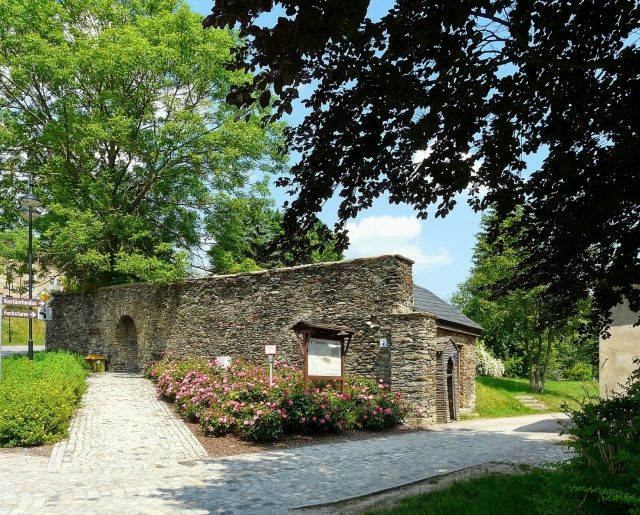
The Grünhain Monastery in Grünhain in the Saxon Ore Mountains, founded and operated by Cistercians, existed from 1230 to 1536 and is now preserved only in ruins.
Foundation+
In 1226, Meinher II, Count of Hartenstein and Burgrave of Meissen, entrusted a group of Cistercian monks from Sittichenbach Monastery with coming to an area that had been settled by Main-Franconian farmers for several decades. They were to help cultivate the largely undeveloped forest area. Near the young community of Grünhain, the monks found a suitable location and began the construction of the monastery complex, which they completed in 1230 after several years. It took another half-decade until the permanent convent from the mother monastery of Sittichenbach moved into Grünhain on September 20, 1235. On Easter Monday of the following year, the monastery was consecrated by Bishop Engelhard of Naumburg.
Complex+
The buildings and garden of the monastery were enclosed by a high wall, which is still well preserved today. Inside, there was another wall that separated the cloister complex in the eastern part of the monastery, to which only the monks had access, from the remaining buildings.
Cloister with Monastery Church
The overall appearance of the monastery complex was dominated by the Church of Saint Mary and Saint Nicholas, which was located at the highest point of the cloister. Of the basilica, approximately 80 meters long and over 20 meters wide, to which other buildings were attached, only parts of the foundations remain today, as after the decline of the monastery, the bricks were released for construction. A wooden cross bearing the motto of the Benedictine monks, "Ora et Labora," was erected at the site of the altar. Based on the remaining wall fragments, the approximate appearance of the church building can be reconstructed. The construction was characterized by a simplicity that was characteristic of early monastic architecture. The floor plan corresponds to the Bernardine building plan, and like all Cistercian churches, the Grünhain house of God was oriented on an east-west axis. Cross-rib parts found during excavations in the 1930s and 1990s indicate a High Gothic architectural style.
The Remaining Monastery Buildings
On the western monastery wall was the administrative building, which in a structurally altered form is still located today at the entrance to the monastery grounds. Upon entering, one encounters another building after about 50 meters, whose foundations date back to the monastery period. The "Langschuppen," now used as a residential building, served the monks as a warehouse, primarily for grain. Following the path further east, one soon comes across a small herb garden, intended to commemorate the botanical work of the monks. A displayed sign lists the names and uses of the spice plants grown here. Before entering the former cloister area further along the path, one encounters the "Fuchsturm" (Fox Tower), which was built in the second half of the 13th century, located on the inner monastery wall, as a gate between the two monastery areas. The upper floor of the tower was used as a prison and is said to have "accommodated" the prince-robber Kunz von Kauffungen in this function. On the Dilich drawing, the Fuchsturm appears only as a ruin, suggesting that it burned down after the dissolution of the monastery. The electoral office of Grünhain had it rebuilt after the Thirty Years' War, and it was probably used during the electoral hunts in the area. Today, the tower serves as an exhibition space and workshop for the Grünhain Carving and Nativity Scene Association.
Possessions+
Even during the construction period, the monks received the village of Grünhain as a fief. The first major increase in possessions can be dated to 1240. Meinher ceded ten villages from his Hartenstein territory to the monastery. Two documents concerning the change of ownership, in which many of the places are mentioned for the first time, have been preserved. One of the two documents, a confirmation letter, lists the villages as follows:
- Beyervelt (Beierfeld)
- Sachsinvelt (Sachsenfeld)
- Raschaw (Raschau)
- Marckquartißpach (Markersbach)
- Newnhußen (later ceased to exist)
- Swartzpach (Schwarzbach)
- Wernhardißpach (Bernsbach)
- Westervelt (later ceased to exist)
- Ditterstorf (Dittersdorf)
- Wildennaw (Wildenau)
The core territory of the monastery also included the deserted village of Holzinhain, the fields of Kühnhaide, Burgstädtel, Zwönitz, and the intervening state forest. Through the clever management of the monks, the monastery territory was subsequently further enlarged. In the area around Zwickau, the villages of Crossen, today's Werdau district of Königswalde, Hartmannsdorf near Werdau, Marienthal, Bockwa, Oberhohndorf, Reinsdorf (proportionally), Zschocken (proportionally), Lauenhain, Gersdorf, Schedewitz, and Weißenborn were acquired. Some villages in the vicinity of Stollberg also came into the possession of the monastery; Abtei Lungwitz, Seifersdorf, Leukersdorf, Kirchberg, Pfaffenhain, and Ursprung.
Later, the town of Zwönitz itself was added, in 1312 half of Lenkersdorf, Zschocken, Gablenz, Günsdorf, Grünau near Wildenfels, Oelsnitz (proportionally), Unterscheibe, and Glaßberg. Even in the Altenburg region, the monks acquired land. They bought Gardschütz, Lehndorf, Niederwiera, Rositz, and Hoyersdorf. Finally, the entire Amt Schlettau was acquired with the towns of Cranzahl, Cunersdorf, Sehma, Walthersdorf, Königswalde (Amt side), and Bärenstein.
Ten other monastery villages were located around the Bohemian cities of Saaz and Kaaden. In its heyday, the Grünhain monastery owned 3 cities and 56 villages, which underlines its position as the most important Saxon monastery of its time.
In the old town of Zwickau, the monastery owned a city court, the Grünhainer Hof in today's Peter-Breuer-Straße, with the Grünhainer Chapel, which is now used as a restaurant.
Monastic Life+
From the beginning, an abbot, elected for life from among the monks, was the head of the monastery. He was responsible for administration and was later supported by a prior, and sometimes also by a sub-prior. There was also a hierarchy within the group of ordinary monks. The gray-clad lay brothers, who did not belong to the clergy, were responsible for the lower tasks. From the ranks of the friars, who appeared in white robes with black belts and dark scapulars and hoods, the abbot appointed a cantor, an infirmarian for the care of the sick, a cellarer who provided for the physical well-being of the monks, a sacristan who was also the librarian, a doorkeeper, a novice master who was responsible for supervising the novices, and a guest master for the well-being of guests. Among these were quite influential contemporaries, including the Roman-German King Adolf of Nassau, who met with King Wenceslaus II of Bohemia at the monastery in 1294. The Saxon Prince Robbery, which occurred in 1455, fell within the term of Abbot Liborius. The initiator of the kidnapping, Kunz von Kauffungen, was overpowered not far from the monastery and is said to have been imprisoned in the Fuchsturm for several days.
Especially to collect tithes in more distant areas, monastic farms were established, which were a kind of estate with a chapel, prison, and steward. In the area around the monastery, the monks had the task of caring for the spiritual welfare of the inhabitants and, as learned people, gave advice on agriculture and animal husbandry. In some communities, e.g., Raschau, they also provided divine service. Under the positive influence of the monastery, Grünhain soon developed into a small town, which is already mentioned as an oppidum in a document from 1267.
Abbots
The list of Grünhain abbots is incomplete due to the sometimes poor source material. The following list is based on that of Enderlein and additional information from Richter.
Brüning or Bruning (from 1235)
Brüning was an experienced monastery head due to his time as abbot in Buch (1215 to 1233). In 1232/33 he was appointed as provisor for the monastery construction in locus Gruninhain and acquired the land from Knight Heidenreich von Stein for 200 marks of silver even before 1231. Presumably on September 20, 1235, he moved into Grünhain Monastery with eight monks, which he has since headed as abbot. In 1238 he issued the document for the purchase of Dittersdorf and in 1240 for the towns of Raschau, Schwarzbach and Markersbach.
Luppold (until 1243)
Presumably, he was only an interim abbot or administrator of the abbot's office until about 1243.
Brüning or Bruning (1243–1254)
He is presumably identical with the first abbot of the monastery. His term of office lasted from June 8, 1243, until shortly before December 1, 1254.
Albert (1254–1265)
According to Enderlein, his term of office was from November 1, 1254, to about October 21, 1265. According to Richter, he was already abbot in 1252, because in that year, in his capacity as abbot, he disputed the road right with Burgrave Erkenbert von Starkenberg (at Stollberg). In 1254, this dispute was settled by the Burgrave ceding the village of Crossen to the monastery as compensation. From this documentary evidence, it can be concluded that in 1252 Kühnhaide and Zwönitz belonged to the Grünhain monastery.
Johannes I (1270–1273)
He is documented as abbot for the period around 1270 until shortly after July 3, 1273.
Dietrich or Theodericus (1273–1289)
His term of office was from February 3, 1273, until shortly before November 12, 1289. He was also mentioned as abbot in a document on December 3, 1273.
Burchard (1293)
According to Richter, he presumably founded the monastery court in Zwickau as abbot in 1293. This possession of the monastery around Zwickau is confirmed in two documents from 1289 and 1295 by Landgrave Albrecht.
Heinrich (1289–1301)
According to Enderlein, Abbot Heinrich's first term of office ran from November 12, 1289, until 1301. Since his term overlaps with the official act of Abbot Burchard, the start of Abbot Heinrich's term in 1289 may be doubted. Abbot Heinrich, as provost of the Cistercian convent of Roda (Stadtroda), was a witness to a purchase by the Michaeliskloster in Jena in 1301.
Johannes
He was only a deputy abbot in the years from 1301 to 1311 and is therefore not counted among the abbots named Johannes.
Heinrich (1311–1316/19)
Abbot Heinrich's second term of office was from 1311 until about April 20, 1316, or 1319.
Conrad von Stein (1319–1363)
Abbot Conrad von Stein presumably came from the Zwickau patrician family of Egerer von Stein. The beginning of his term is uncertain and is presumed to be in 1319. It ended shortly before March 4, 1363.
Johannes II (1363–1399)
Abbot Johannes II came from the family of Feilitzsch (Filcz, Vicz). He was in office from about March 4, 1363, until shortly before 1400.
Nikolaus (1400–1409)
Abbot Nikolaus was the son of the Zwickau councilor Petzold Beyerstorf and the brother of Abbot Michael from Buch Monastery. He was in office from 1400 until shortly before January 5, 1409. It was probably Abbot Nikolaus who, in 1401, bought the Raschau hammer, some estates in Scheibe, and the entire village of Glasberg with jurisdiction from the Hartenstein possessions for 105 Schock and 40 Freiberg Groschen.
Johannes III (1409–1429)
Abbot Johannes von Luckau presumably came from the family of Starkenberg. He was abbot from November 5, 1409, until shortly before 1429. In 1417, on July 17, 1419, and on August 14, 1421, Veit von Schönburg, who had in the meantime bought the lordship of Hartenstein, had the purchase contract with right of repurchase confirmed by Abbot Johannes III with Abbot Nikolaus.
Eberhard (1429–1439)
He was abbot from 1429 (before the Hussite invasion) and remained so at least until May 10, 1439.
Nikolaus II (1443–1455)
His term of office began shortly before October 7, 1443, and ended around early May 1455.
Liborius (1455–1459)
His term of office began shortly after May 5, 1455, and ended shortly after April 25, 1459.
Johannes IV (1460–1475)
According to the chronicler Christian Meltzer, his full name was Johannes Funk. He was abbot from at least 1460, or already 1459, until 1475 (according to Enderlein possibly only until February 11, 1473). Johannes IV came from and presumably studied in Erfurt and was previously a monk in Sittichenbach Monastery. From about 1460, he is immediately mentioned as abbot in Grünhain Monastery, although he had no demonstrable leading position there before. It is therefore assumed that Sittichenbach Monastery provided personnel because no abbot could be found from its own ranks, which was not unusual. He died in 1475.
Laurentius or Lorenz (1473/75–1485)
The beginning of his term (1473 or 1475) is as uncertain as the end of his predecessor's term. Before Laurentius became abbot, he was a monk in Sittichenbach Monastery and was appointed from there as head of the monastery court in Zwickau. A little later, he led Grünhain Monastery as abbot until June 1485.
Paulus Morgenstern (1485–1507)
He was abbot from June 19, 1485, until his death on May 7, 1507. He was the son of the Zwickau councilor Matthes Morgenstern and is said to have studied in Leipzig as early as 1450. In the summer semester of that year, a Paul Morgenstern "de Zwickavia" matriculated there.
Georg Küttner or Gregor Kottener (1507–1524)
He studied in Leipzig and was abbot from 1507 until his death in 1524. Due to the Reformation, 16 monks are said to have shed their habits and turned their backs on Abbot Gregor in 1522.
Johannes V (1524–1536)
Johannes Göpfert was the last abbot of Grünhain Monastery and formally abdicated in Torgau on July 2, 1536. He continued to live married in Schlettau as a private citizen and died on April 30, 1548.
Decline and End+
In the last century of its existence, the monastery faced numerous attacks. First, in 1429, Hussites stormed the town and monastery, plundering and setting everything on fire. Abbot Ern Eberharde, who managed to escape to Zwickau with some monks, had to mortgage his Schlettau possessions as a result of the destruction. By 1460, the monastery had recovered and was able to redeem the pledge. As it continued to face a constant threat from the Hussites, attempts were made to reach an amicable agreement with them, leading to lively traffic and exchange with the Bohemian possessions. Since this cooperation was considered heresy by the Papal States, Pope Paul II placed the monastery and its possessions under interdict, excommunicated the monks, and deposed the abbot. Only in 1469 was the interdict lifted through the mediation of Rudolf, Bishop of Breslau, and with regard to the economic interests of the monastery. The monks swore a new oath of allegiance, and traffic with the Hussites was permitted.
In 1525, the attackers came from their own possessions. Schönburg and Grünhain peasants had joined forces and plundered the monastery and the surrounding villages. The abbot and his monks were also able to escape this attack by fleeing to Annaberg this time after a warning.
The greatest adversary of the monastery was the Reformation, which also made its way into Grünhain in the 1520s. As early as 1522, 16 monks are said to have shed their habits and turned their backs on Abbot Gregor. In 1533, an electoral commission applied for the dissolution of the monastery. Three years later, the possessions passed to the Saxon Elector and were converted into the electoral office of Grünhain, reduced by some villages and towns. The last abbot, Johannes Göpfert, received a house in Schlettau, where he was to spend his old age, and was annually provided with 200 gold guilders as well as food, grain, and firewood. Göpfert converted to Protestantism in old age and married his cook. The few remaining monks who remained loyal to their order left Grünhain for Bohemia.
Today, the Mönchsbrunnen (Monk's Fountain) monument on Schwarzenberger Straße in the town is intended to commemorate the former Grünhain Monastery.
Take Mobile History with you
You are reading this text for free. Premium adds what matters on the road: descriptions read aloud, sites found through your camera, whole regions taken offline.
- Every description, including the ~17,700 Premium sites
- Audio guide: have descriptions read to you on location
- AR finder: see sites through your camera, with distance and bearing
- Unlimited saved sites
14 days free, then from €2.99 a month. Cancel anytime.
Source: Wikipedia · Licence: CC BY-SA 4.0 · Image: Thomas Eichler
This description draws on the facts documented in the linked Wikipedia article; Wikipedia content is licensed under CC BY-SA 4.0. Wording and editing: Mobile History.
Location: 50.5795, 12.8102