Monastery operation
MonasterySpringe-Wülfinghausen
Wülfinghausen Abbey
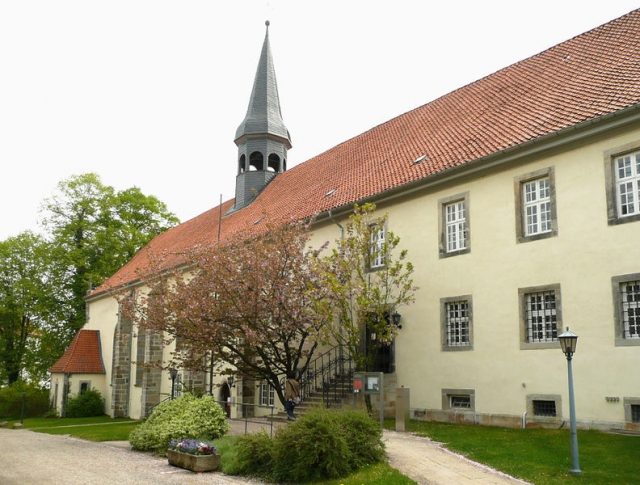
Wülfinghausen Abbey is an Augustinian canonesses' foundation established in 1236, which became an Evangelical women's convent after the Reformation. It is located near Eldagsen in the Hanover region, directly on the Osterwald ridge. The complex consists of the self-contained and immediately adjacent building complexes of the Abbey and the Abbey Estate. Wülfinghausen is one of the five Calenberg Abbeys managed by the Klosterkammer Hannover.
Prehistory
The foundation of the Abbey was preceded by a facility in Engerode near Salzgitter, established by Knight Ditmar von Oddingroht (Engerode) for nuns following the Rule of Saint Augustine. After only a short existence, the Abbey was moved to Wülfinghausen, where a building site had been acquired or donated by Knight Arnold von Wülfinghausen. The building was erected in honor of the Virgin Mary as an Augustinian convent.
Construction
The year 1236 is given for the construction, and 1240 for the consecration, in a document by Konrad II von Riesenberg, Bishop of Hildesheim. Despite donations, including from the Counts of Hallermund as regional rulers, the Abbey remained poor. In 1323, the number of Abbey residents was limited to 60. They came from the nobility and the propertied bourgeoisie. On January 8, 1378, a fire destroyed the Abbey buildings.
Reformation
In 1543, the Abbey converted to Lutheran doctrine. In 1593, it was secularized. Since then, the Abbey has been a women's convent, admitting single Evangelical ladies. In 1618, six conventuals inhabited the Abbey; in 1684, there were twelve women. In the 16th century, the Abbey, along with Mariensee, Marienwerder, Barsinghausen, and Wennigsen, belonged to the Calenberg Abbeys, whose revenues flowed into the Abbey treasury in Hanover.
Fire and Reconstruction of the Abbey Estate and Abbey
In 1728, a fire again destroyed the medieval Abbey buildings, except for the Gothic-style Abbey church. A commemorative plaque at the gate to the Abbey Estate points to the renewed laying of the foundation stone on March 18, 1729, by King George II. The new construction of the Abbey Estate buildings was completed by 1730, while the reconstruction of the convent buildings in Baroque style was not finished until 1740. The farmyard of the Abbey Estate reached dimensions of 160 m × 60 m. It is bordered by barns and stables made of quarry stone and has not been altered since its reconstruction. The entire complex of the Abbey and Abbey Estate gives a castle-like impression.
Hillfort
About one kilometer west of the Abbey, on a spur-shaped offshoot of the Osterwald, lies the Barenburg. It is a hillfort complex with an interior area of 5.5 hectares. The complex is strategically located, as two sides are naturally secured by steeply sloping rock faces and slopes. Since no excavations have been carried out and no finds are known, the construction period of the complex is presumed to be in the pre-Roman Iron Age. It may have been used as a refuge castle until the Middle Ages, as it belonged to the Abbey's possessions.
Today+
Since 1994, the Abbey has been inhabited by seven sisters of the Evangelical Communität Christusbruderschaft Selbitz from Upper Franconia. In 2013, the remaining three sisters separated from their original community and, with a newly admitted postulant, now form an independent Evangelical convent within the Evangelical-Lutheran Church of Hanover.
Courses on Christian and spiritual topics are held at the Abbey. It is possible to spend a holiday in the Abbey's guesthouse or take a break of up to three months.
From Wülfinghausen Abbey, a path with pollard willows leads to a forest restaurant.
Organ
The organ was built in 1969 by the organ builder Emil Hammer in a casing from around 1820. The instrument has 11 stops on one manual and pedal. The playing and stop actions are mechanical.
Take Mobile History with you
You are reading this text for free. Premium adds what matters on the road: descriptions read aloud, sites found through your camera, whole regions taken offline.
- Every description, including the ~17,700 Premium sites
- Audio guide: have descriptions read to you on location
- AR finder: see sites through your camera, with distance and bearing
- Unlimited saved sites
14 days free, then from €2.99 a month. Cancel anytime.
Source: Wikipedia · Licence: CC BY-SA 4.0 · Image: http://de.wikipedia.org/wiki/Kloster_W%C3%BClfinghausen#mediaviewer/Datei:W%C3%BClfinghausen_Klosterkirche.jpg
This description draws on the facts documented in the linked Wikipedia article; Wikipedia content is licensed under CC BY-SA 4.0. Wording and editing: Mobile History.
Location: 52.1409, 9.6648