Abbey
MonasteryBad Wörishofen
Wörishofen Abbey
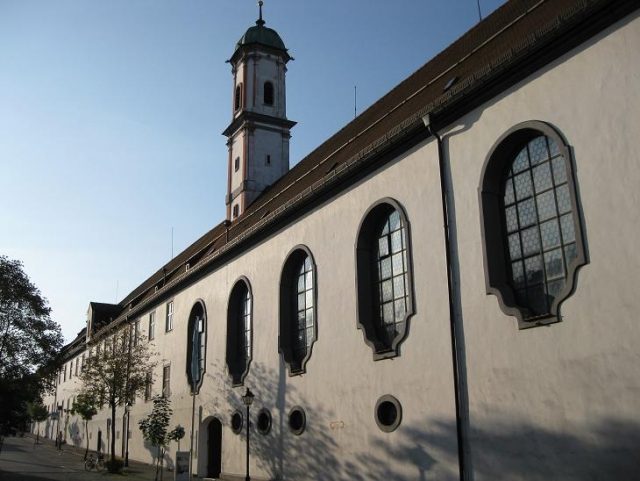
The Wörishofen Monastery is a Dominican convent in Bad Wörishofen, Bavaria, in the Diocese of Augsburg. The Kneipp Museum is located in the east wing of the monastery.
The founding of the Wörishofen Monastery dates back to a condition from 1243, which was linked to a donation to the Dominican Order. Approximately 500 years later, the Dominican Sisters of St. Katharina in Augsburg fulfilled this condition and sent members of their community to Wörishofen; on July 24, 1718, the first sisters arrived here and initially lived in an official building of their order. On August 4, 1719, then the feast day of Saint Dominic, the foundation stone of the monastery building was laid. In 1721, the nuns were able to move into the monastery.
In May 1800, French soldiers occupied the monastery and destroyed, among other things, sacred objects, before it was secularized on November 29, 1802, and its property nationalized. However, the sisters were allowed to stay, but no longer to accept novices. In 1842, King Ludwig I of Bavaria ordered a new beginning.
The sisters in Wörishofen Monastery were originally intended to live in strict enclosure, silence, and abstinence from meat, in accordance with the wishes of Pope Clement XI, which the mother house St. Katharina was not prepared to do. However, a condition for the re-establishment was that the monastery took over the parish's girls' school and set up an educational institution for difficult-to-educate girls. This gradually ended the contemplative life as envisioned by the rules of the order.
After Pastor Sebastian Kneipp was assigned to the monastery as confessor and house chaplain in 1855, it continuously developed, built a school and boarding school building, founded a domestic science school in 1885, and a kindergarten in 1899. Through his knowledge of plants and animal products, Sebastian Kneipp also improved the efficiency of the monastic agriculture.
Due to a lack of new recruits, the number of sisters in Bad Wörishofen steadily decreased over the course of the 20th century, so that the monastery's own businesses had to be given up. The school and boarding school building was converted into a spa house in 1981, which has been operated by Kolpingwerk as a "Spa Oasis in the Monastery" since 2005. The agriculture is leased.
Monastery Church+
"Maria, Queen of Angels" is the name of the monastery in Bad Wörishofen and of the monastery church consecrated on September 23, 1773, which closes off the northern part of the building complex to the west. The church is a rectangular, baroque hall building divided into seven bays, in the center of which stands the high altar. The elevated space behind the altar is the sisters' choir; in the two-bay nave in front of the altar, the congregation attends the service, and the organ stands on the gallery in the western bay.
Altars
From an anteroom, visitors enter the nave through an iron grille door. In front of them in the choir stands an ensemble of three altars: the high altar and two side altars with fine veneer of various wood types and Boulle marquetry. The altarpieces show in the high altar the Coronation of Mary as Queen of Angels – with Wörishofen Monastery below – and in the side altars on the left the Death of Saint Mary Magdalene, on the right the Presentation of the Rosary to the order saints Dominic and Catherine of Siena. In the upper panels of the side altars, Saint Catherine of Alexandria is depicted on the left and Teresa of Ávila, reformer of the Carmelite order, on the right.
Three columns each on the left and right of the high altar flank the altarpiece in a gilded frame, above which a shield with the Marian monogram, surrounded by small angels, forms the upper conclusion. Large angel figures support the columns. Further angels hover around the central altarpiece, pointing to Mary as "Queen of Angels" and protector of the monastery. The statue on the left between the columns depicts Pope Pius V, the sculpture on the right Saint Antoninus Pierozzi (1389–1459), Archbishop of Florence. The small wooden sculpture above the tabernacle shows the pelican tearing open its breast and nourishing its young with its blood, or bringing them back to life – a symbol for Jesus sacrificing himself for humanity.
The high altar, side altars, and all other carvings are works by the master cabinetmaker Valentin Zindter from the Dominican monastery in Augsburg and his assistants. The altarpieces were painted by Franz Haagen.
Stucco, Frescoes and Murals
The stucco on the ceiling and walls was created by Dominikus Zimmermann, younger brother of Johann Baptist Zimmermann, who painted the eight large frescoes. Four of these paintings adorn the ceiling of the sisters' choir, which is not accessible to church visitors. The painting above the choir shows – similar to the altarpiece – the Mother of God Mary as Queen, surrounded by saints of the Dominican Order. To the west, in the nave, follow depictions of the Holy Trinity and of the Archangel Michael, who casts Lucifer into hell with his angels, and above the organ, a painting of heavenly music.
Frescoes by an unknown master in the spandrels of the vault illustrate the mysteries or additions in the Hail Mary of the Rosary prayer. The small, monochrome green paintings between the large frescoes depict moments from the order's history.
The paintings on the south wall of the nave show the Holy Family with the Holy Spirit in the form of a dove and the Dominican nun Margaret of Città di Castello, as well as Saint Margaret of Hungary next to the pulpit. Below them hang paintings of Saint Thomas Aquinas and Saint Leonard of Limoges. On the north wall, Saint Wendelin and Saint Raymond of Penyafort are depicted.
Marian Chapel+
In the southwest, the Marian Chapel is attached to the monastery church, where the faithful pray for the intercession of the Mother of God and light small votive candles before the Black Madonna. The Madonna is a statue in late Gothic style, said to be a copy of the miraculous image in Einsiedeln Monastery, which a sister named Maria Michaela Gonaien brought to Wörishofen in 1721. Other sculptures in the chapel include a late medieval Pietà and a figure with textile garments, similar to the Infant Jesus of Prague.
After a fire in the chapel in 1955, from which the Black Madonna was saved, the room was redesigned. Among other things, Sister Donatilla von Eckardt (1903–1988) painted the ceiling as a sky of flowers and plants.
Take Mobile History with you
You are reading this text for free. Premium adds what matters on the road: descriptions read aloud, sites found through your camera, whole regions taken offline.
- Every description, including the ~17,700 Premium sites
- Audio guide: have descriptions read to you on location
- AR finder: see sites through your camera, with distance and bearing
- Unlimited saved sites
14 days free, then from €2.99 a month. Cancel anytime.
Source: Wikipedia · Licence: CC BY-SA 4.0
This description draws on the facts documented in the linked Wikipedia article; Wikipedia content is licensed under CC BY-SA 4.0. Wording and editing: Mobile History.
Location: 48.0036, 10.5944