School
MonasteryWald
Wald Abbey
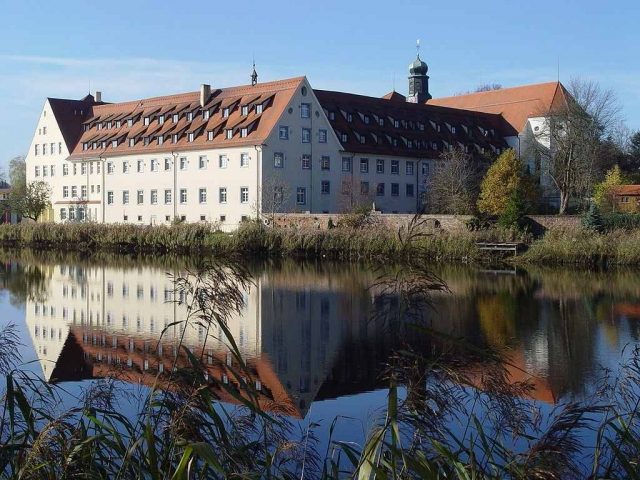
Kloster Wald is a former Cistercian nunnery in the municipality of Wald in the Sigmaringen district of Baden-Württemberg. Today it is a Benedictine nunnery, to which the Heimschule Kloster Wald boarding school is attached.
Foundation
Older than Kloster Wald is the village of Wald, after which it is named. Originally a possession of the Counts of Pfullendorf, Wald came into the possession of Emperor Frederick Barbarossa between 1168 and 1176 through the inheritance contract of Rudolf von Pfullendorf. From the Staufer dynasty, the village passed to the Lords of Fronhofen, who sold it in 1212 to the Staufer imperial ministerialis Burkard von Weckenstein (c. 1180 to after 1241), who in the same year founded the monastery for the benefit of his sisters Judintha and Ita von Weckenstein, both of whom were already consecrated Cistercian nuns. Judintha, the elder of the two sisters, was appointed abbess, and Ita as prioress.
A ministerialis was a high official of the king and belonged to the lower nobility. The Weckenstein family had its ancestral seat in the Schmeietal between Oberschmeien and Storzingen. On March 21, 1212, Knight Burkard von Weckenstein acquired the "praedium Wald" for 55 marks of silver from a noble man (nobilis homo) named Ulrich von Balbe, as well as his mother Adelheid and sister Gertrud. On this property, there was already a small church (ecclesiola) which held the parish rights and passed to the buyer. The Weckenstein family died out in 1383.
The choice of location for Kloster Wald was not strictly in accordance with the rules of the Cistercian order, which forbade the construction of abbeys in cities, fortified places, villages, and generally near secular settlements. However, considering that it was a women's monastery, the location of the new monastery largely conformed to the fundamental requirements. The monastery was far from cities, in an area comparatively untouched by secular activity, which was sparsely populated. Its surroundings were very wooded and entirely dominated by agricultural activity, thus corresponding quite well to the intentions of the Cistercian order to live in seclusion from the world through their own manual labor, through agriculture and animal husbandry, and to serve God alone.
The monastery in Wald was the first Cistercian monastery founded in the Upper Swabia region. At the beginning of the 13th century, many women's monasteries were established to live together in a monastic way, to pray and work in community. At the request of the nuns and Pope Honorius III, and through the mediation of Burkhard von Weckenstein, Kloster Wald was from the beginning subordinated to the Imperial Abbey of Salem as a daughter monastery and was elevated to an abbey as early as 1217 with the support of Salem's Abbot Eberhard von Rohrdorf.
Development of the Dominion
The newly founded monastery evidently gained a certain appreciation very quickly, and it also enjoyed the favor of the ruling Staufer emperors. For example, Frederick II, King of Sicily, gifted the monastery a court in Litzelbach that belonged to him. Further, increasingly numerous donations of land and rights followed. Such donations often came to Kloster Wald as a "dowry" from novices; fields, meadows, and forest plots were brought in, as well as entire farms. Most of these donations were widely scattered, unconnected, and often far from the monastery. Thus, the monastery was forced from the beginning to acquire land in its vicinity through purchase or exchange to have rounded-off possessions not too far away.
Consequently, it displaced the noble family of Reischach, residing at Burrach Castle near Reischach, and by 1290, it managed to conclude a contract with this family, in which the acquisition and expansion interests of the monastery were geographically defined. This area extended in the north from the village of Göggingen over Menningen, then in a southerly direction over Wackershofen and Sauldorf to Linz, and from there over Zell am Andelsbach and Bittelschieß back to Göggingen.
Indeed, the monastery succeeded in extending its possessions and thus its sovereign position over almost the entire area described above. As early as 1474, the dominion was so consolidated that one could speak of a closed Waldisch territory. The monastery was now the lord of the land, the lower court, and the village in many villages, which, however, were often very small and consisted of only two or three farms. Only the high and blood jurisdiction remained with the Counts of Sigmaringen as protective vogts of the monastery. These villages included: Wald, Buffenhofen, Burrau, Dietershofen, Gaisweiler, Hippetsweiler, Kappel, Litzelbach, Otterswang, Reischach, Riedetsweiler, Ringgenbach, Rothenlachen, Steckeln, Walbertsweiler, and Weihwang. The monastery also succeeded in gaining a foothold outside the designated area in Igelswies, Ruhestetten, and Tautenbronn (bought from Pfullendorf citizens in 1420).
The year 1501 marks the conclusion of large-scale acquisition policy and the endpoint of territorial expansion. For this reason, a so-called Urbar (land register) was compiled in this year, in which all possessions of the monastery were recorded.
Vineyards
Very early on, Kloster Wald began to systematically build up a center of ownership on Lake Constance in order to cultivate wine and thus secure the supply of wine for the convent. The focus of their possessions there for the Wald nuns was Überlingen. Within the walls of this city, they already owned several houses in 1240 and vineyards on the municipal territory. Kloster Wald owned further vineyards for many centuries in Aufkirch, Goldbach, Sipplingen and Bermatingen, and even on the Untersee on Reichenau Island and in Allensbach.
High Jurisdiction
The protective vogtei and thus the high jurisdiction over the monastery and its extensive possessions passed to Württemberg in the 14th century, then to the House of Werdenberg in 1399, and to Hohenzollern in 1535. In the course of the 18th century, various sovereign rights passed to Austria through the Landgraviate of Nellenburg.
Further Development
For 600 years, the daughters of the Swabian nobility were often members of the imperial noble foundation of Kloster Wald.
The entire monastery complex was almost completely destroyed during the Thirty Years' War (1618–1648). From the Middle Ages, only the Romanesque and Gothic parts of the cloister, the chapter house, and the "Jennerflügel" remain.
During renovation work in the east wing in 1980, two sets of four-coupled round-arch windows leading to a room behind them were discovered. This is the chapter house required by monastic rules. The protruding columns date from the Romanesque period. There are signatures on the columns, an owl on the shaft, and runners at the base. Both were classified by the State Office for Monument Preservation in Tübingen as stonemason's marks from the Hirsau workshop. On the church-side cloister, a buttress for a previously unknown side aisle of the original church from 1249 was opened. This is depicted as a Gothic basilica on the preserved monastery plan from 1681/85. The buttress stood for a three-aisled church. An corner column protrudes from the masonry, a support for the cloister leaning against the side aisle.
In 1698, Abbess Jakobe von Bodman had the monastery church rebuilt in the Baroque style. Between 1721 and 1727, Abbess Antonia von Falkenstein erected the large Baroque monastery complex to the west and north of the site.
Through secularization due to the Reichsdeputationshauptschluss, the territory of Kloster Wald came to the Principality of Hohenzollern-Sigmaringen in 1806 (together with Kloster Habsthal). Prince Anton Aloys himself concluded a pension contract with the convent; all nuns received a tailored sum of money until the end of their lives. However, the admission of new novices was forbidden, and thus the convent was doomed to die out; in 1853, the last nun left the monastery. In 1849, the former Wald territory, as part of Hohenzollern-Sigmaringen, became part of Prussia as the Hohenzollern Lands.
Monastery Church of St. Bernhard+
The monastery church, built in the 13th century as a three-aisled Gothic church (consecrated in 1249), was redesigned between 1696 and 1698 (year above the church portal) by master builder Jos Beer, a member of the famous Vorarlberg master builder family Beer, as a single-nave Baroque-Rococo church with a nuns' gallery extending far into the nave and the beautiful wrought-iron grille on its balustrade. Beer received 2800 guilders for the church construction. The interior was created through the collaboration of the Vorarlberg stucco artist Johann Jakob Schwarzmann with the facade paintings by Johann Melchior Eggmann. The fresco program begun by Eggmann was completed in 1753 by the Sigmaringen master of decorative Rococo painting Andreas Meinrad von Ow, dominated by the nave fresco depicting the visit of Saint Humbelina to her brother Bernhard of Clairvaux, to whom the church is dedicated. The painter Johann Michael Schmadel undertook the painting and gilding of wooden sculptures and carvings.
The Upper Swabian organ builder Johann Georg Aichgasser added a magnificent organ in 1751, which is considered the only one of his works still completely preserved.
Layout and Structure
The monastery church has the form of an elongated rectangle with a recessed, three-sided choir. The nave has six bays, each with a slender window with an inserted round arch on the north side. On the south side, these are matched by high-set low windows, two of which are only painted on the plaster, while the four western ones, with their round-arched upper part, extend beyond the roof of the cloister and illuminate the vault caps of the nave.
The vault abutments are reinforced externally and internally by wall piers protruding 30 centimeters each. The nave, 10.70 meters high at its apex, is vaulted by a massive, brick, almost semicircular barrel vault with strong lunettes, and the choir by a corresponding dome-like vault.
The tower is built into the west of the nave; its lower, rectangular part dates from the Gothic period, as evidenced by the pointed-arch door without profiling leading from the nave into the tower. Above the ridge of the roof, the tower rises as a wooden octagonal roof turret with an onion dome clad in zinc sheet.
The round-arched portal on the north side of the nave has a broken pediment on engaged Ionic columns. On the keystone is the year 1698, on both sides the coats of arms of the Cistercians and those of Weckenstein, above the keystone a cartouche held by angels with the coat of arms of the commissioning Abbess von Bodman.
Heimschule Kloster Wald+
Since 1946, monastic life has returned to Wald, and the Heimschule Kloster Wald, which combines a girls' boarding school, grammar school, and workshops, has been attached to the Benedictine monastery ever since. As a special feature, students can complete training in one of three professions – tailoring, carpentry, or wood carving – parallel to their Abitur. The school was founded by Sister Sophia, born Princess von Kotschoubey-Beauharnais, and Sister Lioba Korte, and was led by Sister Sophia until 1973. The boarding school has been attended by many daughters of noble houses to this day, for example, Gloria von Thurn und Taxis and Princess Marie of Liechtenstein.
Since 1994, Heimschule Kloster Wald has been under the sponsorship of the School Foundation of the Archdiocese of Freiburg.
Take Mobile History with you
You are reading this text for free. Premium adds what matters on the road: descriptions read aloud, sites found through your camera, whole regions taken offline.
- Every description, including the ~17,700 Premium sites
- Audio guide: have descriptions read to you on location
- AR finder: see sites through your camera, with distance and bearing
- Unlimited saved sites
14 days free, then from €2.99 a month. Cancel anytime.
Source: Wikipedia · Licence: CC BY-SA 4.0
This description draws on the facts documented in the linked Wikipedia article; Wikipedia content is licensed under CC BY-SA 4.0. Wording and editing: Mobile History.
Location: 47.9376, 9.1730