To be privately owned
MonasteryUetersen
Uetersen Abbey
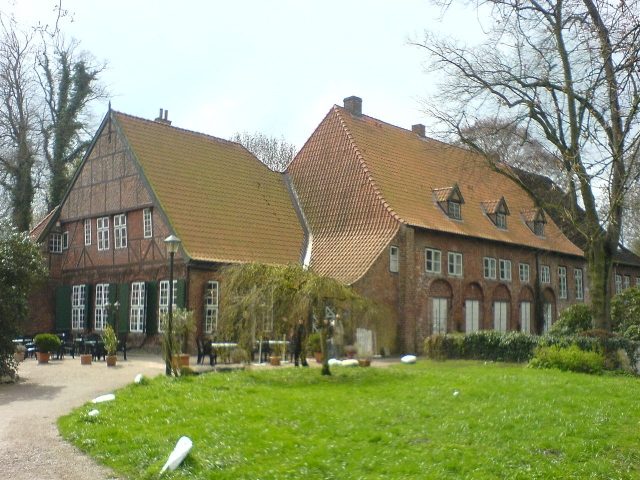
The Uetersen Monastery in Uetersen, Schleswig-Holstein, was founded in the 13th century. The building complex is one of the most important cultural monuments in the Pinneberg district.
The Cistercian Nuns' Monastery
In the Middle Ages, two castles belonging to the Knights of Barmstede stood near the present-day monastery grounds of Uetersen. The secluded location was the "uterst End", the outermost end, of their dominion. In 1234, Heinrich II von Barmstede designated his property on the marshland as a spiritual foundation. He called 12 Cistercian nuns from Reinbek Monastery. Thus, a Cistercian nuns' monastery was established at the "uterst End". In 1424, the monastery, along with its first monastery church, which, like all churches of the Cistercian order, was dedicated to the Virgin Mary as patroness (consistently only in male monasteries, in Cistercian nunneries also as a secondary patronage) and additionally to Saint George, was destroyed by fire but rebuilt as early as 1440.
Through donations, endowments, and acquisitions, the importance of the monastery steadily grew in the following centuries. In its best times, it owned large estates, a brickworks, a quarry, a fishery, and several mills. The scattered landholdings stretched from Neumünster to Altona. There were even landholdings on the other side of the Elbe in the Kehdinger Land. In addition to the prioress as the spiritual head, a provost regulated the economic (and legal) activities. 30 nuns and 30 lay sisters now belonged to the monastery.
In the vicinity of this significant economic enterprise, which the monastery represented, craftsmen and traders settled. The monastery became the nucleus of the town of Uetersen.
The Noble Ladies' Convent
In 1555, the sovereign Christian III of Denmark personally intervened to enforce the Reformation in his territory. The monasteries – like Preetz Monastery and St. Johannis Monastery near Schleswig – were dissolved. The Schleswig-Holstein knighthood then converted Uetersen Monastery into a Noble Ladies' Convent. This prevented the king from confiscating its property. Furthermore, it allowed the former nuns to largely maintain their pious way of life within the monastery grounds. The unmarried daughters of the nobility were also provided for in the future. From then on, they called themselves canonesses or conventuals. The enclosure was now lifted, and the conventuals had the option to marry.
The convent continued to be led by a noble provost, who was no longer an ecclesiastical head but usually came from the knighthood, and a prioress. Under the authority of the convent, Uetersen's economic development continued. The Noble Ladies' Convent still exists today as an independent foundation. In 1996, the convent included the prioress and seven other ladies. However, none of the ladies still reside in the monastery district; the conventual houses are rented out.
Preserved Buildings and Facilities+
Of the main buildings, only the southern longhouse remains today, with bricked-up cloister arches and the attached prioress's house. The current so-called monastery church was built after the monastery had already been converted into a convent. It therefore does not belong to the original buildings. The Baroque building was constructed by the master builder Jasper Carstens between 1747 and 1749 and is equipped with a beautiful pulpit altar and a large ceiling painting. The monastery cemetery lies between the monastery and the church.
The South House
The monastery originally had a cloister quadrangle with an inner courtyard. The South House, an elongated brick building, is the south wing of the former cloister quadrangle. It still shows the remains of the cloister; the arcades were bricked up later. The West House was demolished in 1813. The resulting opening in the South House was bricked up with old bricks in the larger monastery format. These came from the demolition material of the West House. The change from newer small bricks to those in monastery format can also be seen in the arcades.
The Prioress's House
Prioress Margaretha Countess von Ahlefeld (1613–1681) added a gabled building to the old South House. There, the prioress hosted, among others, kings, landgraves, and dukes. Monasteries were obliged to accommodate traveling sovereigns. The half-timbered gable shows brick patterns. The inscription on the lowest gable beam reads: ANNO 1644 DEN 24. MARTI. HABE ICH MARGARETA VON ALEFELT. P. DISES GEBAVE ERBAUWEN LASSEN. G. W. B. M. D. I. D. S. E. I. EW. The Rococo door is also worth seeing. It is a slightly curved, double-leaf transom door from the third quarter of the 18th century.
The Prioress's Tea House
In the Prioress's Garden stands a pavilion in the form of a Doric portico temple. The main part consists of plastered brick, the portico with columns and gable is made of wood. The doors on the front can be fully opened.
The Maiden's Cemetery (Monastery Cemetery)
After its conversion into a noble ladies' convent, the inner courtyard of the monastery quadrangle became the Maiden's Cemetery. There are a number of well-preserved tombs. Many of them date from the early days of the convent and are designed in the Neoclassical style.
Preserved graves by date:
- Augusta Magdalena Elisabeth and Agnes Dorothea (von) Zepelin (double grave without date)
- Unknown Knight († 1485), presumably von der Wisch, removed from the cemetery in 1995 and exhibited in the cloister of the monastery.
- Catarine Alfers (1594–1658)
- Anna Lucia von Leyel († 1693?), Prioress of Uetersen Monastery
- Metta von Schwaben (1636–1709), Prioress of Uetersen Monastery
- Ida Hedwig von Brockdorff (1639–1713), Prioress of Uetersen Monastery
- Olgard von Dessihn († 1716), Conventual of Uetersen Monastery
- Catharina Dorothea von Thienen a. d. H. Bülk (1685-1747), Conventual of Uetersen Monastery
- Anna Dorothea von Reicheln (1684-1749), Conventual of Uetersen Monastery
- Anna Emerentia von Reventlow (1680–1753), Prioress of Uetersen Monastery
- Three siblings, Augusta, Magdalena Elisabeth and Agnesa Dorothea von Zepelin (Anno 176?)
- Christa Sophia von Wedderkop († 1769), Conventual of Uetersen Monastery
- Hedewig Albertina von Rumohr (1706–1778), Prioress of Uetersen Monastery
- Christa Ulrica von Dewitz (1717–1792), Prioress of Uetersen Monastery
- Metta von Oberg (1737–1794), Conventual of Uetersen Monastery
- Elisabeth Benedicta von Brockdorf (1742-1800), Conventual of Uetersen Monastery
- Peter zu Rantzau (1733–1809), Provost of Uetersen Monastery
- Adelheid Dorothea von Rumohr (1737–1814), Conventual of Uetersen Monastery
- Dorothea Catharina von Ahlefeldt (1750–1814), Prioress of Uetersen Monastery
- Amalie von Gollowin (1765–1831), Prioress of Uetersen Monastery
- Louise von Qualen (1810–1895)
- Charlotte von Bülow (1817–1892), together with Greta von Bülow (1820–1890)
- Louise Emilie von Buchwaldt († 1833), Prioress of Uetersen Monastery
- Juliane Caroline von Rantzau († 1864), Prioress of Uetersen Monastery
- Friederike Charlotte von Buchwaldt († 1871), Prioress of Uetersen Monastery
- Louise Sophie Friederike Dorothee zu Ranzau-Breitenburg (1791–1981), Conventual of Uetersen Monastery
- Georgine von Wedderkop (1872–1894)
- Louise vom Wedderkop (1841–1911), together with Juliane von Wedderkop (1854–1928)
- Gertrund von Bernstorff († 1911), Prioress of Uetersen Monastery
- Magdalene Catharine von Rantzau (1873–1919), Prioress of Uetersen Monastery, together with Lilly von Rantzau (1880–1957) and Hedwig Lange, née von Rantzau (1875–1959)
- Arved von Wedderkop (1873–1954), Provost of Uetersen Monastery, together with Thyra née von Ladiges (1885–1865)
- Anna von Bernstoff (1877–1960), Conventual of Uetersen Monastery
- Marie-Christiane zu Rantzau (1889–1964)
- Louise Georgine von Rumohr (1877–1968), Prioress of Uetersen Monastery
- Christian von Platen-Hallermund (1900–1974), Provost of Uetersen Monastery, together with Ilsa-Maria née Kelling (1920–1995)
- Marie-Luise Wittkop, née Countess von Platen-Hallermund (1895–1982)
- Ernst Günther von Luckner (1919–1993), Provost of Uetersen Monastery
- Isabell von Holck, née Countess von Platen-Hallermund (1944–2003)
- Bernhard F. Hooke (1919–2013)
- Ingemarie Countess von Luckner née Wittkop (1924–2013)
The Conventual Houses
In the 18th and 19th centuries, the conventuals built their own houses within the monastery grounds. The convent rules allowed this. Many of these conventual houses are preserved and can be recognized by their similar basic structure: they are single-story eaves houses with a hip roof or a half-hip roof. Above the center is a dormer with a triangular gable; sometimes a dormer is present on both the front and back sides. In one of these houses lived the conventual Countess Augusta Louise zu Stolberg-Stolberg. Through correspondence with the young Goethe, the Countess entered literary history as Goethe's Gustchen. Goethe sent a number of important writings to his confidante in Uetersen.
The Convent's Outbuilding
A little off to the east of the monastery area stands a single-story half-timbered building with a half-hip roof: the outbuilding. (Design: Friedrich Christian Heylmann). This was where the Hofbieter lived, who were responsible for the security of the monastery district. The house originally contained apartments for three monastery servants, a coach house and horse stables, and two prison cells.
An inscription above the gate reads: ANNO 1818 DEN 12. OCTOBER IST DER ERSTE NAGEL IN DIESES KLÖSTERLICHE GEBÄUDE EINGESCHLAGEN VON IHR HOCHWÜRDEN GNADEN FRAU PRIORIN AV GOLLOWIN COMTESSE AG. V. RANTZAU COMTESSE L. ZU RANTZAU BARONESSEE V. BROCKDORFF KLOSTERSYNDICUS ROST KLOSTERHOFMEISTER MATTIESSEN GEBAUET VON DEN ZIMMERMEISTER ALBERT GATGENS IN UETERSEN MAUERMEISTER JACOB MUHL
The Provost's House
On the street Am Klosterhof stands a large white house, the official residence of the provost. It was also built by Jasper Carstens in 1734. In 1829, it underwent a renovation commissioned by Conrad Christoph von Ahlefeldt, during which the house received its current flat hip roof and was plastered. The two-story building features a central risalit three axes wide. The corners of the building are rusticated, and two short, low wall wings are attached to the right and left.
Provosts+
- Godescalcus (1234–1248)
- Bruno (1248–1265)
- Johannes (1315–1350)
- Albert (1350–1368)
- Nikolaus (1350–1362)
- Johann (1376–1386)
- Heinrich (1389); probably again * around 1420
- Hermann Kreyet (1394–1420)
- Heinrich around 1420
- Nicolaus Poppe (1424–1428)
- Egghard Kluver * (1437)
- Jacob Styte (Stiten) (1442–1447)
- Otto von Schauenburg (1450–1466)
- Johann von Schauenburg (1468–1495)
- Ketel * around 1495
- Benedikt von Ahlefeldt (1501–1503)
- Arnold Vaget (1502–1503)
- Johann von Schauenburg (1508–1511)
- Johann von der Wisch (1522–1527)
- Henning Rantzau (1527–1531)
- Jost Ingenhusen (Eigenhusen) * around 1531/32
- Clement von der Wisch (1532–1545)
- Otto Rantzau (1545–1580)
- Tylen Kulen * around 1580
- Daniel Rantzau (1580–1589)
- Balthasar Köller (1589–1602)
- Alexander Sehestedt (1609–1617)
- Sievert von Pogwisch (1617–1626)
- Benedikt von Ahlefeldt (1626–1635)
- Dietrich von Ahlefeldt (1635–1646)
- Friedrich von Ahlefeldt (1646–1657)
- Gosche von Buchwaldt (1657–1696)
- Friedrich von Reventlow (1696–1725)
- Heinrich von Reventlow (1725–1731)
- Benedikt von Ahlefeldt (1732–1757)
- Henning von Qualen (1757–1785)
- Peter zu Rantzau (1785–1809)
- Josias von Qualen (1809–1818)
- Conrad Christoph von Ahlefeldt (1818–1847)
- Otto von Rantzau (1847–1857)
- Emil zu Rantzau (1857–1863)
- Wilhelm von Ahlefeldt (1863–1891)
- Otto von Moltke (1891–1912)
- Ernst Emil Kurt von Reventlow (1912–1920)
- Friedrich Eduard von Buchwaldt (1920–1934)
- Arved von Wedderkop (1934–1954)
- Christian von Platen-Hallermund (1954–1974)
- Ernst-Günther von Luckner (1975–1993)
- Hubertus von Luckner (since 1993)
Prioresses+
- Elyzabet * around 1234
- Alburgis * 1318
- Elisabet * 1328
- Alheydis * 1360
- Yden * 1368
- Alheydis * 1372
- Elizabeth * 1389
- Beke * 1406
- Kerstine * 1418
- Ursula * 1428
- Bertha (von Beidenfleth) 1437
- Katharine * 1488
- Cäcilie Rantzau * 1505
- Mette von der Wisch * 1536
- Dorothea von der Wisch * 1573
- Catharina von Pogwisch * 1583
- Catrine von Gadendorp * 1608
- Catharina von Platen (1614–1632)
- Magdalena von Ucken (1632–1646)
- Magdalena von Schack (1646–1656)
- Margaretha von Ahlefeldt (1656–1681)
- Anna Lucia von Leyel (1681–1693)
- Metta von Schwaben (1693–1709)
- Ida Hedwig von Brockdorff (1709–1713)
- Anna Emerentia von Reventlow (1713–1753)
- Marie Antoinette von Ahlefeldt (1753–1764)
- Margaretha Hedwig von Buchwaldt (1764–1769)
- Hedewig Albertline von Rumohr (1769–1773)
- Katharina von Reventlow (1773–1781)
- Christina Ulrica von Dewitz (1782–1792)
- Dorothea Catharina von Ahlefeldt (1792–1814)
- Amalie von Gollowin (1814–1831)
- Louise Emilie von Buchwaldt (1831–1833)
- Juliane Caroline von Rantzau (1833–1864)
- Friederike Charlotte von Buchwaldt (1864–1871)
- Marie Adelaide von Rantzau (1871–1903)
- Gertund von Bernstorff (1903–1911)
- Magdalene Catharine von Rantzau (1911–1919)
- Louise Georgine von Rumohr (1919–1968)
- Marianne? Keller von Rumohr from Preetz Monastery (Interim) (1968–1983)
- Katharina von Kielmansegg (1983–1987)
- Asta von Bethmann-Hollweg (1987–2004)
- Karine von Rumohr since 2005
Take Mobile History with you
You are reading this text for free. Premium adds what matters on the road: descriptions read aloud, sites found through your camera, whole regions taken offline.
- Every description, including the ~17,700 Premium sites
- Audio guide: have descriptions read to you on location
- AR finder: see sites through your camera, with distance and bearing
- Unlimited saved sites
14 days free, then from €2.99 a month. Cancel anytime.
Source: Wikipedia · Licence: CC BY-SA 4.0 · Image: http://de.wikipedia.org/wiki/Datei:Kloster_in_Uetersen.JPG
This description draws on the facts documented in the linked Wikipedia article; Wikipedia content is licensed under CC BY-SA 4.0. Wording and editing: Mobile History.
Location: 53.6815, 9.6571