The Abbey can be visited
MonasteryReurieth-Trostadt
Trostadt Abbey
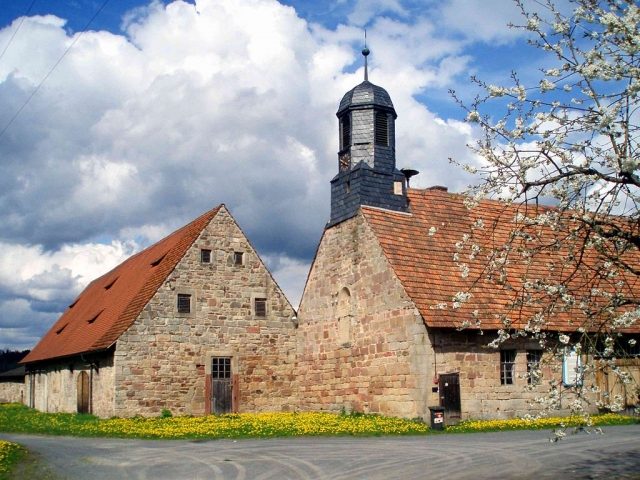
The former Trostadt Monastery – also known as Neuzelle – was a convent of Premonstratensian canonesses, whose structural remains can be found in Trostadt, a district of the municipality of Reurieth in the Hildburghausen district in Thuringia.
Trostadt Monastery and the present-day village of Trostadt are located on the upper reaches of the Werra River, about seven kilometers west of the district town of Hildburghausen. The village lies on the western edge of the valley, already in a flood-prone location, barely two meters above the Werra floodplain. Some of the buildings in the village still date from the time of the former monastery, but only a few remains of the sacred buildings are preserved.
Since 1130, the Counts of Henneberg became patrons of the Premonstratensian Order in Thuringia and, in 1131, also through generous donations, enabled the founding of a double monastery in the village of Veßra. In "return," Veßra Monastery was designated as the counts' house monastery and, from 1182, was also used as their burial site. Veßra Monastery was consecrated in 1138 by Bishop Otto II of Bamberg.
A fire that broke out on the monastery grounds of Veßra in 1175 was taken by the order's leadership as an opportunity to dissolve the double monastery existing in Veßra and to establish a spatially separate settlement for the canonesses. The site of the already existing settlement of Trostadt, about three kilometers east of Veßra, was chosen for this new monastic house. Probably, a farm belonging to the monastery already existed there, as a manor in Trosnastete was already documented in 795.
This new foundation was called Neuzelle in short form and now served as a widows' home and training center for the Henneberg nobility.
Trostadt Monastery was under the protection of the Henneberg Counts; in ecclesiastical matters, it was represented by the abbot of Veßra Monastery. The Premonstratensian canonesses acquired numerous estates and properties in the Henneberg region through endowments and donations. In 1244, another fire, this time within the walls of Trostadt Monastery, destroyed the reconstruction work carried out so far.
From the mid-14th century, penalties had to be imposed on the canonesses due to declining monastic discipline. At the same time, the Henneberg Counts gladly used the monastery's savings to pay off their own debts; as collateral and often with less equivalent value, the monastery was granted further properties and usage rights.
When the unrest of the Peasants' War also spread to the Werra Valley, Trostadt Monastery was also evacuated; all the canonesses fled to the town of Schleusingen, and the monastery treasure reached the protective walls of the nearby Bertholdsburg. As a precaution, a guard commissioned by the count was also sent to Trostadt to protect the monastery grounds from looting and devastation; unfortunately, these mercenaries found a large number of full beer barrels there. Instead of the peasant hordes, looters from Themar and some neighboring villages arrived at the monastery after they had learned of the canonesses' departure and now wanted to seize "ownerless goods." The drunken guard is said to have done nothing, but the destruction in Trostadt was limited. After the defeat of the peasants, the canonesses repossessed their Trostadt Monastery. The next threat came unexpectedly, as their protector, Count Georg Ernst von Henneberg-Schleusingen (1511–1583), had converted to Protestantism in 1544. During the Second Margrave War, Trostadt Monastery was attacked again in 1579; the last canonesses now definitively left the Henneberg area with the consent of their bishop.
The secularized monastery was transformed into a manor. The monasteries of Veßra and Trostadt continued their tradition as educational institutions with the Hennebergisches Gymnasium founded in Schleusingen in 1577.
Take Mobile History with you
You are reading this text for free. Premium adds what matters on the road: descriptions read aloud, sites found through your camera, whole regions taken offline.
- Every description, including the ~17,700 Premium sites
- Audio guide: have descriptions read to you on location
- AR finder: see sites through your camera, with distance and bearing
- Unlimited saved sites
14 days free, then from €2.99 a month. Cancel anytime.
Source: Wikipedia · Licence: CC BY-SA 4.0 · Image: http://commons.wikimedia.org/wiki/File:Kloster_Trostadt.jpg
This description draws on the facts documented in the linked Wikipedia article; Wikipedia content is licensed under CC BY-SA 4.0. Wording and editing: Mobile History.
Location: 50.4651, 10.6410