Monastery operation
MonasteryEichstätt
St. Walburg Abbey
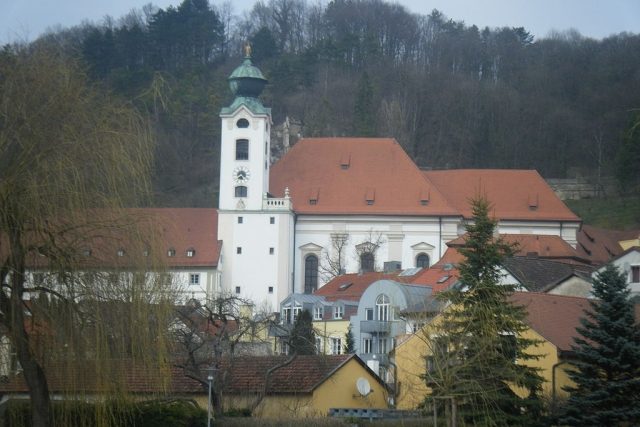
The Abbey of St. Walburg, a Benedictine nunnery in Eichstätt, Bavaria, is a historically significant site that has continuously existed since its foundation in the 11th century. It is renowned for its long history, the veneration of Saint Walburga, and its role as an educational institution.
History+
The origins of the monastery trace back to the 9th century when the relics of Saint Walburga were transferred to Eichstätt between 870 and 879, to a site where a small cross church already stood. Canonesses subsequently settled at this location. In 1035, Count Liutger of Lechsgmünd and Graisbach founded the Benedictine nunnery, with Imma, a niece of the founder, serving as its first abbess. The initial endowment included lands in several surrounding villages. In the 15th century, under Bishop Johann III von Eych, the monastery, by then an important institution for noble daughters, underwent reform. During the Thirty Years' War in 1634, the monastic buildings suffered extensive destruction by fire but were subsequently rebuilt in the Baroque style. Although the monastery was secularized in 1806 during the transition of the Prince-Bishopric of Eichstätt to Bavaria, the nuns were permitted to continue their community life due to their unanimous desire to remain faithful to their vows. The monastery was revitalized in 1835 by order of King Ludwig I of Bavaria, with the condition that the nuns would undertake the education of girls in Eichstätt. In 1914, the monastery was elevated to an abbey. The abbey church, which also serves as a parish church, is a significant pilgrimage site to the tomb of Saint Walburga. The monastery also played a role in the establishment of Benedictine congregations in North America, initiated by Mother Benedicta Riepp in 1852.
Location+
The Abbey of St. Walburg is situated in the city of Eichstätt in the federal state of Bavaria, Germany. It is located at an elevation of approximately 413 meters above sea level.
On site+
Today, the Benedictine nuns maintain an active monastic life, which includes the Liturgy of the Hours, the operation of a monastery shop, and a guesthouse. They are also involved in household management, gardening, various workshops, a kindergarten, and a primary school. Pilgrims are also cared for. The abbey houses an archive with late medieval manuscripts and music manuscripts, as well as a library containing approximately 20,000 volumes, of which 5,080 date from the 16th to the 19th century. In 2022, renovation work was completed, and a guesthouse named “St. Anna” was inaugurated.
Nearby+
- Dominikanerkloster Eichstätt (approx. 359 m away)
- Kollegiatstift St. Willibald, Eichstätt (approx. 414 m away)
- Kloster Heilig Geist (approx. 418 m away)
- Dom zu Eichstätt (approx. 424 m away)
Take Mobile History with you
You are reading this text for free. Premium adds what matters on the road: descriptions read aloud, sites found through your camera, whole regions taken offline.
- Every description, including the ~17,700 Premium sites
- Audio guide: have descriptions read to you on location
- AR finder: see sites through your camera, with distance and bearing
- Unlimited saved sites
14 days free, then from €2.99 a month. Cancel anytime.
Source: Wikipedia · Licence: CC BY-SA 4.0
This description draws on the facts documented in the linked Wikipedia article; Wikipedia content is licensed under CC BY-SA 4.0. Wording and editing: Mobile History.
Location: 48.8957, 11.1831