Church
MonasterySt. Märgen
St. Märgen Abbey
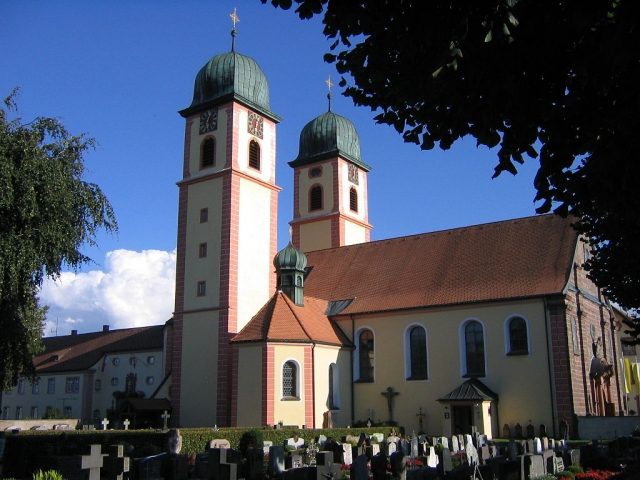
The St. Märgen Monastery is a former Augustinian Canons Regular monastery in St. Märgen in the Black Forest, founded in 1118 under the name Cella Sanctae Mariae. The German form of the name, "Maria-Zell auf dem Schwarzwald" (Mary's Cell in the Black Forest), evolved over the centuries through Mergenzell, Sankt Maria, St. Marien, St. Märijen, and St. Mergen to today's monastery and town name St. Märgen.
The regulated Augustinian Canons Regular monastery of St. Märgen, founded around 1115/1118 by Bruno von Hohenberg, Strasbourg canon, later Bishop of Strasbourg and Chancellor to Emperor Henry V, under the names Cella Sanctae Mariae or Monasterium sanctae Mariae, was a political foundation of the Counts of Hohenberg against the Dukes of Zähringen. The latter were the bailiffs of the St. Gallen estates in the Dreisam Valley and had built Wiesneck Castle for their protection. In 1093, they had moved their house monastery Weilheim unter Teck to St. Peter to secure the road connection through the Glotter Valley to Villingen, thereby bypassing the Hohenbergian possessions around Wiesneck Castle. The dispute between the two monasteries led to the destruction of the Hohenbergian Wiesneck Castle by the Zähringer, which caused a severe loss of Hohenbergian power in the Dreisam Valley.
Bruno von Hohenberg settled the monastery with Augustinians, presumably from St. Leo in Toul, who were soon replaced by German Augustinians. According to tradition, the Lorraine canons brought with them a miraculous image, around which a pilgrimage soon developed and which is still venerated in the pilgrimage and monastery church today. It represents the oldest known miraculous image in the Archdiocese of Freiburg today.
The monastery's possessions primarily included cleared land in the immediate vicinity. Here, a demarcation from the monasteries of St. Peter and St. Gallen soon became necessary. The monastery filled the parish positions in St. Märgen, Wyhl, Scherzingen, and Haslach. Haslach, however, was lost during the Reformation but was replaced by the donation of the Zähringen parish in 1615. In addition, the monastery had citizenship rights in Endingen, Villingen, and Freiburg.
The papal assurance of free Vogt (bailiff) election remained theoretical. From the Counts of Hohenberg, the Vogtship over the monastery passed to the Freiburg knight Burkart Turner in 1293, to the Schnewlin at the beginning of the 14th century, to the Blumeneck in 1370, and back to the Schnewlin in 1450. The constant dispute with the Vogts severely affected the monastery throughout the 14th and 15th centuries; 3 abbots suffered a violent death, among them Abbot Konrad, whom a knight of Schnewlin had murdered near Ebnet in 1355. Abbot Johannes II. Schlegerle was also murdered by the – Blumenecker – Vogts in 1401, while Abbot Berthold was murdered by his own conventuals in 1385.
A fire destroyed the facilities in 1430. The dispute with the Vogts led, on the one hand, to the church only being consecrated again in 1493, and on the other hand, to the monastery selling all its possessions to the city of Freiburg in 1461 and moving the following year to the Augustinian Canons Regular monastery of Allerheiligen in Freiburg, founded around 1300, with which it had already merged in 1370.
In 1546, the abbacy was declared extinct; from then on, the head of the convent held only the title of administrator, and from 1583, a provost of Allerheiligen.
Only after the destruction of the Allerheiligen monastery in Freiburg in 1678 did the canons return to St. Märgen. After the church and monastery were again destroyed in 1704 during the War of the Spanish Succession, they were rebuilt under Provost Andreas Dilger: the church from 1716 to 1725, and the monastery buildings from 1726 to 1729. In 1725, the monastery joined the Lateran Augustinian Congregation in Rome. In 1738, Dilger's successors for St. Märgen again received the abbacy, and in 1771, admission to the Breisgau Prelacy.
The secularization of 1803 still spared the monastery. Initially occupied by Württemberg, it was dissolved in January 1806, its land confiscated by the Baden state, and parts of the monastery buildings sold to farmers. The library went partly to Karlsruhe, partly to the University Library Freiburg; a small part remained as a parish library in St. Märgen, where it burned down in 1907.
In 1907, a lightning strike destroyed the church, which was immediately rebuilt in its old forms. Only the figures by the woodcarver Matthias Faller could be saved from the original furnishings.
In 1995, monks of the Pauline Order from Poland moved into the monastery. On August 31, 2011, the monastery was closed after it became known that a monk had spent almost 250,000 Euros on expensive vestments.
Construction History+
The church and monastery were completely or largely destroyed by fire five times: in 1284, 1430, 1560, 1704, and 1907. Each time, the complex was rebuilt or restored.
The current monastery and pilgrimage church of St. Märgen is a two-towered Baroque church, built between 1716 and 1725 after its destruction in 1704. The interior decoration was largely done by the Black Forest wood sculptor Matthias Faller, who was temporarily a lay brother at the monastery. It represents the first highlight of his work. The carvings of all six altars originally came from him: the high altar, the cross altar, the left and right side altars in the nave, the altar in the northern side chapel with the pilgrimage image, a Romanesque seated Madonna from the monastery's founding period, and the altar in the southern side chapel dedicated to St. Joseph, along with the shrine containing the bones of the catacomb saint Constantius.
On September 12, 1907, this church also burned down. A Silbermann organ from 1776/77 that was there was lost. The altar figures and the pilgrimage image were saved, including the predellas of the side altars in the nave as masterpieces of Faller's carving art. The church was rebuilt "in the old style," meaning as a Neo-Baroque building, from 1907–1914, with the help of collections and donations.
During renovation work on the church, a small Gothic tracery part was found. This suggests that the predecessor building was made of stone and consisted at least in parts of red sandstone.
Bells+
The monastery church has a peal of seven bells, cast in 1988/89 by Karin Schneider-Andris at the Karlsruhe Bell and Art Foundry. The quarter-hour strike is sounded by bells 6–4–5, the hour strike on bell 3, and the hour after-strike on bell 1.
Take Mobile History with you
You are reading this text for free. Premium adds what matters on the road: descriptions read aloud, sites found through your camera, whole regions taken offline.
- Every description, including the ~17,700 Premium sites
- Audio guide: have descriptions read to you on location
- AR finder: see sites through your camera, with distance and bearing
- Unlimited saved sites
14 days free, then from €2.99 a month. Cancel anytime.
Source: Wikipedia · Licence: CC BY-SA 4.0 · Image: http://commons.wikimedia.org/wiki/File:St._Maergen_T%C3%BCrme_8523.jpg
This description draws on the facts documented in the linked Wikipedia article; Wikipedia content is licensed under CC BY-SA 4.0. Wording and editing: Mobile History.
Location: 48.0062, 8.0922