Abbey
MonasterySpeinshart
Speinshart Abbey
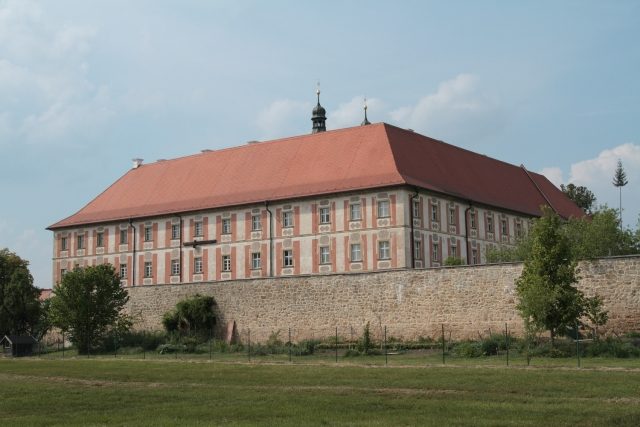
Speinshart Abbey is an abbey of the Premonstratensian Order in Speinshart in the Upper Palatinate in the Diocese of Regensburg. The complex, consisting of four wings, was built in the Baroque period. The collegiate church with the patronage "Maria Immaculata" is today both a monastery and a parish church.
Foundation
A vast forest area, the so-called "Spechtswald" (Old High German Spetheshart), lay in Franconia in the Nordgau (Bavaria) in the High Middle Ages. In this territory, the childless couple Adelvolk and Richenza von Reifenberg presumably founded Speinshart Abbey in 1145. Adelvolk's brothers, Eberhard (later Bishop of Bamberg with the name Eberhard II von Otelingen) and Reinhold, also contributed goods to the endowment of this monastic foundation.
It cannot be said with absolute certainty whether canons from the Premonstratensian monastery of Wilten near Innsbruck in Tyrol – from where the first Premonstratensians came to Speinshart – were already present at the time of the monastery's foundation. In a papal letter of protection from 1181, the Premonstratensians in Speinshart are mentioned for the first time in a document. However, the location in a swampy valley corresponds to the classic choice of location for a Premonstratensian monastery, as Prémontré – the first monastery of the Order of Saint Norbert of Xanten – was also located in a swampy valley, so this indication actually suggests that Speinshart Abbey was founded for the Premonstratensians. The Premonstratensians took over pastoral care for various places in the region and cultivated religious and cultural life there in the following centuries.
The Monastery in the Late Middle Ages
The convent was led by a provost. The first provost, Grimo, joined the Second Crusade in 1147. Under Konrad IV and Heinrich III, numerous possessions were added to Speinshart Abbey towards the end of the 13th century. The monastery experienced its first flourishing in the 15th century under Provost Georg Ochs von Gunzendorf. At that time, Pope Pius II elevated the monastery to an abbey. An abbot now presided over the convent and, with his pontificalia, represented the high self-confidence of the collegiate foundation to the outside world.
The Consequences of the Reformation Era
The Reformation era marked a first turning point in history. Under Elector Ottheinrich, the Catholic doctrine was replaced by the new Lutheran doctrine throughout the Upper Palatinate in 1556; all Catholic rites and practices were forbidden. Abbot Johann III Georg von Gleißenthal married with the permission of the sovereign in 1556 and was able to retain his abbatial dignity. At the end of that year, a visitation took place, where a thoroughly Protestant-influenced institution was found. The collapse of Speinshart Abbey was unstoppable, and it was finally secularized and became state property.
Re-establishment
In 1661, under the Elector of Bavaria Ferdinand-Maria, Premonstratensians returned to Speinshart from Steingaden Abbey. In the following decades, the new convent endeavored to structurally restore the collegiate church and the convent wing. In 1691, the monastery regained the status of an abbey. Wolfgang Dientzenhofer drew up the plans for the church building, which was completed in 1696. The brothers Carlo Domenico and Bartolomeo Lucchese from Mellide on Lake Lugano created the heavy Baroque decoration inside. Their Italian influence cannot be denied.
Baroque Piety
The canons of Speinshart responded to the general Baroque popular piety by reviving the medieval pilgrimage to Barbaraberg around 1684. Finally, Father Hugo Strauß drew up plans for a new pilgrimage church in the Rococo style. Of this church building, which was built between 1741 and 1756, only the monumental facade remains today.
In Speinshart, the veneration of the Scourged Savior also emerged in the 18th century, as in the Wieskirche near Steingaden. For this purpose, a separate chapel to the Scourged Savior was built next to the collegiate church, which still bears the name Wieskapelle today. It is now owned by the municipality of Speinshart and serves various cultural events.
The prayer of the Stations of the Cross can also be attributed to Baroque piety. Michael Wild created the Stations of the Cross with 14 stations for the collegiate church in 1745/46.
Secularization
However, the Baroque splendor, which reached its peak under Abbot Dominikus I von Lieblein in the mid-18th century, finally ended with the secularization on St. Mark's Day, April 25, 1803. For the second time, the monastery and its possessions fell to secular power. The monastery initially came into state ownership and subsequently housed, among other things, the rectory, a school, and the forestry office.
The Second Re-establishment
On September 30, 1921, the extensive monastery complex was repurchased by the Premonstratensian Order from the Bavarian state through the mediation of the Munich canon Prelate Michael Hartig. On October 2, 1921, Premonstratensians from Tepl Abbey in Egerland moved in. In 1923, the Apostolic See confirmed the monastery again as an abbey with all rights. Initially, Abbot Gilbert Helmer of Tepl took over the administration of Speinshart.
The Monastery Today
Today, the convent of Speinshart consists of eight canons. Three Premonstratensians from Windberg Abbey and Roggenburg Abbey support the community in various tasks in parish pastoral care and in the organization of extensive renovation and restoration measures on the monastery building. Since 2007, Abbot Hermann-Josef Kugler of Windberg Abbey has been the administrator of Speinshart.
Collegiate Church+
Romanesque Basilica
In the late 12th century, the foundations were laid for a three-nave Romanesque basilica, which can be seen in the so-called founder's painting in the entrance hall of today's Baroque collegiate church. Parts of these foundations, namely those of the choir apses, were secured in recent years during excavations in the monastery garden. Spolia of the Romanesque basilica can also be seen in the masonry. A drawing from the 17th century still exists of a painted window from this church.
Baroque New Building
When the old Romanesque monastery church was demolished in 1691, the new building began according to the plans of Wolfgang and Georg Dientzenhofer. The Dientzenhofer brothers influenced several important buildings between Prague and Würzburg. The shell was completed in 1696.
Interior Decoration
Now it was time to furnish and design the interior with dignity. Abbot Gottfried Blum commissioned the Italian brothers Carlo Domenico (stucco artist) and Bartolomeo (painter) Lucchese to decorate the interior. The artist brothers gave the room an Italian character through the heavy Baroque design. The walls, structured by pilasters and strongly protruding cornices, seem to flow seamlessly into the ceiling, which is decorated with heavy fruit and flower garlands. Three large-format ceiling frescoes, artfully framed, stand out in the nave, which in turn are surrounded by small medallions that are also frescoed. In the choir, the ceiling decoration is even denser and more closely arranged.
Carlo Domenico Lucchese also created the high altar from stucco, but this was only colored in 1714. The painting of the Immaculata in the high altar is presumably by Antonio Triva, also an Italian artist. After the consecration of the new church in 1706, it took several more years until the interior took on its present form. Abbot Otto Peißner consecrated the last side altars only in 1722.
In the representative vestibule to the actual church space, the founding event of the monastery is staged on the ceiling. This fresco, the so-called "founder's painting," was created after a medieval model that no longer exists today. The vestibule is flanked by the Nepomuk Chapel (left) and the Baptismal or Sylvester Chapel (right). The interior represents a total work of art: architecture, stucco, painting, and the rest of the furnishings all join together in the praise of God.
Monastery Building+
The convent wing, which extends over the east, south, and west wings of the complex, houses the living and working rooms of the canons. From 1674, new buildings for the convent were constructed. The modern Baroque four-wing complex was only completed after the completion of the prelature (west wing) in 1713. The spacious cloister runs through the ground floor. Among other things, the chapter house and the refectory are attached to it.
A representative corridor also runs through each of the two upper floors. In the north wing, the so-called prelate's wing, where the abbot once resided, the "International Meeting Center Speinshart" – the monastery's educational center – finds new rooms. The ceiling paintings in these chambers were created by Michael Wild. Particularly interesting is a painting in one of the guest rooms that shows the reception of the abbot by various guests. Among the people, Christ also approaches the abbey and joins the distinguished company. Abbot Dominikus I von Lieblein greets him.
Michael Wild also created a perspectively successful ceiling fresco in the library. Unfortunately, after the secularization, an intermediate ceiling was installed in the room – which actually extended over two floors – so that this artwork no longer has its originally intended effect.
The Higher Superiors of Speinshart Premonstratensian Abbey+
The list of Higher Superiors of Speinshart Premonstratensian Abbey is divided into four parts. First, the list of provosts from the foundation of the monastery in 1145 until its elevation to an abbey in 1459. The second part names the abbots until its dissolution in the turmoil of the Reformation in 1557. The third part deals with the abbots after the re-establishment by Steingaden Abbey in 1661 and 1691, respectively, when an abbot was elected in Speinshart for the first time again. The secularization in 1803 again marks a strong break. The last and ongoing list begins with the re-establishment by Tepl Abbey between 1921 and 1923.
Coat of Arms+
The abbey's coat of arms refers to the founder of the monastery. It shows a silver tower on a red background. According to tradition, Adelvolk von Reifenberg also bore the same coat of arms. The escutcheon is topped with a miter and, together with the crozier behind it, represents the abbatial dignities.
The political municipality of Speinshart also bears the tower in its coat of arms. As a historical reference to the abbey, the municipal coat of arms also shows the miter.
Take Mobile History with you
You are reading this text for free. Premium adds what matters on the road: descriptions read aloud, sites found through your camera, whole regions taken offline.
- Every description, including the ~17,700 Premium sites
- Audio guide: have descriptions read to you on location
- AR finder: see sites through your camera, with distance and bearing
- Unlimited saved sites
14 days free, then from €2.99 a month. Cancel anytime.
Source: Wikipedia · Licence: CC BY-SA 4.0
This description draws on the facts documented in the linked Wikipedia article; Wikipedia content is licensed under CC BY-SA 4.0. Wording and editing: Mobile History.
Location: 49.7867, 11.8203