Abbey
School
MonasteryLandsberg
Seligenthal Abbey
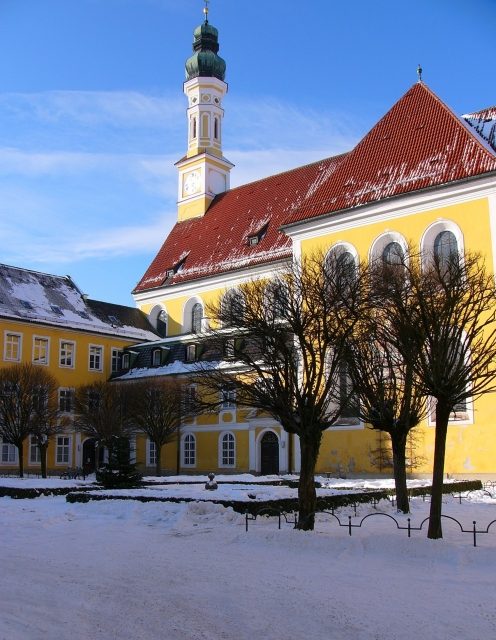
Seligenthal Abbey is a Cistercian nunnery and burial place of the Wittelsbach family in Landshut, Bavaria, in the Diocese of Regensburg.
The monastery, dedicated to the Blessed Virgin, was founded in 1232 by Ludmilla, widow of Louis I the Kelheimer, Duke of Bavaria and founder of Landshut. The late Romanesque (consecrated 1259) abbey church was rebuilt in the early Rococo style between 1732 and 1734. The high altar painting, stucco, and ceiling paintings are by Johann Baptist Zimmermann.
The monastery was dissolved in 1803 during the secularization. However, the admission of novices had already been forbidden in 1768. According to the historian Sigmund Ritter von Riezler, in the Allgemeine Deutsche Biografie, Volume 36 (1893), pp. 551–553, the Munich auxiliary bishop Franz Ignaz von Streber personally interceded with King Ludwig I of Bavaria to re-establish the monastery in 1835. In 1862, Seligenthal became a priory, and in 1925, it was again an abbey.
Throughout its history, the abbey undertook several daughter foundations; for example, in 1863, nuns were sent to Waldsassen (Waldsassen Abbey), in 1955 to Mönchhof (Marienkron Abbey), in 1979 to La Paz (Colegio Ave Maria), and in 1999 to Helfta (Helfta Abbey) to re-establish or establish monasteries there.
Since 1999, Abbess M. Petra Articus has led the abbey, taking over this office from her predecessors M. Columba Baumgartner (1958 to 1987; † September 1, 2007) and M. Assumpta Schenkl (1987 to 1999; thereafter prioress of Helfta Abbey in Eisleben; † April 24, 2009).
Today (2010), 53 sisters live and work in the abbey. This makes Seligenthal one of the largest Cistercian nunneries in the world. The sisters teach, among other things, as teachers and educators in the educational and care facilities of the Seligenthal School Foundation. In 2007, the abbey celebrated its 775th founding anniversary.
Abbey Church+
The slender, ridge-turret-like tower received its current form in 1689. The Munich court master builder Johann Baptist Gunetzrhainer redesigned the interior of the outwardly simple medieval building between 1732 and 1734. The choir was completely newly created by him, so that all parts of the space are now subordinate to the large space of the crossing with the dome.
This part in particular was richly decorated with stucco by Johann Baptist Zimmermann. Zimmermann also created the frescoes, of which the main image in the dome shell depicts the Coronation of Mary. Zimmermann also painted the three altarpieces. The painting of the high altar shows the Assumption of Mary into Heaven, and the two side altars depict Anna selbdritt and the enthroned Mary. The altars were designed by Kaspar Grießmann, and the sculptural decoration is largely by Johann Wenzeslaus Jorhan.
The tomb slab of Duke Ludwig X is located in the church.
Facilities of the Seligenthal School Foundation+
- Kindergarten
- After-school care
- Primary School
- Seligenthal Primary School currently has 12 classes.
- Commercial School
- Gymnasium (Secondary School)
- Technical Academy for Social Pedagogy
Take Mobile History with you
You are reading this text for free. Premium adds what matters on the road: descriptions read aloud, sites found through your camera, whole regions taken offline.
- Every description, including the ~17,700 Premium sites
- Audio guide: have descriptions read to you on location
- AR finder: see sites through your camera, with distance and bearing
- Unlimited saved sites
14 days free, then from €2.99 a month. Cancel anytime.
Source: Wikipedia · Licence: CC BY-SA 4.0
This description draws on the facts documented in the linked Wikipedia article; Wikipedia content is licensed under CC BY-SA 4.0. Wording and editing: Mobile History.
Location: 48.5423, 12.1476