The Abbey can be visited
MonasterySchönbühel - Aggsbach
Schönbühel Abbey
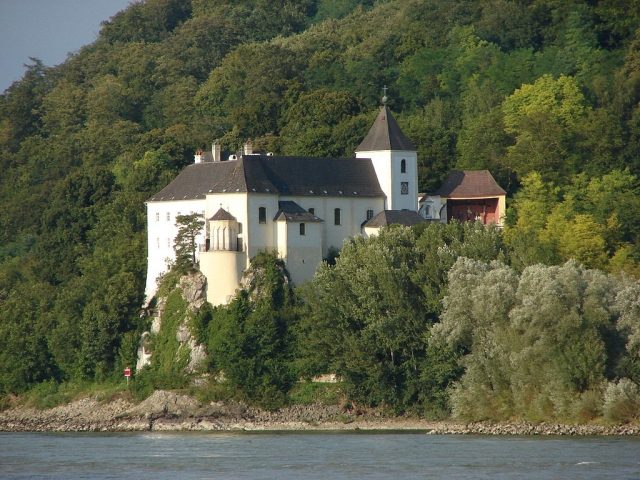
The former Servite Monastery of Schönbühel is located on a rock 500 m downstream from Schönbühel Castle (in Schönbühel) on the right bank of the Danube. It was built starting in 1666 and had to be abandoned in 1980 due to a shortage of priests.
In 1666, Count Conrad Balthasar von Starhemberg (1611/12-1687), owner of Schönbühel Castle and extensive properties in the Dunkelsteinerwald and Waldviertel, called the Servites to Schönbühel to build a monastery on the ruins of the rock popularly known as Teufelsgschloß (Devil's Castle). Conrad Balthasar is the father of Ernst Rüdiger von Starhemberg, who made a name for himself as the defender of Vienna during the Second Turkish Siege. This Teufelsgschloß was probably the remains of a medieval Danube watchtower. Legends also surround these walls. Regarding the origin of the monastery, Dr. Plöckinger's "Wachausagen" (Wachau Legends) states, for example:
"At the site of the small Schönbühel monastery on the Danube, there once stood a knight's castle on the rock rising from the Danube. But it was already completely dilapidated; spirits haunted it. The pious Count Starhemberg, the lord of Schönbühel Castle, had the small monastery built for the Servites to end the haunting."
In the very year of their calling, construction of a Holy Sepulchre Chapel began, and on Christmas Eve of 1667, the first mass was read. In 1669, a Calvary was added. In this year, a parish was also established in Schönbühel with the castle church as the parish church. This parish was also cared for by the Servites.
From 1670 to 1673 or 1675, a replica of the Grotto of Bethlehem was built. This construction goes back to Eleonora de Gonzaga, widow of Emperor Ferdinand III, who thereby fulfilled a request from Count Conrad Balthasar. She obtained plans of the original and chose the location near Schönbühel, as "this site is very similar to that in Bethlehem, and no more convenient opportunity could be found far and wide to establish this holy devotion." The foundation of the convent for 5 priests and 2 lay brothers became legally effective in 1672. Thereafter, the monastery was part of the small pilgrimage sites of the baroque Austria sacra. The replica of the Church of the Holy Sepulchre was immediately very popular and was visited by many pilgrims. Among them was Emperor Leopold I in 1675. Many processions from the surrounding towns to the pilgrimage church arose in the subsequent period. When the plague epidemic reached its peak in 1679, the reputation of the Schönbühel pilgrimage solidified, as the church is dedicated to Saint Rosalia, the patron saint of plague victims. A Scapular Confraternity was founded, and "Miracle Books" report several answered prayers in cases of illness.
The monastery experienced a golden age until the Josephine era. Since 1786, the monastery's pilgrimage church has also been the parish church, as the castle church and the castle itself increasingly fell into disrepair. The interventions in spiritual life, the restrictions on baroque pilgrimages and devotional practices, and the reduced number of priests led to a crisis for the monastery. The dissolution of the convent had already been decided but was then rejected again because the parish rights lay with the monastery church.
During the Coalition Wars in 1805 and 1809, the monastery was plundered by French troops. This, along with the loss of endowments, put the monastery in a difficult situation. Church and monastery buildings were neglected and began to decay. In the 19th century, the dissolution of the monastery was considered several times. Princess Elisabeth of Bavaria, later Empress Sisi, visited the monastery in 1844. This scene is also recreated in the first part of the Sissi films. The renovation of the buildings began in 1967 and stopped the impending decay. From 1904, the monastery could no longer be staffed due to a shortage of priests and was taken over by the Tyrolean province of this order. In 1980, the Servite monastery had to be abandoned due to a shortage of priests. In accordance with the foundation agreement, the monastery buildings were returned to the castle.
The church facilities continue to serve Catholic pastoral care and can be visited. The Schönbühel parish has been managed by Melk Abbey since its abandonment by the Servites. The monastery is connected to the village by a footpath. The monastery is an early Baroque building that has hardly been altered. With its simple forms, it blends perfectly into the Danube landscape. From the cemetery, located above the right Danube bank road, there is a beautiful view over the Danube and to Schönbühel Castle and Monastery.
Surroundings of the Monastery Complex+
Chapel on the Footpath to the Monastery
On the path from the village to the monastery, there is a solitary chapel with a spring. It used to be very popular with pilgrims. Inside the chapel was a copy of the miraculous image of Maria von Scharten and a statue of Saint Rosalia.
Calvary
The Calvary can be reached via a staircase directly at the monastery door. The figures show the stylistic change from early Baroque to late Baroque.
Via Sacra
At the instigation of Count Conrad Balthasar von Starhemberg, a via sacra was laid out from Schönbühel via Aggsbach-Dorf to Maria Langegg after the monastery's founding. It connected the two pilgrimage sites dedicated to the "Sorrowful Mother of God," which were cared for by the Servites. Along its path were 15 rosary chapels. 5 of them are still preserved. They are simple, squat buildings with a gabled roof that house a deep niche, which tapers into a round arch at the back. Near one of these chapels are the remains of a tower. This so-called "Blashaus" (blowing house) served to announce the nearby toll station in Aggsbach-Dorf to passing ships with a horn.
Tavern House
In 1887, the philosopher Franz Clemens Brentano (1838-1917), a nephew of the poet Clemens Maria Brentano, bought the tavern house next to the monastery. He converted it into his summer residence and settled there. The former Catholic priest, who had left the church, maintained good contacts with his neighbors in the Servite monastery.
Take Mobile History with you
You are reading this text for free. Premium adds what matters on the road: descriptions read aloud, sites found through your camera, whole regions taken offline.
- Every description, including the ~17,700 Premium sites
- Audio guide: have descriptions read to you on location
- AR finder: see sites through your camera, with distance and bearing
- Unlimited saved sites
14 days free, then from €2.99 a month. Cancel anytime.
Source: Wikipedia · Licence: CC BY-SA 4.0 · Image: https://commons.wikimedia.org/wiki/File:Kloster_Schoenbuehel_001.jpg
This description draws on the facts documented in the linked Wikipedia article; Wikipedia content is licensed under CC BY-SA 4.0. Wording and editing: Mobile History.
Location: 48.2628, 15.3771