Cultural Events
MonasteryGießen
Schiffenberg Abbey (Gießen)
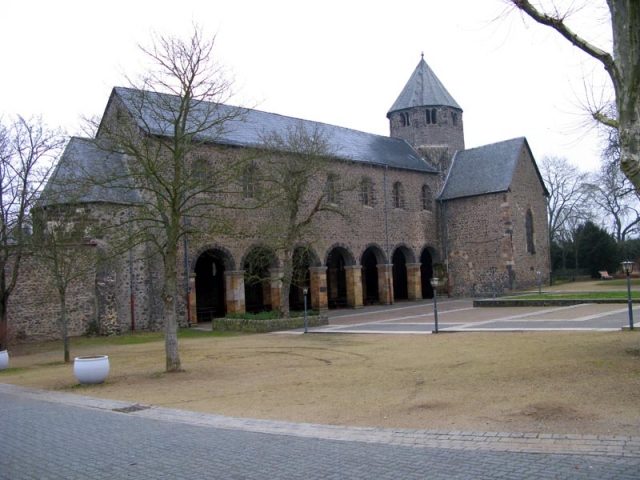
Schiffenberg Monastery is a former monastic complex on Gießen's local mountain, Schiffenberg (281 meters). It is located on the southeastern edge of the Gießen city forest near the Petersweiher district and the Pohlheim district of Hausen.
In summer, the basilica and courtyard are used for cultural events and church services.
On the north side of the large inner courtyard, which is planted with old trees, stands a pillar basilica with a transept, built from 1130 to 1150. A special feature is the octagonal crossing tower. The southern aisle was demolished after secularization, creating a kind of "arcade" through which the nave can be entered from the side along its entire length. The western apse, articulated with pilaster strips, and two accompanying round towers (almost completely destroyed) were added during the 12th century. The building almost entirely foregoes architectural ornamentation. Among the furnishings, an early Gothic baptismal font (13th century) made of basalt in the choir area is preserved.
In 1463, the provost's building was erected on the west side of the square, and from 1493 to 1500, the commandery on the south side. Another building, standing between these two structures and only erected in 1700, stands out due to its elaborately designed fountain.
An excavation north of the monastery complex reveals early settlement traces on the Schiffenberg, dated to the late Bronze Age around 1000 BC.
In 1129, the site was donated by Countess Clementia von Gleiberg, the widow of Konrad I of Luxembourg, to the Archdiocese of Trier, with the stipulation that a monastery be built there. In the same year, Archbishop Meginher von Vianden consecrated the unfinished complex. Shortly thereafter, Augustinian canons from the mother monastery of Springiersbach on the Moselle moved into the monastery. In 1239, a convent of canonesses on the southern slope of the Schiffenberg was first mentioned, which existed in community with the Augustinian canons, but was later abandoned. In 1264, the canonesses complained before a Gießen lay court that the canons were not fulfilling their duties towards them. The legal dispute dragged on for a long time, and the imposed division of the monastic estates led to new conflicts. Added to this were mismanagement and the political goals of Archbishop Balduin of Trier, due to which he dissolved the monastery in 1323 and entrusted it to the Teutonic Order.
Within the Teutonic Order, Schiffenberg Monastery belonged to the Bailiwick of Hesse. In 1333, it became the seat of a commander. From the following centuries, legal disputes over the administration of the monastery and its associated possessions are repeatedly documented. In 1543, Philip I of Hesse attempted to secularize the monastery as part of the Reformation, but was unsuccessful.
When Napoleon Bonaparte dissolved the Teutonic Order in 1809 and distributed its possessions, Schiffenberg became a Hessian domain. From 1837, the former monastery was leased to the Lyncker family. This marked its beginning as a popular excursion destination for the people of Gießen and students. In the 19th and 20th centuries, Schiffenberg was one of the most important dueling locations for Gießen students. In 1885/86, older farm buildings directly adjacent to the church were demolished and new ones built, which in turn were pulled down in 1972/73. In 1939, Schiffenberg became part of the Gießen municipal area as part of a territorial reform, and in 1972, it became municipal property.
This ended the lease agreement with the Lyncker family.
Take Mobile History with you
You are reading this text for free. Premium adds what matters on the road: descriptions read aloud, sites found through your camera, whole regions taken offline.
- Every description, including the ~17,700 Premium sites
- Audio guide: have descriptions read to you on location
- AR finder: see sites through your camera, with distance and bearing
- Unlimited saved sites
14 days free, then from €2.99 a month. Cancel anytime.
Source: Wikipedia · Licence: CC BY-SA 4.0
This description draws on the facts documented in the linked Wikipedia article; Wikipedia content is licensed under CC BY-SA 4.0. Wording and editing: Mobile History.
Location: 50.5553, 8.7218