Monastery operation
MonasteryRebdorf
Rebdorf Abbey
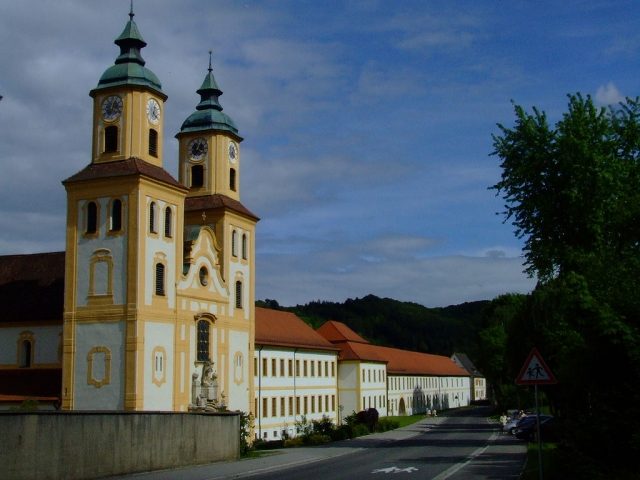
Rebdorf Abbey is a monastery in Eichstätt, Bavaria, in the Diocese of Eichstätt. Rebdorf first appears in a document in 1055. In 1063, a church was consecrated in the village. In 1153, Emperor Frederick Barbarossa handed over the imperial village to Bishop Konrad I von Morsbach of Eichstätt. Around 1156, he founded the monastery dedicated to St. John the Baptist as an Augustinian Canons Regular foundation. It experienced good spiritual and economic development. By 1239, the foundation owned properties in 47 prince-bishopric locations. In 1309, the last Count of Hirschberg, Gebhard VII, was buried in the monastery church.
Having become in need of reform, the foundation, after much resistance, joined the Windesheim Congregation in 1458 and achieved a significant position in humanism with Priors Hieronymus Rotenpeck and Kilian Leib. The canons also looked after the neighboring Augustinian Canonesses' convent of Marienstein, founded in 1460.
During the Thirty Years' War, the monastery complex suffered severe damage. Reconstruction took place in the 18th century. In 1732, the Romanesque monastery church of St. John the Baptist was rebuilt in Baroque style, and the Eichstätt princely building director Gabriel de Gabrieli erected new convent buildings, which form a 183-meter-long castle-like facade facing the Altmühl. Since then, the old refectory with good Baroque stucco has adjoined the medieval cloister. In the former prelature, with its representative Rococo facade (around 1730), there is a festive hall from 1731 adorned with stucco and frescoes. Behind the monastery church, the so-called Gabrielihof was created with beautiful arcades.
The monastery was dissolved in 1806 during the secularization. At that time, its possessions included, among other things, 191 Tagwerk (approx. 69 hectares) of meadows, 533 Tagwerk (approx. 192 hectares) of fields, and 2,040 Tagwerk (approx. 735 hectares) of forest. The monastery church was desecrated (later reversed), and its furnishings were moved to other locations; altars, for example, were sold to Hausen and Rögling. Ownership changed several times after the secularization. In 1824, Duke of Leuchtenberg Auguste de Beauharnais acquired the buildings. In 1855, the Bavarian State took over the monastery buildings and established a workhouse there. Between the former monastery and the foot of the eastern Altmühl slope, where the branch line between Eichstätt-Bahnhof and Eichstätt-Stadt has operated since 1885 (converted to standard gauge in 1932), a historic flood bridge runs across the meadows.
Known members of the foundation were:
- Provost Silvester von Passau (reg. 1448-54), who wrote "Meditationes de Passione Christi" (Meditations on the Passion of Christ),
- Kilian Leib (* 1471; † 1553), prior from 1503, who was in contact with the most important scholars of humanism and wrote several treatises and a diary (1513-31) - an important meteorological document due to its exact weather observations,
- Maximilian Münch (* 1743; † 1791), author of historical writings,
- Michael Stein (* 1747; † 1779), author of historical writings, member of the Bavarian Academy of Sciences,
- Provost Erhard Räm (reg. 1711-32), who commissioned the Baroque redesign,
- Hieronymus Rotenpeck († 1773), praised by contemporaries as a second Cicero, who, among other things, wrote a Latin metric,
- Andreas Strauß (* 1751; † 1805), monastery librarian and author of several works that gained importance for local historians and geographers.
From 1946 to 1949, the Lithuanian Gymnasium for refugee Lithuanians was housed in the former monastery, which served as a refugee camp for Balts in general. In 1951/52, the buildings were converted to accommodate the III. Department of the Bavarian Riot Police. In 1958, the Congregation of the Missionaries of the Sacred Heart bought the complex, restored it, and in 1959 established a boys' secondary school with a boarding school; the latter was closed in 2007. The monastery built an observatory above a soon-to-be-built gymnasium. In 1990, the Diocese of Eichstätt took over the sponsorship of the school and bought the complex from the order in 2003. The church is the parish church of the Parish of St. John (Rebdorf). In 2003, the parish comprised 787 Catholics in Rebdorf itself, and a total of 1801 Catholics with Marienstein, Wasserzell, Blumenberg, and the Marienstein children's village.
Former Monastery Library+
Rebdorf is world-famous for its former monastery library. It was considered one of the most important spiritual libraries in Germany. In the reform efforts of the 15th century, which aimed at a renewal of spiritual and intellectual life, Rebdorf was part of a network of monasteries that copied important works of mystical-ascetic literature and then lent them out for copying themselves. Manuscript relationships refer, among others, to the reform monasteries of Pillenreuth and Tegernsee, for example in the transmission of important Tauler texts. Under Prior Kilian Leib, the library holdings were then expanded in the 16th century, especially with regard to humanist interests. The library continued to be expanded in the subsequent period and provided the basis for numerous scholarly studies. Around 1800, it comprised 30,000 volumes and almost 800 manuscripts, numerous incunabula, and a Gutenberg Bible. The end of the library came with the secularization in 1806; before that, the library had already been plundered by the French army in the summer of 1800. The holdings, as far as they were saved, are now scattered across Europe and the USA.
Former Monastery Church "St. John the Baptist"+
Construction
Construction of the church began in the second half of the 12th century.
The lower parts of the towers date from the first half of the 13th century; their upper sections were altered in the 15th century and redesigned in Baroque style in the 18th century. The Baroque transformation of the church was carried out by Matthias Seybold in 1732-34.
Secularized in 1806, the church fell into disrepair until it was used as an institutional church in 1855. It remained in this capacity until 1958, when the Missionaries of the Sacred Heart made it their monastery church and simultaneously used it as a church for the curacy of Eichstätt-Rebdorf. From 1961-63, it was restored by the Bavarian State Office for Monument Preservation. From 2007-2009, the roofs and the roof truss were renovated.
Current Appearance
The interior contains stucco of high quality. The frescoes were painted by Joseph Dietrich in 1734. Above the high altar hangs a crucifixion group by Andreas Frosch from 1519, on loan from Donauwörth. A late Gothic Madonna stands at the left side altar. In the church and its vestibule are tombstones from the 15th century onwards.
Organ+
The organ was built in 1979 by the organ building company Sandtner. It has two manuals and a pedalboard.
Take Mobile History with you
You are reading this text for free. Premium adds what matters on the road: descriptions read aloud, sites found through your camera, whole regions taken offline.
- Every description, including the ~17,700 Premium sites
- Audio guide: have descriptions read to you on location
- AR finder: see sites through your camera, with distance and bearing
- Unlimited saved sites
14 days free, then from €2.99 a month. Cancel anytime.
Source: Wikipedia · Licence: CC BY-SA 4.0
This description draws on the facts documented in the linked Wikipedia article; Wikipedia content is licensed under CC BY-SA 4.0. Wording and editing: Mobile History.
Location: 48.8881, 11.1676