Museum
MonasterySchwäbisch Gemünd
Prediger Abbey
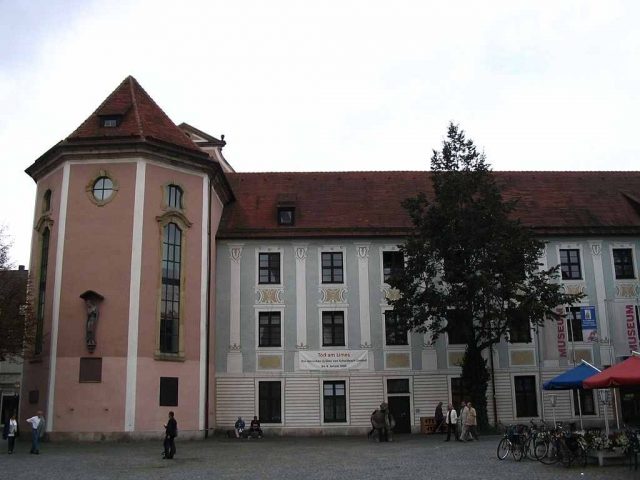
The former Dominican monastery (monastery of the Preaching Friars) of Schwäbisch Gmünd, now used as a cultural center, is known as the Prediger. It is centrally located in the city center opposite the Romanesque Johanniskirche.
In 1294, the Gmünd convent was admitted to the order. The establishment probably took place in the same year from Esslingen. An orally transmitted legend states that the monastery was founded in a hunting lodge, which was donated by a noble lady as an act of repentance, thereby transforming a place of sin into a dwelling of God. Therefore, the church was consecrated to Mary Magdalene, the penitent and patron saint. Historians assume that the foundation took place in a manor house of the Rechberg family, as successors to the Staufer in the Gmünd area, or in a manor house of the city community as successors to the Staufer city lords.
In the middle of the 14th century, a new Gothic church was built, which was completed around 1356, as the first masses were read in the church at that time. Several members of the Lords of Rechberg are buried in the monastery church.
In the middle of the 18th century, the monastery was rebuilt. Dominikus Zimmermann took over the planning and initially also the construction. The foundation stone was laid on July 2, 1724. The Baroque transformation of the monastery church was begun in 1762 under master builder Johann Michael Keller the Younger and completed in 1764. At that time, it was the second largest church building in the imperial city after the Gmünd Minster.
In 1802, with the transition of the imperial city to Württemberg, the monastery was dissolved. On December 29, the monks had to leave the monastery and move to the Gmünd Franciscans, where members of the former monastic communities were temporarily allowed to live. Probably as a gesture of humiliation, the new lord converted the monastery into a barracks; the magnificent monastery church initially became a wood store, later a stable. Various demolition works also took place, including the bell tower, which was deemed "superfluous" for the barracks. The bells were sold to benefit the war chest. In the following years, the interior of the church was destroyed for further conversion.
The Baroque ceiling painting by Johann Anwander in the monastery church (1763/64) was also completely destroyed during the 19th century. A design drawing is located in the Staatliche Graphische Sammlung München.
In 1919, the "Alte Kaserne" (Old Barracks) was taken over by the city. At that time, 30 emergency dwellings were installed. In 1938, NS offices and cultural rooms were established. Immediately after the war, these offices were again converted into 200 emergency dwellings. From 1947 to 1965, there was a struggle over the use of the building. In 1960, there was a thought of demolishing the Prediger in favor of a department store. However, a citizens' initiative succeeded in ensuring that the conversion was decided in 1965. On March 23, 1973, the Prediger was inaugurated as a cultural center, although significant interventions were made into the remaining medieval and Baroque building fabric during the renovation.
From 2010 to 2012, the Prediger cultural center will undergo extensive interior and exterior renovation and reconstruction for approximately nine million euros. The original appearance of the monastery complex is also to be restored as far as possible.
Current Use+
Since 1973, the Municipal Museum has been housed in the Prediger, displaying a significant part of the Minster treasure of the Heilig-Kreuz-Münster, and since 1994, the Galerie im Prediger, which presents temporary exhibitions.
In addition to the covered inner courtyard, a large and small hall in the area of the former monastery church, as well as the Baroque refectory room with 18th-century stucco, are available for events.
Both the Gmünd Adult Education Center (until 2006) and the City Library (now in the Gmünd Hospital) were housed in the Prediger from 1973.
Take Mobile History with you
You are reading this text for free. Premium adds what matters on the road: descriptions read aloud, sites found through your camera, whole regions taken offline.
- Every description, including the ~17,700 Premium sites
- Audio guide: have descriptions read to you on location
- AR finder: see sites through your camera, with distance and bearing
- Unlimited saved sites
14 days free, then from €2.99 a month. Cancel anytime.
Source: Wikipedia · Licence: CC BY-SA 4.0
This description draws on the facts documented in the linked Wikipedia article; Wikipedia content is licensed under CC BY-SA 4.0. Wording and editing: Mobile History.
Location: 48.7997, 9.7958