The Abbey can be visited
MonasteryGeorgsmarienhütte - Kloster Oesede
Oesede Abbey
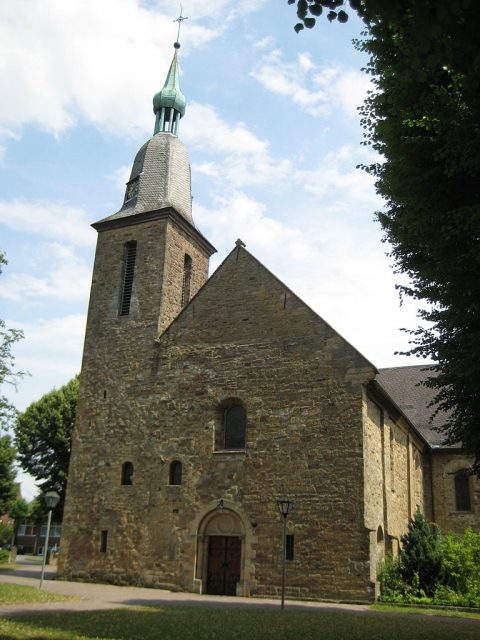
Kloster Oesede is a former Benedictine nunnery in Georgsmarienhütte in the district of Osnabrück (Lower Saxony). The monastery gave its name to a district of Georgsmarienhütte; the former farming community of Kloster Oesede was called "Sutorpe" before the monastery was founded. The former monastery church, now the Catholic parish church of St. Johann, which is a listed building, is the most important monument in the city of Georgsmarienhütte. A structural peculiarity of the monastery church is the medieval hagioscope, a so-called leper's squint. The monastery was the first women's monastery in the district of Osnabrück. It existed for 633 years until 1803.
Benedictine Nunnery+
The monastery was founded in the second half of the 12th century by Count Ludolf von Oesede and his wife Thedela. The Count made his ancestral castle available for this purpose. The monastery was consecrated to the Virgin Mary, the Holy Cross, and John the Baptist. The daughters of the Count who could not be married were to find a safe home in the monastery. Goda, the eldest daughter, had already been a nun in the Benedictine monastery of Willebadessen in the diocese of Paderborn. She returned to her homeland and became the first prioress, her sister Regenwita the sacristan.
On January 15, 1170, the first nuns began their work. In addition to nuns, lay sisters lived in Kloster Oesede. They came from farming, artisan, and bourgeois families in the region. Their task consisted of work in the house, in the kitchen, and in the fields, as well as in the bakehouse. They also brewed beer, a nutritious strong beer.
The nuns of Kloster Oesede were dependent on their own possessions or on the support of their families, as they received accommodation and food from the order, but no clothing. They earned money with handicrafts, the proceeds of which remained their property. Not a few had considerable wealth, so that in 1569 they were able to jointly buy the house Brinke near Georgsmarienhütte to further increase the now substantial monastic property. From the 16th to the 18th century, the monastery operated coal mining in the Borgloh area.
The Oesede Benedictine nuns also dedicated themselves to welfare. They provided food to needy inhabitants of the parish. The poor reached the entrance to the monastery kitchen via the so-called Hunger Stairs.
The farmers of the parish were subject to manual and draft services. These were fixed labor services, wagon deployments, and work with horses. They had to be provided without compensation when demanded.
Kloster Oesede was dissolved in 1803, after the monasteries in the territories that had fallen to France had been secularized in accordance with the Reichsdeputationshauptschluss (Principal Resolution of the Imperial Deputation). A state commission declared the monastery closed on February 14, 1803. The nuns had to vacate the monastery by April 1, 1803; they were promised an annual pension payment. On April 12, 1803, the monastery inventory was sold, the church silver and liturgical equipment remained in the monastery church. It became the parish church of the farming community. The monastery building and the lands and properties belonging to the order passed to the Klosterkammer, i.e., into state ownership. In the 19th century, the farming community of Kloster Oesede bought the church and the monastery from the Klosterkammer.
Monastery Church+
In the former monastery church, built in the 12th century, the tombstone of the founder Count Ludolf († 1184) and his wife Thedela can be found on a wall in the right transept. The founding couple jointly holds a model of the monastery in their hands. The Count holds a shield in his left hand with the coat of arms of the Oesede Counts, which shows a striding lion.
The miraculous image "Maria im Kindbett" (Mary in Childbed), which originated in the first half of the 15th century, goes back to the first Oesede provost Theoderich (* 1170). He was followed by Provost Bernhard, who donated the Marian altar. This was consecrated by Bishop Gerhard on May 24, 1203. A wall painting is preserved on a crossing pillar. The red-ground fresco from the middle of the 15th century shows Saint Benedict with the open book of the monastic rule.
In the north of the eastern nave, a hagioscope was uncovered around 1980. Through the wall opening, lepers and others excluded from participating in the mass could see the altar. The Catholic castle church in neighboring Bad Iburg also has a hagioscope - albeit bricked up. Of the originally two church towers of the monastery church, one still exists. It bears a baroque spire.
Monastery Building+
Of the medieval monastery building, which was demolished between 1790 and 1803, only the northern part, the Alte Abtei (Old Abbey), remains today. A two-story new building was erected around 1723 by the architect Alexander Ludwig von Corvey (1670–1728). Also preserved is the monastery gate, also called the gatehouse. It dates from 1704. The former monastery complex now houses parish apartments, the parish office, meeting rooms of the church community, a branch of the Order of the Sisters of Saint Anne of Bangalore, and the Graf-Ludolf-Schule.
Transport+
Near the former monastery is the Kloster Oesede train stop, where trains of the RB75 line of the NordWestBahn run between Osnabrück and Bielefeld. The station is one of three stops in Germany named after a monastery (also: Kloster Marienthal near Altenkirchen/Westerwald and Stift Keppel-Allenbach in Siegerland.)
Take Mobile History with you
You are reading this text for free. Premium adds what matters on the road: descriptions read aloud, sites found through your camera, whole regions taken offline.
- Every description, including the ~17,700 Premium sites
- Audio guide: have descriptions read to you on location
- AR finder: see sites through your camera, with distance and bearing
- Unlimited saved sites
14 days free, then from €2.99 a month. Cancel anytime.
Location: 52.2008, 8.1136