Church
Cultural center
MonasteryObermedlingen
Obermedlingen Abbey
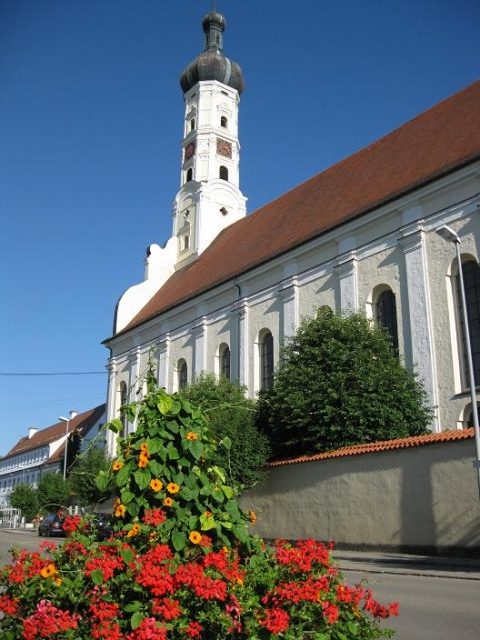
Obermedlingen Monastery is a former monastery in Medlingen, Bavaria, in the Diocese of Augsburg. In 1251, the ministerialis Walter II von Faimingen provided property for a small monastery, into which 15 nuns moved in 1260. The monastery was finally assigned to the German province of the Dominican Order in 1263. The parish of Obermedlingen was incorporated into Obermedlingen Monastery in 1266, and the parish of Untermedlingen in 1337.
In 1462, Obermedlingen and the monastery were severely affected during the Bavarian War in the Battle of Giengen (Giengen an der Brenz).
Following Martin Luther's posting of the theses in 1517, a crisis arose in Obermedlingen Monastery. In 1544, Duke Ottheinrich of Pfalz-Neuburg appointed a Protestant preacher, to whom the 20 Catholic Dominican nuns in the monastery were also subordinate. In the following year, the monastery church burned down during the Schmalkaldic War, probably due to arson. In 1546, the Dominican nuns were held captive for several months in Lauingen Castle on Ottheinrich's orders.
The Untermedlingen branch was subsequently Protestant from 1552 to 1614. In 1555, Obermedlingen Monastery was finally dissolved after the Peace of Augsburg, and its assets were confiscated.
The monastic establishment of Obermedlingen, previously belonging to the Dominican nuns, was transferred to the Dominicans in 1651 and converted into a male convent. In 1663, despite protests from the city of Gundelfingen, the friars established a brewery and built a small church between 1666 and 1672. In 1678, the monastery was elevated to a priory.
In 1804, the convent was dissolved, and two electoral commissioners confiscated the monastery's assets; some of the monastery buildings were demolished. In the following year, Obermedlingen served as the main camp for the French before their battle at Elchingen.
In 1923, the "Oblates of the Immaculate Virgin Mary" moved into the remaining monastery buildings and opened a six-grade Progymnasium in 1925. 100 to 150 students from Swabia, Upper Franconia, and Saarland soon attended the school and boarding house. The mission school was closed in 1940, after which resettlers from Bukovina were accommodated, and a reserve hospital was established.
After the Second World War, the monastery became a district refugee camp (1946–1951). Afterwards, the mission school moved back into the monastery and remained there until 1970.
Obermedlingen Monastery was renovated in 1985 and 1987, after which the "Tepl Premonstratensian Abbey" moved in. In 1996, the last Premonstratensian left the monastery, and since then, the Marian Fathers religious community has been represented in the Obermedlingen monastery.
A local electronics company acquired the buildings of the mission school, and the former refectory of the monastery is used by local associations and the community.
Collegiate Church of the Assumption of Mary+
In 1700, the foundation stone for the new monastery and the current collegiate church was laid. The church was consecrated in 1721 by the then Auxiliary Bishop of Augsburg, Johann Jakob Mayer, although the interior decoration was not yet completed.
The construction management was entrusted to Valerian Brenner, who was succeeded after his death by his foreman Jakob Albrecht; both were Baroque master builders from Vorarlberg.
The interior decoration is in elegant early Baroque white, to which the altars, confessionals, pews, choir stalls, organ, and pulpit made of dark brown wood provide a pleasant contrast. The inlay work is particularly noteworthy.
The large paintings and frescoes on the ceiling were created by Konrad Huber in 1784, of which, however, only the ceiling painting in the choir remains today, as part of the nave vault collapsed in 1861. The current ceiling paintings in the nave were created in 1894/96. The ceiling stucco was also lost in 1861, but the remaining, extremely rich stucco work in the choir and sacristy testifies to great skill and is of high quality, suggesting the work of Dominikus Zimmermann.
The exterior is particularly impressive due to the widely visible, 73 m high church tower with a double onion dome. The church tower is also listed among the tallest church towers and sacred buildings in the world. The design of the church's west facade is also impressive.
The church last underwent a thorough exterior renovation for its 300th anniversary in 2000.
Take Mobile History with you
You are reading this text for free. Premium adds what matters on the road: descriptions read aloud, sites found through your camera, whole regions taken offline.
- Every description, including the ~17,700 Premium sites
- Audio guide: have descriptions read to you on location
- AR finder: see sites through your camera, with distance and bearing
- Unlimited saved sites
14 days free, then from €2.99 a month. Cancel anytime.
Source: Wikipedia · Licence: CC BY-SA 4.0
This description draws on the facts documented in the linked Wikipedia article; Wikipedia content is licensed under CC BY-SA 4.0. Wording and editing: Mobile History.
Location: 48.5683, 10.3202