Monastery operation
MonasteryMönchengladbach
Neuwerk Abbey (Mönchengladbach)
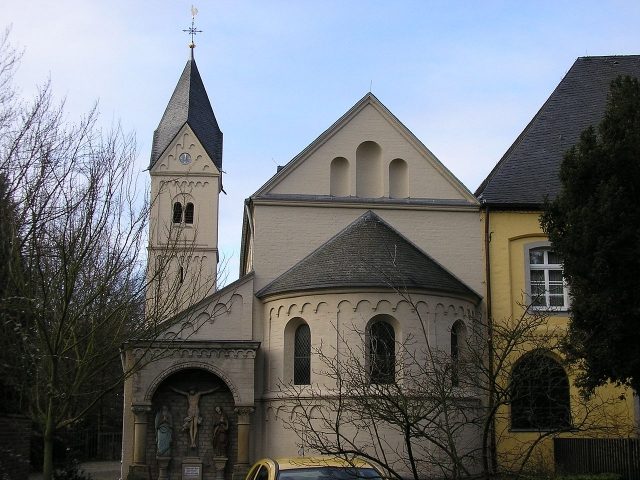
The Neuwerk Monastery is located in the center of the Neuwerk district of Mönchengladbach. The monastery church is one of the most important architectural monuments and is the second oldest building in the city of Mönchengladbach. Today it serves as the order church for the Salvatorian Sisters.
Foundation+
A precise founding date is not known, but it can certainly be assumed to be in the year 1135. In a document dated December 5, 1135, the monastery is first mentioned as "novo oratorio", as a new chapel of the Blessed Virgin Mary, when the Gladbach Benedictine monastery ceded part of its income for the support of the sisters.
The settlement itself was built on an abbatial estate called "Cranendonk" in the Niers lowlands. It consisted of a small, flat-roofed chapel, the remains of which are still preserved and visible today, probably with some small outbuildings.
Only in the years 1170 - 1182 did the chapel become a church and the farmstead the actual monastery with approx. 20 nuns and an abbess. These belonged to the Benedictine order.
The Name Neuwerk+
The court chapel on the Kranendonk did not immediately bear the name "novum opus" (= Neuwerk) after its construction.
The oldest document from 1135 calls it "novum oratorium" (= new chapel). It is still mentioned under this name in 1168. However, this is only the designation for the house of worship. The actual place name in the same document is "Cranendonk".
Only when the large church and the actual monastery were built did the designation "novum opus" (= Neuwerk or new work) appear for the first time. This is how it reads in a document from the year 1182.
The different names and spellings over time:
The Monastery and its Inhabitants+
Since the 16th century, the name was: "Geistadeliges Gotteshaus Neuwerk" (Spiritual Noble House of God Neuwerk).
From this designation, it can be inferred that only ladies of noble descent could enter the Neuwerk convent. To enter the monastery, one had to be at least 10 years old. Upon entry, the women and girls brought large assets as a dowry. After a certain training and preparation, the daughters of noble families were admitted to the probationary year. If they proved themselves during this time, the solemn clothing followed, to which all noble relatives were invited. After the subsequent novitiate year, which had to be passed as the final test, the young ladies often took their monastic vows at the age of 16-18.
The five stages for admission to the convent at a glance:
- Training/Preparation
- Probationary year (if proven)
- Solemn clothing
- Novitiate year (final test)
- Monastic vows
From the first years after the monastery's foundation until approx. 1250, recluses also lived in the Neuwerk monastery. This was the name given to those women who turned away from the world to serve God only through prayer and fasting while studying holy scriptures. In many cases, they had themselves locked in or even walled up in a church.
Two clerics were active in the monastery, the prior and the chaplain. Both clerics were appointed by the abbot of Gladbach from 1342 onwards. But even before that, it was Gladbach monks who determined who became prior or chaplain in the Neuwerk monastery.
In 1712, the prior earned 20 Reichstaler and the chaplain 10 Reichstaler.
The two clerics lived outside the monastery. The gatehouse of the monastery, a two-story half-timbered house, renewed in 1771 and already documented in 1750, served as the residence of the clerics in the 18th century. Since the efforts to preserve and restore the house, which now houses a local history museum, in the 1950s, it has therefore also been known as the Prior's House.
Some examples of the payment at that time:
- The 2nd gardener received 16 Reichstaler, 2 pairs of shoes, 2 shirts and 1 smock,
- the monastery chamberlain received 12 Reichstaler, 2 pairs of shoes, 12 cubits of shirt fabric and 2 cubits of narrow fabric,
- the head cook received 7 Reichstaler, 3 pairs of shoes, 12 cubits of broadcloth, 6 cubits of narrow fabric and 3 "aprons".
As early as 1334, the monastery accommodated noble, wealthy ladies in special guest rooms. In 1711, the board fee was 30 Reichstaler.
Monastic Life+
Little is known about monastic life, but it most likely followed the Christian motto "pray and work." In contrast to medieval men's monasteries, women's monasteries did not focus on science and research, but rather on charity and the practice of Christian neighborly love. This manifested itself in hospitality for travelers, and those in need at the monastery gate never asked in vain. In addition, the Neuwerk nuns always distributed homemade cookies and cakes to the crowds on St. Barbara's Day, Christmas, before Christmas, Easter, and New Year.
The physical well-being of the monastery residents was ensured by an excellent kitchen that satisfied even the most pampered taste. It served fresh and pickled meat from oxen, cows, calves, sheep, lambs, and pigs. Geese, chickens, ducks, and pigeons provided variety on the menu. On holidays, there was game, especially hares. On fast days, salted fish or fresh fish sufficed. The kitchen also processed large quantities of butter, milk, Dutch cheese, salt, herbs, spices, currants, and raisins. The daily bread was baked from rye.
There was also beer from the monastery brewery and wine from the Moselle estates of the Abbot of Gladbach, later from the estates of the Abbot of Brauweiler.
During meals, religious texts were read aloud, and according to an ancient custom, each nun served her fellow sisters weekly.
When one of the nuns died, the monastery usually donated rye to the poor. The nuns were buried in the monastery cemetery, which was located east of the church choir. Only the abbesses found their final resting place in the monastery church.
Within the monastery walls, so-called immunity and the right of asylum applied, meaning that the monastery and the people staying in the monastery were inviolable for public authorities (police, etc.).
Building History+
Before 1135, a small court chapel (= novum oratorium) was built on the estate in Kranendonk. In this 1st Romanesque building period, the court chapel was a three-aisled basilica of simple masonry with a flat ceiling.
Between 1168 and 1183 - in the 2nd Romanesque building period - the chapel became a proper church. It received an extension, which made it more than twice as large. After this expansion, the term "novum opus" was used for the church for the first time.
At the same time, the actual monastery with now approx. 20 nuns and an abbess developed from the farmstead. These belonged to the Benedictine order.
In the last quarter of the 12th century (3rd Romanesque building period), the church was enlarged again. It thus became a uniform three-aisled basilica and received two towers on the west side. The northern tower was dismantled in the 16th century due to dilapidation; today, the monastery buildings directly adjoin the church there.
The basic structure has not been significantly changed since then. However, there have been various changes, refinements, and restorations in the spirit of the respective times, so that the current form of the church is significantly more magnificent.
After the monastery church suffered great damage in the Thirty Years' War, which lasted from 1618-1648, a baroque tower dome was placed on the formerly Romanesque tower in 1771, which was only replaced by a Romanesque roof again during the restoration work from 1886 onwards.
In 1804, the entire monastery complex consisted of the following areas:
- In the center of the complex, the monastery church with directly adjoining monastery building.
- The square monastery building has a large open inner courtyard with a garden.
- Next to and behind the church and monastery building is the inner orchard, which is surrounded by a wall.
- Outside the wall are the outer garden and the outer orchard.
- In front of the church and monastery building are the courtyard and monastery square.
- The courtyard and square are bordered towards the street by stables, the barn, and in the middle, the monastery gate.
- Slightly set back - next to the stables - is the gatehouse, which separates the church path from the public road, directly on the passing path.
- The monastery grounds are (almost completely) surrounded by a moat, which can be crossed by a bridge at the gate. Only the gatehouse or prior's house is also directly accessible from the path.
Decline and Dissolution+
Around 1650, unrest arose, and monastic discipline, love, unity, and order increasingly declined. Even commandments and prohibitions issued by the president of the Bursfeld Congregation to restore monastic morality had little influence on the disputes within the monastery. Only after the death of the rebellious nuns and under a new abbess, who had behaved with extraordinary strength of character during the disagreements, did a tolerable peace return. But until the dissolution of the monastery, which was to follow about 50 years later, its good reputation was gone, and only a few sisters entered the monastery, so that the entire convent consisted of only 11-12 nuns. Although for the first time in the history of the monastery, non-noble ladies were also allowed to enter the convent, the small number of nuns remained.
After the French defeated the Austrians under Napoleon at Aldenhoven in 1794, they took possession of the entire left bank of the Rhine.
When they entered Mönchengladbach in October, they were initially welcomed as liberators. But soon, oppressive burdens and high war taxes had to be endured. As early as 1794, Neuwerk Monastery had to deliver 50 pairs of shoes, 12 sacks of wheat, 21 malter of oats, and 112 Reichstaler for requisition (= confiscation) in Maastricht.
On January 22, 1801, a French government commissioner appeared at Neuwerk Monastery and ordered Abbess Rosa von Bronsfeld to gather the convent members. When all were present, he counted them and recorded the personal details of the only 10 remaining sisters. This interest of the French did not bode well. About 10 months later, on November 9, 1801, the Peace of Luneville established the Rhine as France's eastern border. This sealed the end of the German monasteries on the left bank of the Rhine.
On August 12, 1802, the official dissolution of the monastery took place. When the nuns left the monastery a short time later in the autumn, the French government still assured them an annual remuneration of 500-600 francs.
The French dissolution decrees put an end to a development that had begun 100 years earlier with the internal decay of the monastery and would probably have led to its decline anyway.
After the monastery was dissolved in 1802, however, it still had a very eventful time ahead of it. While it was still in French possession in 1804, it was offered for sale by the then administration. Although there were several interested parties, the sale did not take place until 1812, i.e., 10 years after the dissolution. In February 1812, the wealthy Rheydt textile entrepreneur and then mayor Dietrich Lenssen acquired the Neuwerk monastery buildings. However, he sold them again seven months later, in September 1812, as they were completely unsuitable for a textile business. The largest part of the former monastery was acquired by the Dapper couple, who were millers at the Broichmühle. They turned it into a flour and fruit trade. The buyer of the remaining part was the parish priest of Neuwerk. In 1821, the General Vicariate of Aachen additionally authorized the Neuwerk church and school board to accommodate the rectory, vicarage, and school in the west wing of the monastery buildings.
After the school moved out in 1870, the west wing served as the rectory and sacristan's residence until 1964.
At the beginning of the 19th century, the north wing of the former monastery had to be demolished due to dilapidation.
In 1874, another important part of the monastery's history began. At this time, Therese von Wüllenweber rented the vacant east wing, for which the Dapper heirs were looking for a new tenant. From then on, Therese von Wüllenweber played a major role in the former monastery.
Therese von Wüllenweber+
She was born on February 19, 1833, at Myllendonk Castle and received a strict upbringing in the following years. At the age of 20, she was enthusiastic about the missionary idea and searched in vain for a female missionary order.
Although she joined various orders in both 1857 and 1868, she returned to Myllendonk in 1871 to contact the parish priest of Neuwerk, Dr. von Essen, because he was engaged in founding a missionary order. Due to the Kulturkampf, the missionary institute planned by Dr. von Essen did not materialize.
Therefore, in 1876, Therese von Wüllenweber took matters into her own hands and rented - as described above - the vacant east wing of the former monastery building. Three years later, in 1879, she even bought it. Since the appearance of a monastery was not allowed, von Essen insisted that the house be called "Stift" (foundation). Therese von Wüllenweber called it "St.-Barbara-Stift". But the title "Stiftsdamen" (canonesses) did not attract women for a missionary vocation. Therefore, she took in neglected children for education.
In 1882, she then came into contact with the "Apostolic Teaching Society", which had been founded in December 1881 by the priest Johann Baptist Jordan in Rome. A few years later, Jordan called Therese von Wüllenweber to Rome to found a female order, the Salvatorian Sisters. On May 31, 1883, she took her perpetual vows in Neuwerk and received the religious name "Sister Maria of the Apostles".
Even today, the hospital in Neuwerk bears the name "Maria von den Aposteln".
Theresia von Wüllenweber died on Christmas Eve 1907 and was beatified in Rome in 1968.
Modern Times+
When Therese von Wüllenweber left Neuwerk and went to Rome, the then parish priest Hermann Koch bought the part of the monastery buildings that had belonged to her in January 1889. He intended to transform the monastery rooms into a hospital. Therefore, he endeavored to find an order that wanted to take over nursing and other social tasks in the community.
The sisters of the Congregation of the Lüdinghausen Franciscans seemed most suitable to him for the problems to be solved in Neuwerk. The Mother General agreed, and in November 1889, the first three sisters, including the superior, moved into Neuwerk. The newly founded monastery and hospital were named "St. Josef and St. Barbara".
In 1906/07, the hospital had to be enlarged by an extension because it had become too small. After the First World War, in which parts of the house had served as a military hospital, major new constructions and conversions became necessary. In addition, repair work was carried out on the entire monastery complex.
In recent years, many orders have experienced a shortage of sisters. This was also the case with the Franciscans. For this reason, in 1960 - after over 70 years, which included two world wars - they had to give up the monastery in Neuwerk, including the hospital, to concentrate their strength on a few larger establishments.
As the Franciscans were about to leave Neuwerk at the end of 1960, the Mother General of the Salvatorian Sisters announced her visit. After the necessary negotiations, they (the Salvatorian Sisters) acquired the entire monastery complex with the hospital on January 1, 1961.
About 30 sisters of the order replaced the Franciscans (as of 1988: 55 sisters).
The Salvatorian Sisters soon decided to build a new modern hospital. After the construction work had progressed rapidly, the modern Neuwerk Hospital was opened on May 15, 1968.
It was named after the founder of the Salvatorian Sisters: "Maria of the Apostles".
The old hospital buildings, which were no longer usable, were demolished, and the north wing, which had been demolished years ago, was rebuilt, so that after the restoration of the original condition, the monastery and monastery church could be returned to their actual purpose.
Take Mobile History with you
You are reading this text for free. Premium adds what matters on the road: descriptions read aloud, sites found through your camera, whole regions taken offline.
- Every description, including the ~17,700 Premium sites
- Audio guide: have descriptions read to you on location
- AR finder: see sites through your camera, with distance and bearing
- Unlimited saved sites
14 days free, then from €2.99 a month. Cancel anytime.
Source: Wikipedia · Licence: CC BY-SA 4.0
This description draws on the facts documented in the linked Wikipedia article; Wikipedia content is licensed under CC BY-SA 4.0. Wording and editing: Mobile History.
Location: 51.2239, 6.4713