Educational Institution
MonasteryRinteln - Möllenbeck
Möllenbeck Abbey
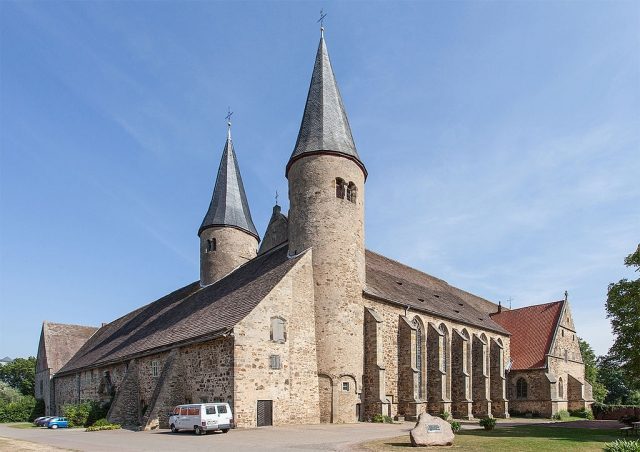
The former Möllenbeck Monastery in Möllenbeck, located in the Weser floodplains near Rinteln in Lower Saxony, is one of the most significant architectural monuments in the Weserbergland region of Lower Saxony. It was built between 1478 and 1505 in the late Gothic style on the site of a previously burned-down predecessor building and is considered one of the best-preserved late medieval monastic complexes in Germany. From the Ottonian period, only the round towers and the crypt remain. The cultural-historical significance is described by the Lower Saxony State Office for Monument Preservation as follows: "In their overall layout, the cloister buildings are among the most extensive and best-preserved monastic complexes of the late Middle Ages in Germany."
The monastery was founded in 896 by the noblewoman Hildburg as a canonesses' foundation and endowed with seven proprietary churches. Bishop Drogo of Minden materially supported the monastery. Emperor Arnulf of Carinthia confirmed the foundation on August 13, 896. The document attesting to this is the oldest known document of the Schaumburg region and is located in the Bückeburg State Archives. This makes Möllenbeck one of the oldest abbeys in the Weser valley. The Counts of Sternberg served as vogts at times.
After a high medieval flourishing, the foundation, like so many others, gradually fell into disrepair in the 15th century due to the effects of war, personnel disputes, extravagance, mismanagement, loss of property, and a decline in morals and discipline. Consequently, it was dissolved in 1441 and transferred to the male order of Augustinian Canons, whose North German branches were reformed at that time under the guidance of the Augustinian prior and monastery reformer Johannes Busch in the spirit of the Windesheim Congregation. The canons also successfully endeavored to restore the monastery's property but suffered a catastrophe in 1474: the entire complex, including the extensive library, was destroyed in a major fire; only the crypt and the Ottonian round towers, which still characterize the exterior of the building complex today, remained. Between 1478 and 1505, the church, cloister, and cloister buildings were rebuilt.
After the official introduction of the Reformation in the County of Schaumburg in 1558, the prior of the monastery, Hermann Wenig, and the entire convent converted to Lutheranism. In the now Protestant canonry, a consciously evangelical monastic life flourished until the end of the Thirty Years' War. The monastic order, the monastic habit, and choral prayer (now with German hymns) were explicitly retained; the Mass was celebrated in the form of the German Mass. A theological Latin school was opened for the training of good pastors and preachers. One of the most important teachers at the school was Subprior Conrad Hoyer, who, in addition to several theological works, such as catechism interpretations, published an apology of evangelical monastic life in 1623 in the Rinteln university press under the title "De fundatione Monastrii Mollenbeccensis."
Only towards the end of the Thirty Years' War, with the division of the County of Schaumburg in 1640 and the incorporation of its southern part into the Landgraviate of Hesse-Kassel, was the foundation finally dissolved and all its possessions converted into a Hessian state domain. The last evangelical canon in Möllenbeck, the monastery preacher Father Petrus Grener, died in 1675.
During the Napoleonic occupation, when French troops used the church as a barn and storage space, the valuable interior furnishings were auctioned off, so that today primarily the architectural harmony of the complex with its roof covering of Weser sandstone (Solling slabs) is of art-historical significance. Only in 1836, when the church was rededicated as the Protestant parish church of the Möllenbeck community, did it receive its current neo-Gothic interior.
The Complex+
Only remnants of the original Carolingian foundation building are still detectable in the area of the apse foundations. In the 10th century, a significantly larger, three-aisled church was built, an approximately 60-meter-long cruciform basilica. Its original form was proven by an excavation that uncovered foundations, which Klessmann published in 1952. Only the two round towers and the crypt remain from it. In the crypt, a massive, ascetically simple sarcophagus from around 900 was found, which presumably contains the remains of the monastery founder Hildburg; a Romanesque tumba fragment with fine figural work could be assigned to this tomb (today walled up at the church entrance).
The current three-aisled hall church dates from 1478 to 1505; it has a choir with a large sacristy extension. The cloister buildings, newly built at the same time, join the church as a two-story, fully basemented three-wing complex to form a mighty square building group. The outer walls are structured by regularly arranged rectangular windows and are interrupted only on the north side of the east and west facades by risalits. The cloister is integrated into the ground floor and, like the cellar, is spanned by groin vaults. The rooms are equipped with rich late Gothic wall and ceiling paintings, carved tracery on the beams, delicate spiral staircases, and scrollwork decor. The remaining stucco remnants on the ceilings contain early Renaissance ornamentation. Also interesting are the stonemason's marks from the construction period, visible in many places on the southern outer wall of the nave.
The west gable, facades, roof, and winter refectory have been renovated in several construction phases since 1995 with the help of the German Foundation for Monument Protection.
The Organ+
The organ of the monastery church was built in 1844, presumably by the organ builder Christian Wilhelm Möhling (Rinteln). In 1909, a new organ work was built by the organ builder Friedrich Klassmeier (Kirchheide), reusing old pipe material. The instrument has 20 stops on two manuals and pedal. In 2013/14, organ builder Henrik Ahrend carried out a restoration that returned the instrument to its original condition.
Current Use+
The monastery is now owned by the Evangelical-Reformed Church. It is used in various ways by the local community and made accessible to a wide public. Once a year, the Irish Folk Festival at Möllenbeck Monastery and the youth rock concert Möllenbeck rocks! take place here, organized voluntarily by some community members.
Guided tours take place between Easter and the end of October by prior arrangement or on the second Sunday of each month at 11:00 AM.
Take Mobile History with you
You are reading this text for free. Premium adds what matters on the road: descriptions read aloud, sites found through your camera, whole regions taken offline.
- Every description, including the ~17,700 Premium sites
- Audio guide: have descriptions read to you on location
- AR finder: see sites through your camera, with distance and bearing
- Unlimited saved sites
14 days free, then from €2.99 a month. Cancel anytime.
Source: Wikipedia · Licence: CC BY-SA 4.0 · Image: https://de.wikipedia.org/wiki/Datei:Kloster-M%C3%B6llenbeck-Gesamtansicht.jpg
This description draws on the facts documented in the linked Wikipedia article; Wikipedia content is licensed under CC BY-SA 4.0. Wording and editing: Mobile History.
Location: 52.1682, 9.0352