To be privately owned
MonasteryWünschendorf - Mildenfurth
Mildenfurth Abbey
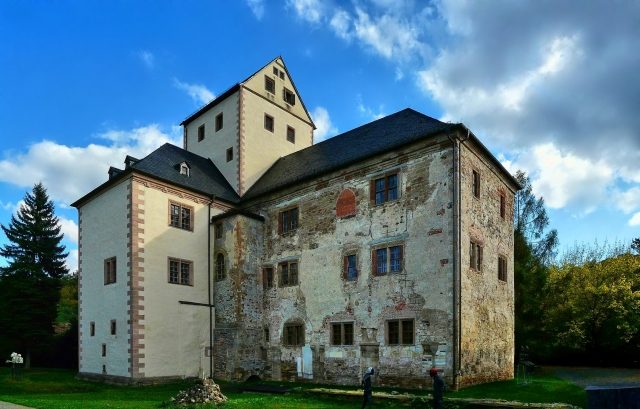
Mildenfurth Monastery is a former Premonstratensian monastery in the Mildenfurth district of Wünschendorf/Elster in the Greiz district of Thuringia. It was founded in 1193 by Vogt Heinrich II von Weida. Around 1200, the Romanesque monastery church was built, parts of which are still preserved today. It was a three-aisled basilica in a bound system with a staggered choir. To the south, the cloister adjoined it. Its south wing with the adjacent refectory is partially preserved. The site is still partly surrounded by a very high and fortified wall with loopholes and a Romanesque entrance gate.
The Mildenfurth Monastery Mill was first mentioned in a document in 1260. A 1500 m long mill race from the Krähenholz supplied the mill with water. The former water mill is located outside the former monastery grounds. In 1995, the mill's machines were still running for the agricultural cooperative Köckritz for mixed feed production. After modernization, mixed feed production was discontinued on October 30, 1999.
Between 1436 and 1440, Sigismund of Saxony stayed in the monastery, feeling closer to a nun with whom he had fallen in love.
In 1526, the Reformation was introduced in the country, which led to the dissolution of the monastery in 1543. In 1544, the site was sold to Matthes von Wallenrod from Coburg, who had it converted into a Renaissance castle in 1556. The transept, the main choir, and parts of the nave were integrated into the castle building. The west tower complex was demolished, only the ground floor with the former main portal remained. From 1617, after its acquisition by Elector Johann Georg I, the castle was a Saxon chamber estate, and the Mildenfurth office was established. From 1816 to 1918, Mildenfurth, including the estate and castle, belonged to the Grand Duchy of Saxony-Weimar-Eisenach, and in 1918 it was taken over by the state of Thuringia. Various uses followed from 1945 to 1988, such as a retirement home and fruit storage.
The monastery has been used by the artist couple Volkmar Kühn and Marita Kühn-Leihbecher as an exhibition space since 1992 and as a gallery since 2007. The complex has been one of the objects of the Thuringian Castles and Gardens Foundation since 1995 and is being restored.
Take Mobile History with you
You are reading this text for free. Premium adds what matters on the road: descriptions read aloud, sites found through your camera, whole regions taken offline.
- Every description, including the ~17,700 Premium sites
- Audio guide: have descriptions read to you on location
- AR finder: see sites through your camera, with distance and bearing
- Unlimited saved sites
14 days free, then from €2.99 a month. Cancel anytime.
Location: 50.7903, 12.0812