Uninhabited
Church
MonasteryEgeln
Marienstuhl Abbey
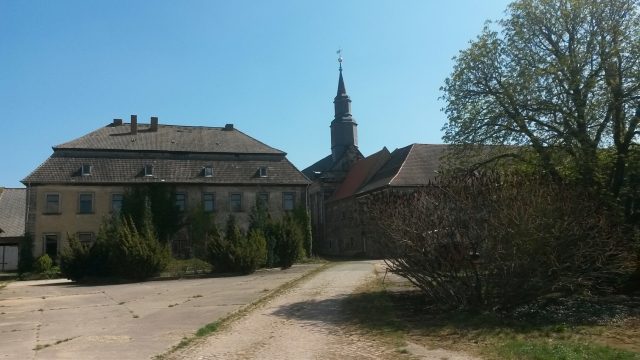
The Marienstuhl Monastery, a former Cistercian convent, is situated in the Salzlandkreis district of Saxony-Anhalt, Germany. It is renowned for its extensive history and its preserved Baroque interiors.
History+
The Marienstuhl Monastery was founded in 1259 by the nobleman Otto von Hadmersleben and his wife Jutta von Blankenburg. It was intended for Cistercian nuns who lived according to the Rule of Saint Bernard of Clairvaux. Mechthild von Blankenburg, Jutta's sister, became the first abbess. Through numerous endowments, the monastery quickly achieved economic independence, engaging in agriculture, livestock farming, and the cultivation of medicinal herbs. It also maintained an apothecary, an infirmary, an embroidery workshop for paraments, a monastic school, and various other crafts. Despite the introduction of the Reformation in Egeln in 1547, which saw the town become Protestant and some clergy and nuns lean towards Lutheranism, the monastery steadfastly adhered to the Catholic faith. Between 1577 and 1730, the monastery church was shared with the Protestant community. The buildings visible today were constructed between 1696 and 1734, with the old Gothic monastery church being demolished and rebuilt in an enlarged form. The unique Baroque interior decoration was completed by 1738. A Gothic statue of Mary from around 1450 serves as a pilgrimage Madonna. In 1769, King Frederick II granted the monastery permission for free election of its provost and for Catholic pastoral care in Egeln and the surrounding area. The dissolution of the monastery occurred on May 13, 1809, by a decree from Jérôme Bonaparte.
Location+
Marienstuhl Monastery is located in Saxony-Anhalt, within the Salzlandkreis district, near the town of Egeln, at an elevation of approximately 75 meters above sea level.
On site+
The former monastery church has been preserved as St. Mary's Church and serves the local Catholic community. It has undergone several restorations and, since July 2005, has been a station church on the St. James Pilgrimage Route through Saxony-Anhalt. The church houses a Gothic statue of Mary, a Gothic altar cross, a late Romanesque sandstone Madonna, a Pietà, and a Renaissance baptismal font.
Nearby+
- Egeln Castle (castle, approx. 735 m away)
- Wolmirsleben Manor House (manor and estate house, approx. 3648 m away)
- Schneidlingen Castle (castle, approx. 5379 m away)
- Groß Germersleben Palace (palace, approx. 8000 m away)
Take Mobile History with you
You are reading this text for free. Premium adds what matters on the road: descriptions read aloud, sites found through your camera, whole regions taken offline.
- Every description, including the ~17,700 Premium sites
- Audio guide: have descriptions read to you on location
- AR finder: see sites through your camera, with distance and bearing
- Unlimited saved sites
14 days free, then from €2.99 a month. Cancel anytime.
Source: Wikipedia · Licence: CC BY-SA 4.0 · Image: Jörg Heldt
This description draws on the facts documented in the linked Wikipedia article; Wikipedia content is licensed under CC BY-SA 4.0. Wording and editing: Mobile History.
Location: 51.9409, 11.4280