Youth training center
MonasteryPünderich
Marienburg Abbey
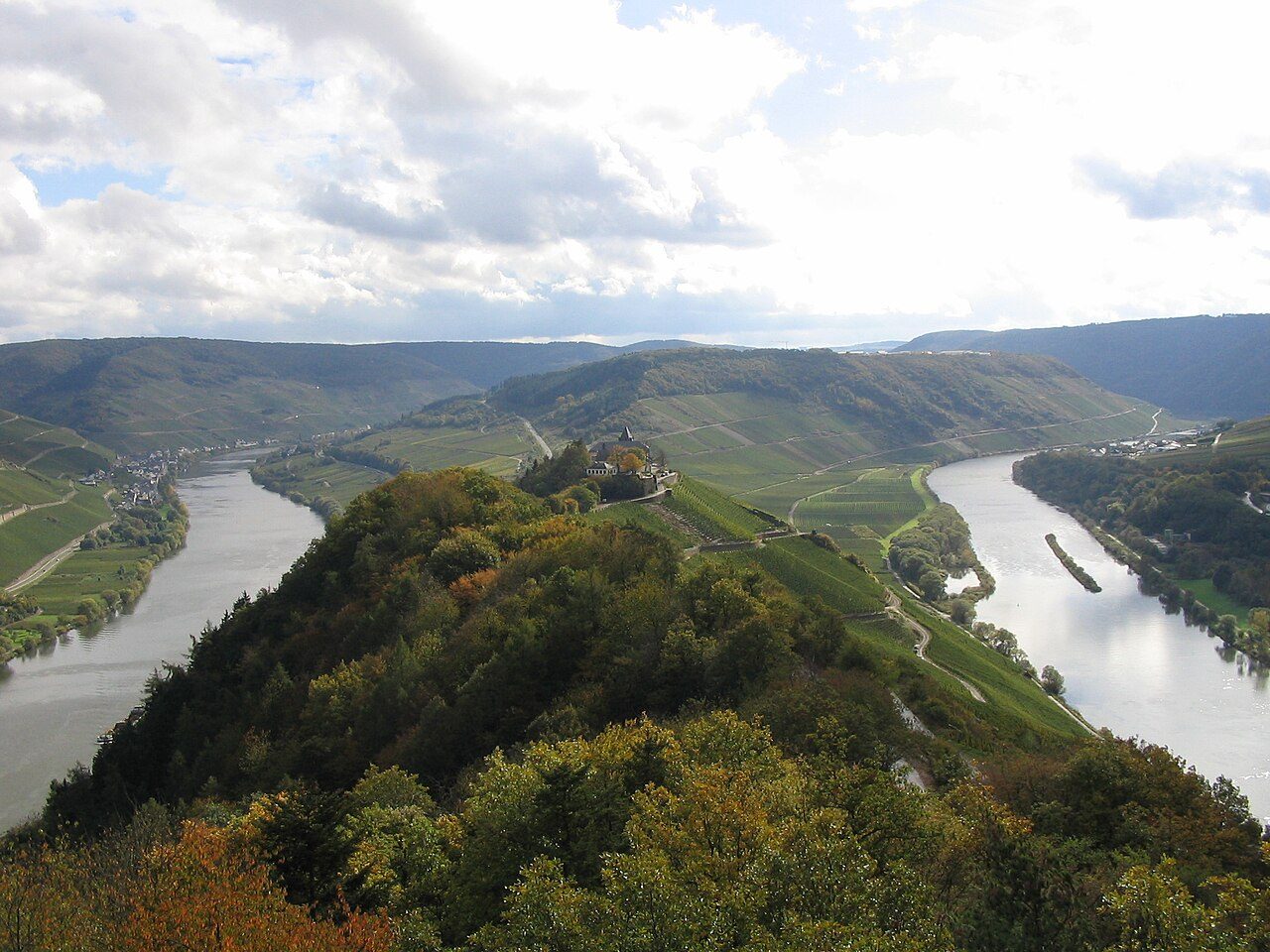
The (Pünderich) Marienburg is located on the last foothills of Zell (Mosel) near Pünderich, Alf and Bullay on the Moselle, more precisely at a narrowing of the almost 14 km long Moselle loop of the Zeller Hamm. The former Augustinian convent was dissolved in 1515 and converted into a fortification. Today it serves as a youth education center of the Diocese of Trier.
The Marienburg is located on the Petersberg, a hill in the Moselle loop of Zell and Kaimt. On two sides, the Moselle flows at the foot of the Petersberg. The surrounding slopes are used for viticulture.
1100–1500: High Middle Ages – From the founding to the closure of the monastery
The Marienburg monastery was built on the site of a Trier castle. The old name "castrum Mariae" and the existing old fortifications speak for its existence. On April 22, 1143, Pope Innocent II confirmed to Springiersbach Abbey the possession of the parish church on St. Petersberg with the five associated filial churches. In 1146, Abbot Richard I began founding a women's monastery according to the rule of St. Augustine; he had the Peterskirche, which had become dilapidated, demolished. On October 18, 1157, Archbishop Hillin of Falmagne performed the solemn consecration of the new monastery church of Marienburg in the name of "the pure and immaculate Virgin Mary".
Around 1280, Archbishop Heinrich II of Finstingen had the fortifications strengthened to defend the archdiocese and protect the Marienburg choir nuns. The monastery was plagued by constant warlike conflicts. The income was exhausted; the nuns often had to seek refuge in neighboring monasteries for years. Pope Leo X, the Renaissance pope who later excommunicated Martin Luther in 1520, responded to the archbishop's requests in two documents dated January 20, 1514, and December 28, 1515, and authorized him to close the monastery. The bull also ordered the relocation of the convent to the Sisters' Convent of St. Nicholas on the Stuben peninsula near Bremm, stipulated the care of the choir nuns, and granted the Archbishop of Trier and his successors the right to use and inhabit the Marienburg monastery for their own purposes.
1500–1800: Late Middle Ages and Upheaval – The Marienburg as a pilgrimage church until its destruction
Around 1520, Archbishop Richard von Greiffenclau ordered the reconstruction of the monastery building with the intention of creating stronger fortifications on the Marienburg; however, the expansion plans were never fully realized. The existing fortifications were occupied by Bavarians and Swedes during the Thirty Years' War and destroyed by French troops in 1650.
During this time, the church was under the supervision of a rector and served as a place of pilgrimage. Hermits also lived on the Petersberg. Around 1700, the castle and church underwent a Baroque-style restoration. In 1787, according to a description, the church on the Marienburg was in good condition and had three altars: the high altar (made of linden wood) in the east choir in honor of the Three Magi, a Mother of God altar on the south side (where there was probably also a raised pulpit) and a stone side altar on the north side, which had been donated in 1639 by the Zell district administrator Maas.
In 1794, French revolutionary troops occupied the area. In January 1797, Matthias Clar from Zell succeeded Rector Justus on the Marienburg. He was probably able to maintain operations on the Marienburg until January 1797; after that, French soldiers took everything usable (metal, bells, organ pipes, window lead) and destroyed the roofing. A hermit saved the revered image of Mary to Kaimt. A delegation of Pünderich citizens had traveled to Koblenz to present their case to the French prefect there to preserve the tower; their request was granted, but when they returned, the destruction was already complete.
1800–1925: The Transition to Modern Times – The Marienburg in private ownership – Decay and hesitant reconstruction
On September 8, 1803, the Marienburg with all its possessions was declared French national property and auctioned off. Surgeon Jodokus Crossius from Zell bought the Marienburg including the adjacent garden for 1,075 Francs. Stephan Kallfelz from Merl bought it from him. In 1838, District Administrator Moritz von Zell, merchant Clemens von Alf and ironworks owner Ferdinant Remy zu Alfereisenwerk acquired the Marienburg ruin, including the monastery garden and estate, from Stephan Kallfelz's son.
1950 - today: Present
On February 25, 1950, the last owner, Mrs. Gertrud Weinbach, sold the entire property with the church ruin to the Diocese of Trier, in order to restore the Marienburg to a sacred purpose. On September 8, 1957, Bishop Matthias Wehr reconsecrated the house of God. After more than 200 years, in 1996, a priest, regional youth pastor Joachim Keil, moved into the Marienburg for the first time again. He became Rector Ecclesiae and later spiritual advisor to the Youth Education Center. In 1998, the management of the Marienburg Youth Education Center was transferred to the Trägergesellschaft Bistum Trier TBTmbH, based in Trier. On October 1, 2000, the diocese established a Youth Education Center on the Marienburg with the task of offering its own measures in the areas of political, social, religious, and artistic-cultural youth education. From 2000 to 2001, the Trägergesellschaft Bistum Trier TBT mbH renovated the entire property. In 2003, the management of the Café-Restaurant Marienburg was also transferred to the Trägergesellschaft Bistum Trier TBT mbH. The premises underwent a general renovation.
On March 31, 2006, as part of a fundamental restructuring of children's and youth pastoral care in the Diocese of Trier, all three youth education centers were closed, including the one on the Marienburg. This ended successful international educational work, especially in the artistic-cultural field. To continue the legacy of the Marienburg, on April 1, 2006, a specialist center plus for church children's and youth work with a Church of Youth on the Marienburg (under the current leadership of youth pastor Jan Lehmann) was established.
Take Mobile History with you
You are reading this text for free. Premium adds what matters on the road: descriptions read aloud, sites found through your camera, whole regions taken offline.
- Every description, including the ~17,700 Premium sites
- Audio guide: have descriptions read to you on location
- AR finder: see sites through your camera, with distance and bearing
- Unlimited saved sites
14 days free, then from €2.99 a month. Cancel anytime.
Source: Wikipedia · Licence: CC BY-SA 4.0 · Image: The original uploader was AlterVista at German Wikipedia. (Original text: de:Benutzer:AlterVista) / CC BY-SA 3.0 via Wikimedia Commons
This description draws on the facts documented in the linked Wikipedia article; Wikipedia content is licensed under CC BY-SA 4.0. Wording and editing: Mobile History.
Location: 50.0434, 7.1368