Diaconal institution for youth and disabled assistance Mariaberg
MonasteryGammertingen
Mariaberg Abbey
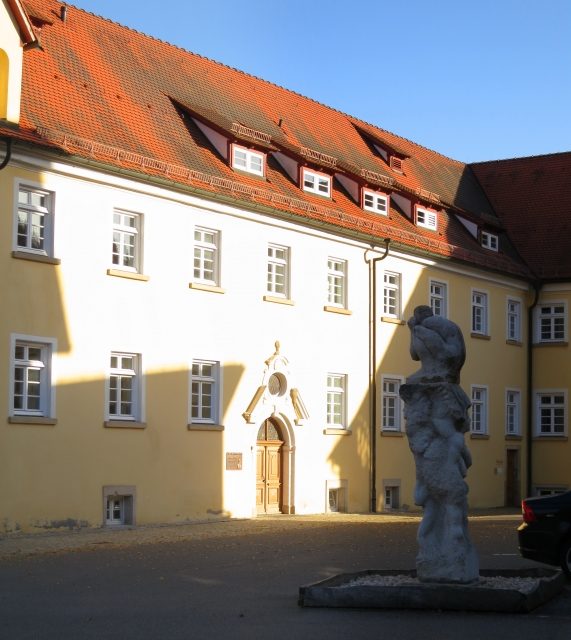
The monastery was managed by nuns for about 600 years until its secularization in 1802 by the then Duchy of Württemberg. It was probably founded by the Counts of Gammertingen and later, along with Bronnen belonging to it, was under the Vogtship of the Gammertingen lordship. Initially, Augustinian nuns lived there, then from the end of the 13th century until 1802, Benedictine nuns, although the last nun did not leave the monastery until 1837, after which it stood empty for ten years. On May 1, 1847, the Urach district physician Carl Heinrich Rösch (life data: 1807–1866), with a group of young people considered intellectually disabled and care staff, moved into the former monastery and founded the "Mariaberg Healing and Care Institution."
In addition to his empirical research – for example, on the spread of alcoholism in the Kingdom of Württemberg – and his groundbreaking commitment to humanistic disability care, Rösch was a convinced liberal and supporter of the democratic movement that led to the bourgeois March Revolution of 1848 in the principalities of the German Confederation. After the suppression of this revolution, he felt compelled to emigrate to the USA, where he eventually settled in Texas. However, the disability institution he established in Mariaberg remained and was expanded by his successors.
The central former monastery building is now the administrative headquarters of the institution originally founded by Rösch, renamed Mariaberger Heime in 1966, for outpatient and inpatient assistance for people with various intellectual, physical, or psychological disabilities of all age groups. After 1945, the institution became a member of the Diakonisches Werk Württemberg.
Mariaberg is considered the oldest comprehensive disability care institution in Germany, which from the outset had an approach that went beyond a mere custodial institution. This approach, already at its founding in the 19th century, included a then-revolutionary claim for disability care and support on a medical-scientific basis – with offers of schooling, employment, and housing.
Despite all this, Mariaberg was not spared from historically disastrous developments throughout its history. Particularly serious was the deportation of 61 men and women in 1940, as part of the NS regime's so-called "euthanasia" program Aktion T4, to the Grafeneck institution, located about 25 kilometers to the east, where they were murdered along with a total of about 10,000 other disabled people. The Mariabergers were picked up in two transports with the so-called Grey Buses. In memory of these victims of National Socialism, a memorial was erected in 1990 as a monument with five stepped stone pillars, decreasing in size towards Grafeneck, next to the Mariaberg monastery church. The three memorial plaques in front of the rising wall of lava gravel (symbolizing fire and ashes) list the names and respective birth years of the murdered Mariaberg victims under the heading "If men remain silent, the stones will cry out (Luke, Chapter 19, 40)," before the text ends with the words: "Their death obliges us to resist all thought and action that seeks to divide human life into worthy and unworthy of life. – "And forgive us our trespasses" (Matthew 6,23)". Since 1991, in connection with the nationwide Ecumenical Peace Decade, Mariaberg and Lebenshaus Schwäbische Alb have organized a vigil at the memorial.
Monastery Church+
Mariaberg's baroque monastery church, like the monastery buildings, is a protected monument. In addition to baroque altars, frescoes and sculptures can be seen in the monastery church, including a 14th-century Pietà. A sensitive renovation preserved the authentic character of the interior. With its high-arched vaults and clear acoustics, the Mariaberg monastery church provides a fitting setting for concerts, which are offered several times a year in cooperation with Gammertinger Schlosskonzert e.V.
Take Mobile History with you
You are reading this text for free. Premium adds what matters on the road: descriptions read aloud, sites found through your camera, whole regions taken offline.
- Every description, including the ~17,700 Premium sites
- Audio guide: have descriptions read to you on location
- AR finder: see sites through your camera, with distance and bearing
- Unlimited saved sites
14 days free, then from €2.99 a month. Cancel anytime.
Source: Wikipedia · Licence: CC BY-SA 4.0
This description draws on the facts documented in the linked Wikipedia article; Wikipedia content is licensed under CC BY-SA 4.0. Wording and editing: Mobile History.
Location: 48.2767, 9.2144