Monastery operation
MonasteryDahlem
Maria Frieden Abbey (Dahlem)
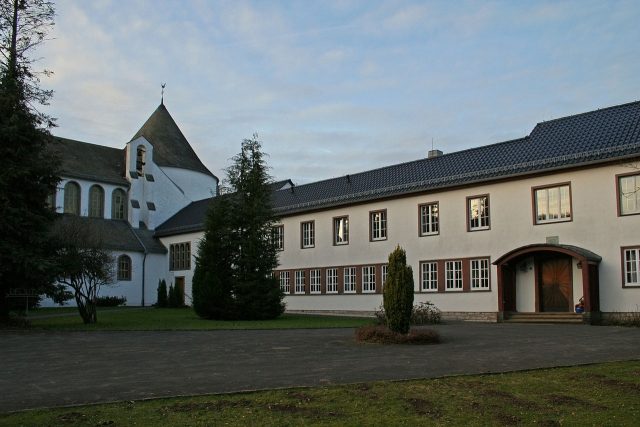
The Abbey of Maria Frieden is a Cistercian monastery in Dahlem (North Eifel).
The Beginnings
On March 24, 1952, the Abbey of Mariawald purchased the former Dahlemer Binz sheep farm from the British occupation forces for 27,500 DM. This had been established in 1935 by the National Socialist People's Welfare as a "model sheep farm". After the Second World War, the site was confiscated by the British occupation forces.
With the acquired 70 acres of land, the order had the basis for founding a new – and at that time the only – women's monastery in Germany. The monks of Mariawald, shaped by the experiences of two world wars, chose Maria Frieden as the name for the new foundation, as prayer for peace was and still is the main concern of the nuns of the monastery.
The first three settlers who moved into the monastery were monks from Mariawald: P. Albericus Bergs, P. Angelus Hinzmann, and Br. Georg Hauser. They established agriculture and set up a chapel, living rooms, and dormitories for the nuns in the former home of the shepherd family.
Founding as a Women's Monastery
The first four nuns who moved into the monastery on December 8, 1952, were Sr. Pauline, Sr. Franca, Sr. Theobalda, and Sr. Veronika from the Dutch Abbey of Koningsoord near Tilburg. In the course of 1953, more nuns from Holland came to Maria Frieden and the monastery was built up. The actual act of foundation took place on December 8, 1953. The 16 founding sisters gathered in the Dahlem parish church. Cathedral Chapter member Neujean, as a representative of the Bishop of Aachen, held a devotion with Eucharistic blessing. Afterwards, a procession to the monastery took place. There, the sisters were introduced into the enclosure by Abbot Christopherus Elsen. On this day, the regular Cistercian life and the full Liturgy of the Hours began in Maria Frieden.
The nuns initially earned their living from chicken, pig, and cattle breeding and agriculture. In September 1954, they also began producing a herbal liqueur.
At Easter 1954, the first postulants entered Maria Frieden.
Threat to Monastic Life by Plans to Build a Military Airfield
The plans to build a military airfield for jet fighters near the monastery represented a setback for the flourishing new foundation. Due to the noise, a Cistercian life would no longer have been possible there.
The Abbess of the mother monastery Koningsoord, M. Gertrudis Demarrez, and the Prioress of Maria Frieden, Sr. Pauline de Reuver, submitted a petition to the then Federal Chancellor Konrad Adenauer. A few weeks later, the then Minister of Defense Theodor Blank announced that the military airfield would not be built.
Elevation to Abbey and Expansion
On September 21, 1955, Maria Frieden was elevated to an Abbey. On November 5, 1955, the sisters elected their former Prioress, Sr. Pauline de Reuver, as the first Abbess.
From the mid-1950s, the monastery's rooms, which had only been provisionally built until then, became too small for the steadily growing community. Thus, the monastery was expanded.
On August 12, 1955, the Auxiliary Bishop of Aachen, Friedrich Hünermann, laid the foundation stone for the new monastery church. On December 8, 1958, the Bishop of Aachen, Johannes Pohlschneider, consecrated the new monastery church. After the completion of the monastery church, the monastery building itself was expanded from 1960 onwards. The keystone was laid in 1968. It was designed by Sr. Praxedis and the Mariawald Abbot P. Otto as a dove with an olive branch as a symbol of peace.
Establishment of the Vestment Weaving Mill
Since the end of the 1960s, agriculture proved unprofitable, so it was increasingly reduced and finally abandoned altogether. In addition to selling the monastery liqueur, the sisters developed another source of income by setting up a weaving mill and producing vestments.
Succession of the First Abbess
In the autumn of 1967, Abbess Pauline had to resign from her office due to health reasons.
Sr. Christophora van Dijck was elected as her successor, holding the office until 1970 and then becoming a librarian. In 1976, she was the first of the sisters of Maria Frieden to pass away.
From 1971 to 1983, Sr. Fabiana van Swaaij led the monastery as Abbess. Her term of office saw the innovations in monastic life following the Second Vatican Council. These include, in particular, the abolition of the separation between choir and lay sisters and liturgical innovations such as the introduction of the vernacular in the liturgy. The monastery church was structurally adapted to the requirements of the liturgical reform.
From 1983 to 1984, Sr. Ruth Mersmann presided over the monastic community as Abbess. Her term of office saw the new foundation of the Cistercian monastery of Gethsemani on the Donnersberg (Palatinate), to which Sr. Josefa and Sr. Praxedis from Maria Frieden were sent.
Sr. Justina Lumcerova succeeded Sr. Ruth as Abbess. She was followed by Sr. Gabriele Visser on February 22, 1993.
Today (as of 2009), 24 nuns live in Maria Frieden. Sr. Blandina Paschalis Schlömer OCSO, who lived in the abbey from 1972 to 2000, became known for her research on the Veil of Manoppello.
Life+
The nuns in Maria Frieden live according to the Regula Benedicti, the monastic rule of Saint Benedict of Nursia, and the Constitutions of the Cistercians. In accordance with the monastic ideal, prayer, reading, and physical labor determine their daily rhythm.
The foundation of monastic life in Maria Frieden is the contemplative way of life, the permeation of God's presence in everyday life. The nuns live in seclusion to seek God and to point to His existence through their lives.
The day in Maria Frieden begins at 04:05 with communal prayer, Vigils. Afterwards, the nuns hold silent contemplation. On weekdays, Lauds take place at 07:00 and Holy Mass at 07:30. After Terce at 09:00, the morning work period begins, which concludes at 12:15 with the prayer of Sext. Afterwards, lunch is taken in silence. After a short rest, None takes place at 14:20. This is followed by the afternoon work period. Vespers are prayed at 17:15. Afterwards, dinner is taken. After a short rest, the day concludes at 19:25 with the prayer of Compline.
Take Mobile History with you
You are reading this text for free. Premium adds what matters on the road: descriptions read aloud, sites found through your camera, whole regions taken offline.
- Every description, including the ~17,700 Premium sites
- Audio guide: have descriptions read to you on location
- AR finder: see sites through your camera, with distance and bearing
- Unlimited saved sites
14 days free, then from €2.99 a month. Cancel anytime.
Source: Wikipedia · Licence: CC BY-SA 4.0
This description draws on the facts documented in the linked Wikipedia article; Wikipedia content is licensed under CC BY-SA 4.0. Wording and editing: Mobile History.
Location: 50.3974, 6.5204