Monastery operation
MonasteryKaufungen
Kaufungen Abbey
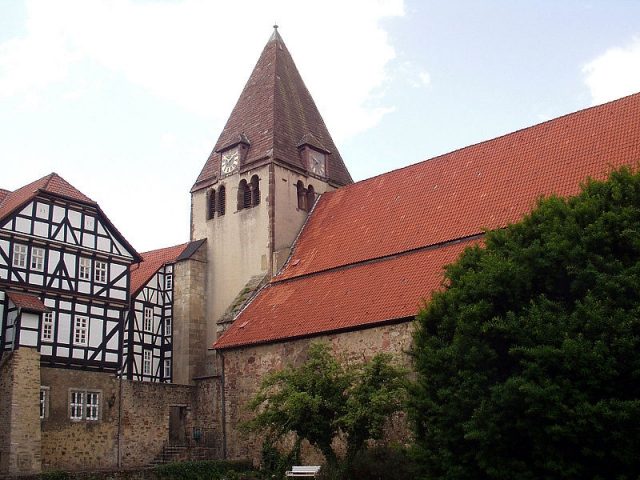
Kaufungen Abbey was a Benedictine nunnery founded in 1017 by Empress Kunigunde in Kaufungen, in the North Hessian district of Kassel.
In May 1017, Kunigunde was staying at the royal court of Kaufungen, which had been given to her as a widow's dower by her husband, Emperor Henry II, as early as 1008. There, according to Thietmar of Merseburg, she is said to have vowed to found a monastery during a severe illness. She recovered and soon after began the construction of the monastery. After the death of her husband in 1024, the later canonized Kunigunde retired as a simple nun to the young Benedictine nunnery, where she died on March 3, 1033.
On July 13, 1025, the monastery church, which had begun in 1018, was consecrated.
The vogts of the Imperial Abbey of Kaufungen were, starting in 1024 with Werner I, the Gaugrafen of Maden and Gudensberg respectively.
Conversion to a Collegiate Foundation
Kaufungen remained an imperial monastery until 1089, but was then subordinated to the Bishop of Speyer by Emperor Henry IV. It was able to free itself from this dependence in the 12th century. It first transformed into a collegiate foundation for canonesses without monastic vows and finally into a secular collegiate foundation for the provision of noble ladies.
Reform
In the 16th century, at the instigation of Landgrave Wilhelm II, the foundation was affiliated with the Bursfelde Congregation. In February 1509, the abbots Franz von Ketteler of Corvey and Dietrich II of Bredelar, with the participation of Dean Heinrich Ruland of the Kassel Martinsstift and the abbots Heinrich Ohm of Bursfelde and Johann Meyer of Breitenau, carried out the first visitation. Abbess Elisabeth von Plesse and the canonesses were replaced by a new convent from the Benedictine nunnery of Gehrden, which had belonged to the Bursfelde Congregation since 1474. However, since the Archbishop of Mainz, Uriel von Gemmingen, did not want to recognize the appointment of the new Abbess Anna von der Borch, he ordered a new visitation. This was carried out in November 1509 by the abbots of Corvey, Bursfelde, and Breitenau, as well as by Heinrich Ruland and two clerics from the Fritzlar Petersstift. The monastery was thereafter a member of the Bursfelde Observance, but not for long.
Dissolution
After the introduction of the Reformation in the Landgraviate of Hesse, the monastery was dissolved in 1527 and the reform convent returned to Gehrden. The monastery's possessions were transferred in 1532 by Landgrave Philip the Magnanimous, together with those of the Wetter Collegiate Foundation, to the Hessian Knighthood for the provision of female members of this noble corporation. As the Knightly Collegiate Foundation of Kaufungen, it exists to this day.
The Complex+
The Collegiate Church of Kaufungen is considered the most important late Ottonian building in North Hesse. The choir of the original Romanesque basilica, completed and consecrated in 1025, had to be vaulted around 1175 after severe damage. In the second quarter of the 13th century, the conversion to a Gothic hall church began, and in 1422, most of the windows and doors were renewed and the side aisle walls were raised in the Gothic style. Also in the 15th century, the Gothic wall paintings were created. After another fire, the church was extended in 1564, and painted wooden ceilings were installed. The Emperor's gallery in the westwork was uncovered again in 1938.
Take Mobile History with you
You are reading this text for free. Premium adds what matters on the road: descriptions read aloud, sites found through your camera, whole regions taken offline.
- Every description, including the ~17,700 Premium sites
- Audio guide: have descriptions read to you on location
- AR finder: see sites through your camera, with distance and bearing
- Unlimited saved sites
14 days free, then from €2.99 a month. Cancel anytime.
Source: Wikipedia · Licence: CC BY-SA 4.0
This description draws on the facts documented in the linked Wikipedia article; Wikipedia content is licensed under CC BY-SA 4.0. Wording and editing: Mobile History.
Location: 51.2799, 9.6342