School
MonasteryKastl
Kastl Abbey
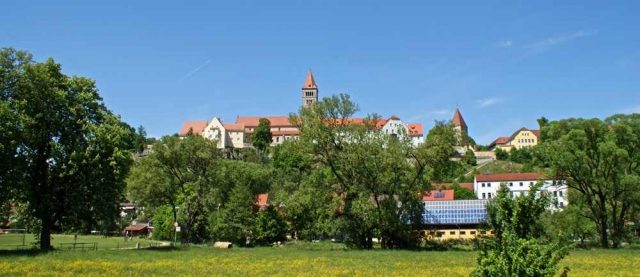
Kastl Monastery is a former monastery in the Upper Palatinate/Bavaria (Diocese of Eichstätt), which was initially settled by Benedictines, later came into the possession of the Jesuits and then the Knights of Malta.
The Era of the Benedictine Abbey (1098/1103–1556)
The Monastery of Saint Peter in Kastl was probably founded in 1103 (according to monastic tradition already in 1098) by Margravine Luitgard of Zähringen, Count Berengar I of Sulzbach, as well as Lord Friedrich of Kastl and his son Otto, in Kastl Castle, which was probably built in Carolingian times. Bishop Gebhard III, a brother of Margravine Luitgard, who had been displaced from Constance, was also involved in the founding. He sent the founding convent from Petershausen Monastery, which was under the influence of the reform emanating from Hirsau Monastery.
Monks from the rapidly flourishing Kastl Abbey were already able to settle Reichenbach am Regen Monastery in 1118, which Margravine Luitgard of Zähringen had also founded together with her son, Margrave Diepold II. Monks from Kastl probably also settled the newly founded monasteries of Plankstetten and Auhausen.
The monastery was able to steadily increase its possessions and soon became one of the most powerful and richest monasteries in the Empire. At the end of the 14th and beginning of the 15th centuries, Kastl Monastery became an important center of monastic renewal, which radiated to numerous monasteries in Bavaria (Kastl Reform). Emperor Sigismund elevated the monastery to imperial status in 1413.
In the 16th century, a rapid decline of the monastery began. After the introduction of the Reformation in the Upper Palatinate by Elector Ottheinrich of the Palatinate, the impoverished Benedictine Abbey of Kastl was dissolved in 1556.
The Era of the Jesuits and Knights of Malta (1636–1808)
During the Counter-Reformation in the Upper Palatinate (1625), Kastl Monastery was handed over to the Jesuits in Amberg by the Bavarian Electors in 1636. After the dissolution and prohibition of the Jesuits (1773), the Order of Malta received Kastl Monastery in 1782. Under the Jesuits, the monastery church underwent renovation and baroque redecoration. The current early classicist high altar was erected by the Knights of Malta.
From Nationalization to the Present
After secularization, the monastery church became a parish church in 1808. In 1825, the district court was moved from Pfaffenhofen Castle to the buildings that had been unused since 1803, where it remained until its dissolution in 1862. From 1958, a Hungarian Gymnasium was located in the former monastery buildings, which was dissolved at the end of the 2005/2006 school year.
Monastery Church+
The Romanesque monastery church was probably largely completed by the consecration of the choir in 1129. The original church was a three-aisled basilica with a flat-roofed nave, a vaulted choir, and a large narthex in the west. In the Romanesque monastery church, architectural and artistic influences from the monasteries of Hirsau and Cluny combine with local building traditions.
At the beginning of the 15th century, the main nave and the side aisles received Gothic rib vaults. The nave was extended to the north and south by chapel additions.
The preserved frieze of coats of arms is significant; it displays coats of arms of noble houses from the Upper Palatinate that were connected to the monastery, e.g., as vogts, such as Karg von Bebenburg, Steinling from Edelsfeld, Brand von Neidstein.
Monastery Buildings+
The monastery buildings form a courtyard around the choir of the church. They were built on the foundations of the medieval castle. The buildings essentially still show the state at the time of the dissolution of the Benedictine abbey or the restoration after the monastery fire of 1552.
Princess Anna+
During a stay of Louis the Bavarian in Kastl, one of his children traveling with him, 3-year-old Anna, fell ill. On January 29, 1319, the princess finally died, but was not transferred to Munich; instead, she was embalmed like a mummy and buried in the monastery. In 1715, the body was removed from the high tomb and kept in an oak cabinet. The mummified remains now rest in a shrine in the Paradise, the narthex of the monastery church, and were accessible for viewing until recently.
Take Mobile History with you
You are reading this text for free. Premium adds what matters on the road: descriptions read aloud, sites found through your camera, whole regions taken offline.
- Every description, including the ~17,700 Premium sites
- Audio guide: have descriptions read to you on location
- AR finder: see sites through your camera, with distance and bearing
- Unlimited saved sites
14 days free, then from €2.99 a month. Cancel anytime.
Source: Wikipedia · Licence: CC BY-SA 4.0 · Image: http://de.wikipedia.org/wiki/Datei:Kastl.jpg
This description draws on the facts documented in the linked Wikipedia article; Wikipedia content is licensed under CC BY-SA 4.0. Wording and editing: Mobile History.
Location: 49.3693, 11.6839