Monastery operation
MonasteryIlbenstadt
Ilbenstadt Abbey
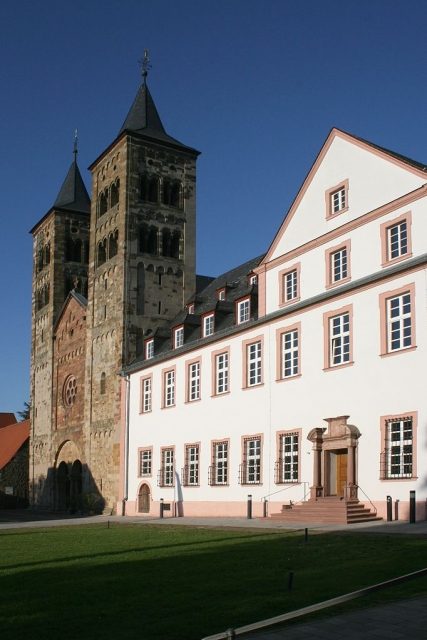
Ilbenstadt Abbey is a former Premonstratensian monastery in Niddatal-Ilbenstadt, Wetteraukreis, Hesse, in the Diocese of Mainz.
In 1122, Gottfried von Cappenberg and his brother Otto von Cappenberg, after an encounter with St. Norbert of Xanten, donated their possessions to the Premonstratensian Order as penance for the destruction of Münster Cathedral and were themselves ready to join the order. Ilbenstadt was among the Cappenbergers' possessions. Construction of the basilica and the monastery began in 1122. In 1127, Gottfried died in Ilbenstadt and was buried in the parish church. In 1149, his remains were transferred to the basilica.
The first canons came from Prémontré. In fierce disputes, the monastery, with the help of Mainz, was able to maintain its independence against the Burgraviate of Friedberg. Thus, even after the Reformation, it remained a Catholic island in the Wetterau and for years shaped the entire Wetterau through practical pastoral work.
In 1622, during the Thirty Years' War, the monastery and church were plundered and desecrated by Mansfeld's troops. Then came the Swedes, who occupied the monastery for years. King Gustav Adolf gifted it to Colonel von Wartenberg. In 1635, the Imperial forces arrived, but the "liberators" behaved even worse. They tortured Provost Conradi, who died from the consequences. The steep rise of the provostry from the ravages of war was honored in 1657 by its elevation to an abbey. The monastery complex was replaced by a new building in the Baroque style in the following decades.
The abbey was dissolved in 1803 during the secularization. The Counts of Altleiningen-Westerburg received the monastery and its estates as compensation for their possessions on the left bank of the Rhine. In 1819, part of the east wing, including the north cloister and the old parish church, was demolished. The prelature served as a castle. In the same year, Karl Graf Leiningen-Westerburg (Károly Leiningen-Westerburg), general of the Hungarian Revolution of 1848/1849 and one of the martyrs of Arad, was born here. A plaque affixed to the prelature in 1999 commemorates him. In 1921, the counts sold the entire property to the Hessian state, which created a state domain from it. In 1923, Benedictines from Kornelimünster moved into the leased convent buildings. In 1939, the Reich Labor Service arrived. After the war, the Diocese of Mainz leased the buildings again in 1946 and bought them entirely in 1958.
Girls' Home St. Gottfried+
In the 1950s, the monastery was a correctional facility, run by the nuns under the name "Caritaswerk St. Gottfried". In 1963, the home was completely destroyed by fire. In 1968, it was reopened after an investment of four million D-Mark. Approximately 100 girls were housed in six groups. After massive criticism during the home campaigns in the 1970s, the home was transformed into a "Children's and Youth Home" under secular leadership and became internationally known for its client-centered pedagogical-therapeutic concept. Despite widespread protests from experts, the house was closed by the church leadership in 1976 and completely dissolved in 1979.
Educational Center+
The current Haus St. Gottfried has since been used as a diocesan youth and educational center for conferences. From 2005 to 2008, it was renovated for five million Euros.
Complex+
Basilica
The former abbey church of Maria, St. Peter and Paul, consecrated in 1159, was built in the Romanesque-basilical style. Around 1500, the previously flat wooden ceiling was Gothicized. From 1681 to 1699, Johann Wolfgang Frölicher created sculptures and altars, as well as the pulpit for the monastery church. As part of the Baroque furnishing of the abbey church, Abbot Jakob Münch had Franz Vossbach erect the organ gallery and the organ case between 1732 and 1734. Johann Onymus from Mainz then built the organ that still exists today.
In 1803, the abbey church became a parish church during the secularization. The valuable inventory of the former monastery church was squandered. In 1929, the church was elevated to a Basilica minor by Pope Pius XI. The basilica, thoroughly renovated from 1960 to 1970, is still an imposing church today and is popularly known as the "Wetterau Cathedral".
Convent Buildings and Prelate's Building
The convent buildings on the south side of the monastery church originally completely enclosed the cloister. After the demolition in 1819, the remaining buildings form an L-shaped courtyard. These are Baroque buildings in a restrained style from the period between 1709 and 1716, each with a portal with a broken segmental pediment in the central axis.
Upper Gate, so-called "Gottfried Arch"
The southern gate, mostly called the Upper Gate or Gottfried Arch, is a two-story building with a mansard roof and a side staircase from 1721. It was built during the monastery's heyday under Abbot Andreas Brand. On the upper floor, there is a ballroom with a stucco ceiling. On the outside, the gate has rich architectural ornamentation.
Take Mobile History with you
You are reading this text for free. Premium adds what matters on the road: descriptions read aloud, sites found through your camera, whole regions taken offline.
- Every description, including the ~17,700 Premium sites
- Audio guide: have descriptions read to you on location
- AR finder: see sites through your camera, with distance and bearing
- Unlimited saved sites
14 days free, then from €2.99 a month. Cancel anytime.
Source: Wikipedia · Licence: CC BY-SA 4.0
This description draws on the facts documented in the linked Wikipedia article; Wikipedia content is licensed under CC BY-SA 4.0. Wording and editing: Mobile History.
Location: 50.2803, 8.8021