Abbey
MonasteryHeiligenbronn
Heiligenbronn Abbey
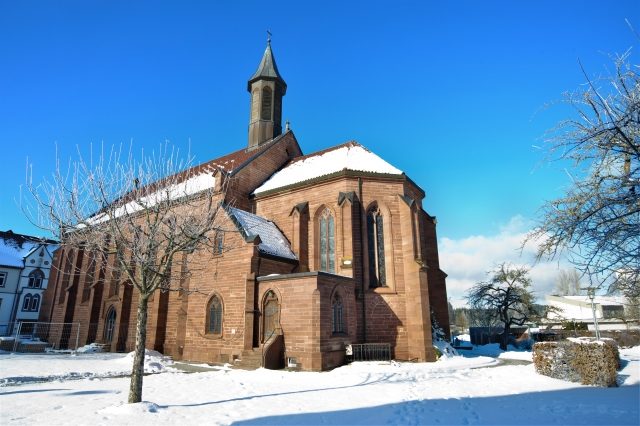
The Heiligenbronn Monastery, located in the present-day Heiligenbronn district of the municipality of Schramberg, is a Franciscan convent in the Black Forest, standing on the site of a holy spring and pilgrimage church known since the 14th century.
In Heiligenbronn, a hamlet and Lichtenau Castle probably existed since the mid-13th century. The latter was abandoned by the lords of the castle after 1353 – they settled in the Bernecktal – while the hamlet continued to exist until after 1444. In addition, there was the Lichtenau church, a branch of the parish church in Dunningen.
In the 14th century, a spring, said to be miraculous according to legend, was established at the current location of the monastery. In 1385, a Franciscan monk bought a piece of land where the spring is located, and in 1442, a wayside shrine was erected. Soon the spring became a popular pilgrimage site, and pilgrims built a small Marian chapel at the spring in the mid-15th century. Later, a residential house and a pilgrim house were built, which was donated in 1463/64 by Elisabeth von Rechberg, whereupon Franciscans established a hospice belonging to the Franciscan monastery in Villingen. A larger church was also built soon after.
After two plague epidemics and decreasing revenues from pilgrimages, the Franciscans withdrew to Villingen around 1532. In 1547/51, Rochus Merz von Staffelfelden acquired the pilgrimage site along with the Lordship of Schramberg. The miraculous image was re-erected, and Heiligenbronn became a place of Counter-Reformation. During the Thirty Years' War, the miraculous image was moved to Oberndorf am Neckar, but was returned to Heiligenbronn as early as 1637. However, it was not until around 1700 that the number of pilgrims increased again and a new chapel was built. The lordship was now in the possession of the Barons von Bissingen-Nippenburg.
However, it was not until around 1850 that the place received its own spiritual leadership. In mid-1855, David Fuchs arrived in Heiligenbronn as the first vicar and remained until his death in 1885. In 1856, he began building a house near the spring, which was to be used as an orphanage under the direction of sisters of the Third Franciscan Order. In the spring of 1857, the first five candidates arrived, who were introduced to monastic life by a sister from Dillingen/Donau. On September 9, 1857, the investiture took place, and just one week later, the first four orphans were admitted. Soon, deaf-mute and blind children were also taken in for care.
In the following years, the number of children steadily increased; in 1864, 19 sisters and 79 children lived in Heiligenbronn, and by 1871, there were already 32 sisters, 16 candidates, 68 orphans, 42 deaf-mute, and 10 blind, totaling 168 people. In 1900, 400 people lived in the monastery (compared to 209 inhabitants of the village), and in 1935, the community reached its peak of 323 professed sisters. As the demands for care constantly increased, but the number of sisters decreased, the St. Franziskus Heiligenbronn Foundation was established in 1991 to continue the monastery's work as a provider of disability support.
Take Mobile History with you
You are reading this text for free. Premium adds what matters on the road: descriptions read aloud, sites found through your camera, whole regions taken offline.
- Every description, including the ~17,700 Premium sites
- Audio guide: have descriptions read to you on location
- AR finder: see sites through your camera, with distance and bearing
- Unlimited saved sites
14 days free, then from €2.99 a month. Cancel anytime.
Source: Wikipedia · Licence: CC BY-SA 4.0
This description draws on the facts documented in the linked Wikipedia article; Wikipedia content is licensed under CC BY-SA 4.0. Wording and editing: Mobile History.
Location: 48.2581, 8.4478