Monastery operation
MonasteryHeidenfeld
Heidenfeld Abbey
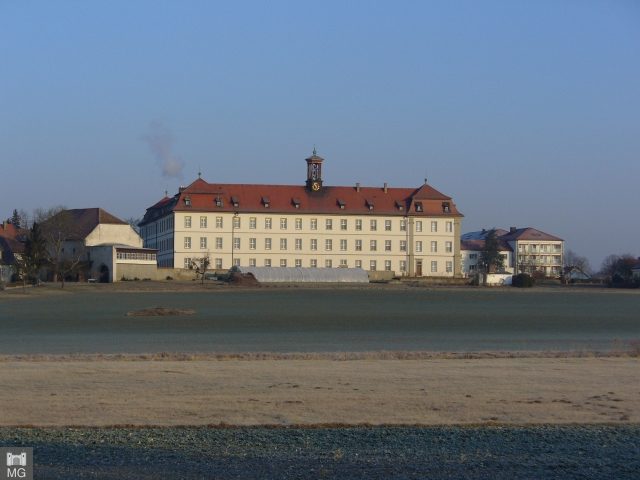
Heidenfeld Monastery, also known as Maria Hilf Monastery, is a monastery of the Congregation of the Daughters of the Redeemer in Heidenfeld near Schweinfurt in Lower Franconia (Bavaria).
In 1069, Countess Alberada of Schweinfurt, together with her husband Count Hermann of Habsberg-Kastl, donated one of her dowries for the establishment of a monastery. Bishop Adalbero of Würzburg, to whom the donation was handed over, passed it on in 1071 to the Augustinian Canons, who subsequently were primarily active in pastoral care and looked after over 20 parishes.
During the Peasants' War in 1525 and the Margrave War in 1553/54, the monastery was completely destroyed twice, but rebuilt by the Augustinian Canons. In 1632, the priest Liborius Wagner, beatified as a martyr, was buried in the collegiate church. Under Provost Andreas Deichmann (1644-1673), the collegiate church flourished again after the turmoil of the Thirty Years' War. Balthasar Neumann provided the plans for a baroque new building of the convent building between 1723 and 1733. From 1783, the collegiate church was redesigned by the Mainz court painter Joseph Ignaz Appiani and the Würzburg court stucco artist Materno Bossi. The staircase, which spans three floors, and the richly stuccoed main hall on the second floor are still remarkable today.
The dissolution of the monastery as part of the secularization took place in 1803. The complex was sold in 1805 to Count Türkheim, who had the church demolished. The church and monastery furnishings were sold; individual items are still preserved in churches in the surrounding area. From 1807 to 1901, the Barons of Bodeck-Ellgau owned the remaining monastery buildings. In 1910, through the mediation of the later Cardinal Michael von Faulhaber, the "Congregation of the Daughters of the Redeemer", a women's congregation of pontifical right founded in 1857, acquired the preserved buildings. In 1935, the gap created by the demolition of the church was closed and a new south wing with a chapel and baroque altar was built. The monastery initially served as a convalescent home, then as a retirement and nursing home for members of the congregation. In 1975, an additional building was also erected as a nursing home.
Take Mobile History with you
You are reading this text for free. Premium adds what matters on the road: descriptions read aloud, sites found through your camera, whole regions taken offline.
- Every description, including the ~17,700 Premium sites
- Audio guide: have descriptions read to you on location
- AR finder: see sites through your camera, with distance and bearing
- Unlimited saved sites
14 days free, then from €2.99 a month. Cancel anytime.
Source: Wikipedia · Licence: CC BY-SA 4.0
This description draws on the facts documented in the linked Wikipedia article; Wikipedia content is licensed under CC BY-SA 4.0. Wording and editing: Mobile History.
Location: 49.9650, 10.2014