Church
MonasterySigmaringen
Hedingen Abbey
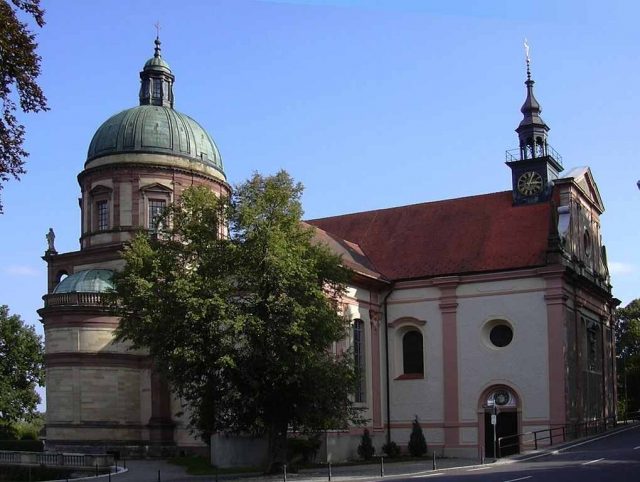
Hedingen Monastery is a former monastic complex and is located, together with Hedingen Church, on the southern outskirts of the city of Sigmaringen, in the Sigmaringen district of Baden-Württemberg. The history of the convent dates back to the 14th century and was continued in the 17th century by Franciscans of the reform branch (the Franciscan Observants). The monastery's Church of the Redeemer is the burial place of the Hohenzollerns.
The monastery was founded according to the rule of the Dominican Tertiaries in the first half of the 14th century, with the first documented mention in 1338. The women's monastery was a foundation by Junker Ital Volkwin. It probably belonged to the Dominican Order from the beginning. The Weckensteiners, with their ancestral castle Burg Weckenstein near Storzingen, had connections to the Dominican convent founded shortly before 1388, in whose anniversary book the nun Margret von Weckenstein and also Anna von Weckenstein as well as Junker Hans von Weckenstein are recorded.
Count Eberhard II of Württemberg allowed the nuns of Hedingen on August 24, 1349, to occupy the care of St. John's Chapel and the associated house in the churchyard with an honorable priest or layman, and on June 26, 1362, as feudal lord of the parish church in Laiz, to the dean in Bingen, the foundation of an altar with a prebend in Hedingen Monastery for a chaplain of the nuns. On September 1, 1369, he granted the city of Sigmaringen the grace that properties in the city that were previously taxable should remain taxable, even if they came into the possession of Hedingen Monastery.
The women's monastery of Hedingen near Sigmaringen was also mentioned in a lawsuit. The lawsuit was brought against the Truchsessian Landammann and church warden of Hohentengen, Christoph Weinschenk, concerning the assets and income of the monastery in Bremen, which had been granted to Sebastian Krisell there in 1582, before the episcopal-Constance court, later as an appeal before the archiepiscopal-Mainz court.
The Dominican convent was dissolved between 1595 and 1597 due to moral neglect; its assets were transferred to the Augustinian Canonesses' Abbey of Inzigkofen (1354-1856), and the building fell to the Sigmaringen Hospital. The convent moved to Habsthal Monastery in Habsthal near Ostrach.
The monastery complex in Hedingen served as the city hospital of Sigmaringen until 1624, when a Franciscan branch was opened. The Franciscan monastery (franciscanorum Hedingae) was part of the Diocese of Constance. In 1770, a public Latin school was opened in the monastery, which was expanded into a gymnasium in 1776.
On October 5, 1796, Hedingen Monastery was plundered by retreating French troops.
The Franciscan monastery fell to the Princes of Hohenzollern-Sigmaringen in 1806 and was dissolved in 1816. In 1821, the Archdiocese of Freiburg was formed from the Diocese of Constance and parts of the dioceses of Mainz, Strasbourg, Worms, and Würzburg.
On October 2, 1818, the princely government under Prince Anton Aloys von Hohenzollern-Sigmaringen (1762-1831) announced the establishment of a "Latin school" in the buildings of the former monastery for the coming school year, financed by the scholarship fund. From 1818 to 1893, the buildings were used for the princely Hohenzollern, later state, gymnasium (Royal Catholic Gymnasium zu Hedingen; the origins of today's Hohenzollern-Gymnasium).
Volumes (incunabula) from the dissolved monastery library are located in the Baden State Library in Karlsruhe. They give a small impression of how splendid the monastery library must have looked in the 18th century. Further volumes from the library were located in the Donaueschingen Court Library, which were dispersed worldwide from 1999 onwards.
Hedingen Church+
The Roman Catholic Hedingen Church, also known as the Church of the Redeemer, was originally built as the monastery church of the former Franciscan monastery. It is a crypt church, meaning it is the burial place of the princely family of Hohenzollern, with a cloister.
Hedingen Church consists of a total of three building sections.
- The nave of the current church was built between 1680 and 1682 by the Franciscans, who then owned the monastery, in place of an older church. It is Baroque.
- Around 1715, the Lady Chapel was added in Rococo style. The chapel was soon after destroyed by fire and renewed in 1747.
- In 1889, the reconstruction of the monastery church began, and a monumental dome structure was erected over the princely crypt by court architect Johannes de Pay. The dome structure is in the style of the Italian High Renaissance.
In the altar area, one can see the dome structure and the high altar from Venice, made of white Carrara marble. Below the Latin words "Ego sum resurrectio et vita" (German: "I am the resurrection and the life"), the four evangelists are depicted. Further up, in addition to a depiction of the Trinity, Mary and John the Baptist can also be seen. Higher up in the dome room are eight windows and, among other things, rose-shaped decorations on a golden background. Below, small holes in a round metal plate allow a glimpse into the new crypt. Crypt, dome, and the cross on the apex form a single line.
The floor is comparatively plain; the Hohenzollerns had to save money – the castle had cost a lot.
The organ was built by Franz Xaver Späth from Ennetach in 1911 and is largely preserved in its original historical condition. The organ, listed by the organ building company Späth as opus 194, has 32 stops on three manuals and pedal.
The church was consecrated in 1911. The church is not accessible throughout the year but is opened on special occasions.
Hedingen Nativity Scene+
For about 40 years, the princely family has opened the doors of their burial church during the Christmas season. In the Lady Chapel, a side chapel of the church, the approximately 20 square meter and 250-year-old Baroque nativity scene from the mid-18th century is displayed during Christmas. The Hedingen Nativity Scene is owned by the Hohenzollern family. It was supplemented in the 19th century and first shown again in 1893. It consists of 175 individual parts (including 64 nativity figures, animals, and utensils).
The nativity scene is a so-called simultaneous nativity scene, depicting various scenes. Over a depth of seven meters and a width of five meters, the various biblically significant events are gradually added according to the Christmas calendar: The first scene depicts the birth of Jesus with the Holy Family. Another scene shows the Massacre of the Innocents in Bethlehem, which occurred on the command of King Herod the Great and is depicted with grim-looking soldiers. Furthermore, the Adoration of the Magi. There is also a group of citizens in front of a city backdrop.
The painted heads and hands of the 40 to 60 centimeter tall figures are carved from wood. While the figures also embody biblical depictions, they are entirely committed to the aesthetic ideal of the Baroque era. Thus, the ladies are dressed in powdered wigs and elaborate dresses made of magnificent fabrics. The splendidly robed ladies and other figures probably originally depicted the Wedding at Cana. In contrast, the respectable citizens and country folk are shown in contemporary clothing. The Orientally robed Magi and their retinue are accompanied by a camel. Strongly oriented to the biblical narrative, in the group of soldiers of the mounted King Herod, arranged to the upper right of the actual nativity scene, two armored lancers impale babies. Furthermore, one of the soldiers is even equipped with the uniform of a member of the Hohenzollern Cuirassier Regiment from the 18th century. Setting up the initial scenery alone takes at least two days for two or three people.
The painted backdrops of the nativity scene are made of burlap. They model the mountains, the vault under which the Holy Family found refuge, and the silhouette of the city of Jerusalem. As another part of the backdrops, real trees from the princely forest are used.
Burial Place+
Hohenzollern Burial Place
Among others, the following persons were buried in Hedingen Monastery and its cloister:
- Count Ferdinand von Hohenzollern-Sigmaringen (1571-1571)
- Countess Maria Magdalena von Hohenzollern-Sigmaringen (1574-1582)
- Countess Barbara von Hohenzollern-Sigmaringen (1575-1577)
- Count Karl von Hohenzollern-Sigmaringen (1579-1585)
- Countess Euphrosyne von Hohenzollern-Sigmaringen (1580-1582)
- Count Georg Friedrich von Hohenzollern-Sigmaringen (1593-1593)
- Countess Maria Salome von Hohenzollern-Sigmaringen (1595-1595)
- Count Philipp Eusebius von Hohenzollern-Sigmaringen (1597-1601)
- Count Jakob Friedrich von Hohenzollern-Sigmaringen (1598-1598)
- Count von Hohenzollern-Sigmaringen (infant death August 22, 1650; child of Meinrad I, Prince of Hohenzollern)
- Count von Hohenzollern-Sigmaringen (infant death August 6, 1655; child of Meinrad I, Prince of Hohenzollern)
- Count Friedrich Joseph Fidelis Anton von Hohenzollern-Sigmaringen (1750-1750)
- Count Johann Baptist Friedrich Fidelis von Hohenzollern-Sigmaringen (1751-1751)
- Count Anton Joachim Georg Franz von Hohenzollern-Sigmaringen (1752-1752)
- Count Fidelius Joseph Anton Franz von Hohenzollern-Sigmaringen (1753-1754)
- Countess Maria Franziska Anna Antonia von Hohenzollern-Sigmaringen (1754-1755)
- Count Joachim Adam von Hohenzollern-Sigmaringen (1755-1756)
- Prince Karl Anton Joachim Zephyrin Friedrich Meinrad von Hohenzollern (1811-1885)
- Prince Anton Egon Karl Friedrich von Hohenzollern (1841-1866)
- Prince Friedrich Eugen Johann von Hohenzollern (1843-1904)
- Prince Friedrich Wilhelm von Hohenzollern (1925-2010)
Burial Place of Wettins
Members of the former Royal Saxon House of Wettin are also buried here:
- Luise of Austria-Tuscany (1870–1947), last Crown Princess of Saxony
- Ernst Heinrich of Saxony (1896-1971), youngest son of the last Saxon King Frederick Augustus III and his wife Crown Princess Luise of Austria-Tuscany
- Gero of Saxony (1925-2003), son of Ernst Heinrich of Saxony (Columbarium)
- Dedo of Saxony (1922–2009), son of Ernst Heinrich of Saxony (Columbarium)
Take Mobile History with you
You are reading this text for free. Premium adds what matters on the road: descriptions read aloud, sites found through your camera, whole regions taken offline.
- Every description, including the ~17,700 Premium sites
- Audio guide: have descriptions read to you on location
- AR finder: see sites through your camera, with distance and bearing
- Unlimited saved sites
14 days free, then from €2.99 a month. Cancel anytime.
Source: Wikipedia · Licence: CC BY-SA 4.0
This description draws on the facts documented in the linked Wikipedia article; Wikipedia content is licensed under CC BY-SA 4.0. Wording and editing: Mobile History.
Location: 48.0818, 9.2238