Cultural Events
Apartments
MonasteryGeistingen
Geistingen Abbey
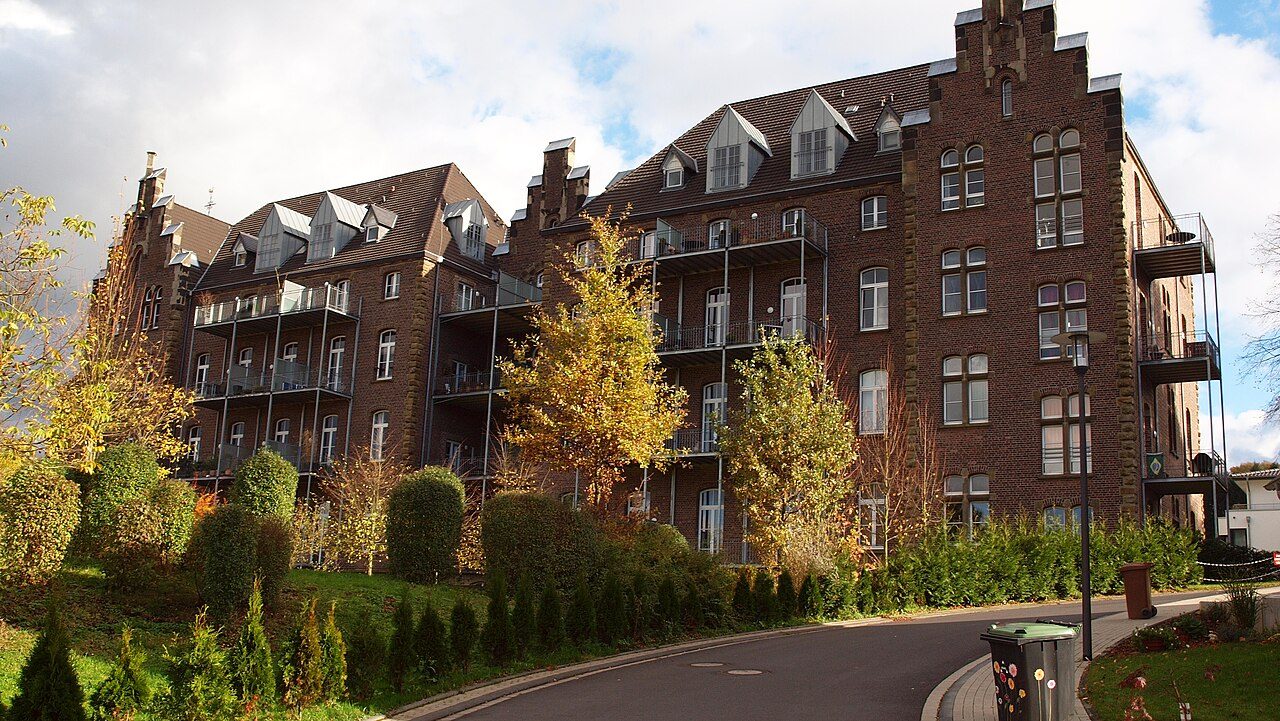
The Geistingen Monastery was a Redemptorist monastery in Hennef-Geistingen. It existed in its predetermined function from 1903 to 2006 and was temporarily also the location of a state-recognized Philosophical-Theological University. The building complex is now used for residential purposes and private commercial use. The entire monastery area covers approximately 14,500 square meters.
Founding+
The Geistingen Monastery was founded by the Lower German Province of the Redemptorists. Since the Trier Monastery, which had been in use since 1898, no longer met the space requirements of a university, 19 Morgen Am Eschenberg were purchased in Geistingen. After the archiepiscopal approval, the approval of the Prussian government was granted on February 18, 1902.
Construction+
Planning and management were undertaken by the Cologne architect Theodor Roß, who also built the parish church of St. Simon and Judas in Hennef. A monastery with a church and a university for 40 order students were to be built. On March 19, 1902, the foundation stone was laid and the grounds were consecrated.
The first building to be erected was an outbuilding on Waldstraße, as this was the only access road. This also resulted in the later postal address Waldstraße (today additionally Klosterstraße for the area accessible via the main portal on the front side).
On June 19, 1902, construction of the north-south wing began, which could already be occupied at the end of August 1903. On September 8, 1903, the monastery was inaugurated and opened with a ceremony.
Work on the monastery church began on February 13, 1903. It was put into service and blessed on September 15, 1904. However, a consecration only took place on June 17, 1915.
In 1907, the expansion parcel towards Dürresbachstraße was purchased, which made sense as the front of the building, including the monastery gate, had been laid out in this direction.
On July 25, 1910, the foundation stone for the west-east wing was laid. At the end of April 1911, a kitchen and dining room were set up, and finally, at the beginning of October 1912, a library.
After an increase in students in the mid-1950s, an extension was built. The foundation stone was laid on February 26, 1959, and completion was on January 12, 1961. The extension included 52 student rooms, three lecture halls, an auditorium, and a student chapel.
On January 18, 1906, the Archdiocese, with the consent of the parish priest of Geistingen, gave its approval to open a mass also for the parish: At the request of the railway and postal officials, a public mass was held on Sundays and holidays at 5:00 a.m. or in winter at 5:30 a.m.
On July 2, 1941, the monastery was confiscated to establish a National Political Educational Institution (Führerschule) here, and the fathers had to leave the premises. However, the city of Cologne, after tough negotiations with the Gestapo, managed to have the Elisabeth-Breuer-Stift orphanage from Cologne-Mülheim housed on the premises instead. In September, 20 sisters from the Nonnenwerth monastery, 30 employees, and 250 orphans moved in. This was certainly also why the complex was not bombed by the Allies, while large parts of Geistingen were completely destroyed by American bombs on March 8, 1945.
At the end of June 1945, classes resumed. Subsequently, the Geistingen Monastery gained a very good reputation as a place of study and a Philosophical-Theological University. Joseph Ratzinger, the later Pope Benedict XVI, also regularly visited the Geistingen Monastery and used its library during his time as a professor of theology in Bonn (1959 to 1963). With over 180,000 volumes, it remained one of the most extensive theological libraries in Europe until the end.
Due to declining student numbers, a study community with the University of the Steyler Mission in Sankt Augustin was formed from October 2, 1969. In addition, there was a general opening for laypeople and theology students not belonging to the order or clergy.
On October 1, 1982, the Congregation for Catholic Education in Rome approved the diploma program in Catholic Theology. This allowed the titles of Diplom-Theologe/Theologin (Master of Theology) to be awarded. Subsequently, state recognition as a university followed on September 21, 1983.
Since student numbers continuously declined in the following years and drastically since the early 1990s, teaching operations were finally discontinued on September 30, 1996, by the leadership of the Cologne Province. The St. Alfons Monastery in Würzburg was designated as the new community for training, and the order's priestly candidates have since studied at the Theological Faculty of the University of Würzburg. Only ten fathers and four brothers remained in Geistingen Monastery after 1996. The house subsequently served as an educational and retreat house, a Redemptorist conference center, and a student dormitory. By 2001, considerations had already been voiced to close the monastery entirely. In October 2005, the end of Geistingen Monastery was finally announced. On January 8, 2006, the last service was celebrated. In April, the monastery grounds were handed over to the new owners.
Further Use+
The old monastery building, which is a listed monument, was professionally restored and partially converted internally from autumn 2006 to December 2007, and balconies were added externally. This created over 50 condominiums (a total of 4300 square meters of living space), which were ready for occupancy by January 2008. In addition, a large underground car park was created for the residents' vehicles. The extension completed in 1961 was demolished.
The church (approx. 800 square meters), which was deconsecrated on January 8, 2006 – also a listed monument – was sold in 2007 to the promotion and event agency Time Trax from Dortmund. Since November 2008, this agency has been using and renting the sacred building, which has been completely renovated and modernized internally, for cultural and commercial events.
Take Mobile History with you
You are reading this text for free. Premium adds what matters on the road: descriptions read aloud, sites found through your camera, whole regions taken offline.
- Every description, including the ~17,700 Premium sites
- Audio guide: have descriptions read to you on location
- AR finder: see sites through your camera, with distance and bearing
- Unlimited saved sites
14 days free, then from €2.99 a month. Cancel anytime.
Source: Wikipedia · Licence: CC BY-SA 4.0 · Image: Wolkenkratzer / CC BY-SA 3.0 via Wikimedia Commons
This description draws on the facts documented in the linked Wikipedia article; Wikipedia content is licensed under CC BY-SA 4.0. Wording and editing: Mobile History.
Location: 50.7697, 7.2728