Cultural Events
Vineyard
MonasteryEberbach
Eberbach Abbey
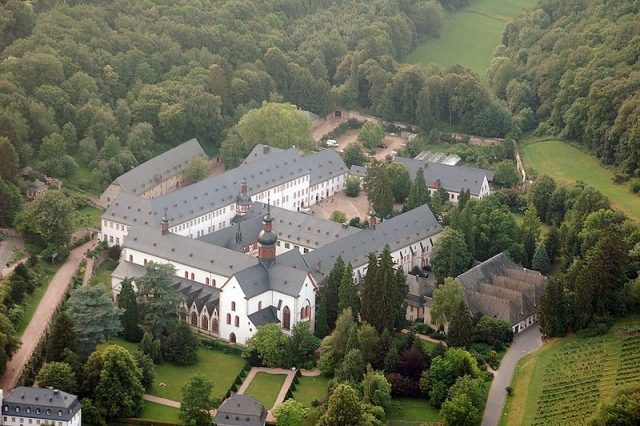
Eberbach Abbey is a former Cistercian monastery near Eltville am Rhein in the Rheingau. With its Romanesque and early Gothic buildings, it is one of Germany's most significant art monuments.
In the winter of 1985/86, almost all interior scenes for the film The Name of the Rose were shot at the monastery.
Before 1131, there was a settlement of Augustinian canons and Benedictines at the site of the present group of buildings, founded by Archbishop Adalbert I of Saarbrücken from Mainz. However, they were expelled by Adalbert due to alleged indiscipline and relocated to St. Aegidius in Mittelheim.
On February 13, 1136, the founding convent dispatched by Bernard of Clairvaux arrived in the Rheingau. Abbot Ruthard and 12 monks moved into the existing monastery buildings. On May 23, 1186, the monastery church, begun around 1145, was consecrated by Archbishop Konrad of Mainz in the presence of Bishop Hermann II of Katzenelnbogen from Münster, whose family made Eberbach Abbey their house monastery and, from 1311, the southern part of the transept of the monastery church their family burial site.
Around 1220, the Romanesque building period of the monastery ended with the completion of the lay brothers' building and the hospital building. The monastery, initially consisting of 12 brothers, quickly developed into one of the largest and most important monasteries in Germany, from which several new foundations originated: 1142 Schönau Abbey (Odenwald) near Heidelberg, 1144 Otterberg Abbey in the Palatinate, 1155 Hocht Abbey, later Gottesthal (Val-Dieu) near Liège, 1174 Arnsburg Abbey in the Wetterau. According to the order's regulations, at least 60 brothers had to live in the mother monastery for the founding of a daughter monastery. In its heyday, in the 12th and 13th centuries, an estimated 100 monks and 200 lay brothers lived in Eberbach. They created a complex system of monastery buildings during the Romanesque, Gothic, and Baroque architectural eras, a monastic complex unique in Germany due to the coherence of its overall appearance and its good state of preservation. A property register, the "Oculus Memorie" from 1211, provides information about the abbey's possessions.
The Eberbach monks were also very successful economically, with wine sales being the main source of income. At the beginning of the 13th century, the monastery even transported wine and salt as far as Cologne on self-built ships and a Rhine shipping service operated by lay brothers. A privilege issued for Eberbach by Pope Alexander III in 1162 mentions a cellar and a house in Cologne. At the beginning of the 16th century, monastic rooms such as the fraterny and the lay refectory were converted into wine cellars. In 1476, the Grobrot grape variety was mentioned for the first time. This is the only clue to the question of which wine was cultivated in the monastery during the Middle Ages.
During the Peasants' War in 1525, rebellious Rheingauers, encamped on the nearby Wacholder Heide, plundered supplies from the monastery. The Great Eberbach Wine Barrel, with a volume of approx. 71,000 L, was almost two-thirds emptied.
In the Thirty Years' War, Swedish troops occupied the Rheingau and thus also the monastery in 1631. Even before that, the convent left the abbey and fled to Cologne. Hessian and Swedish soldiers not only confiscated supplies but also carried off valuable church utensils. The greatest damage to the abbey was suffered by the monastery library, which in 1502 still had a verifiable stock of 754 books. Many of these books were transported away and sold as spoils of war, but most were probably destroyed. The most significant loss is an unknown work by the philosopher and theologian Meister Eckhart, which is not preserved anywhere today. The monks only returned in 1635, but the reconstruction of the monastery proceeded slowly in view of the immense economic damage.
The 18th century, in particular, was characterized by economic prosperity. Annual accounts show that surpluses were repeatedly invested in the Frankfurt capital market. From 1704 to 1715, the interior of the monastery church underwent Baroque redesign. There was also lively construction activity on the monastery buildings.
The final decline began with the French Revolution. High war costs and a political reorganization in Germany through the Reichsdeputationshauptschluss (1803) led to the transfer of the monastery to Prince Friedrich August of Nassau-Usingen, who dissolved the abbey on September 18, 1803. The last abbot, Leonhard II Müller von Rüdesheim, and his fellow brothers were forced to leave the monastery.
After the secularization in 1803, the abbey became state property as a wine-growing domain (Nassau-Usingen: 1803-1866; Prussia: 1866-1945; Hesse: 1945-1997). In the first years, parts of the cloister were demolished, and there was extensive squandering and destruction of the monastery's inventory.
A prison was located in the buildings until 1912. Due to an edict of the Duchy of Nassau, on August 16, 1815, the "Eberbach Asylum," later the Eichberg Clinic for Psychiatry and Psychotherapy, emerged from individual parts of the monastery. The psychiatric clinic was established until 1973 (predecessor of Vitos Rheingau).
In 1998, the property was transferred to the ownership of the non-profit public law foundation Stiftung Kloster Eberbach. Winegrowing is continued by the Hessische Staatsweingüter GmbH Kloster Eberbach.
After several restoration works, Eberbach serves, among other things, as a venue for cultural events, but also as a film set (e.g., the film adaptation of Umberto Eco's novel The Name of the Rose in 1985). Hanno Hahn, Otto Hahn's son, received his doctorate from Professor Harald Keller at the University of Frankfurt/Main with a dissertation on The Church of the Cistercian Abbey of Eberbach in the Rheingau and the Romanesque Monastic Architecture of the Cistercians in the 12th Century. The writer Berndt Schulz used the monastery as the setting for his crime novels Regenmord (2007) and Die verzauberten Frauen (2011).
Foundation+
Establishment of a Public Law Foundation
Effective January 1, 1998, the State of Hesse transferred the entire abbey complex as fixed assets into the ownership of a legally capable public law foundation.
The constitution of the thus established "Stiftung Kloster Eberbach" was published in the Staatsanzeiger for the State of Hesse on February 2, 1998, p. 347.
The foundation's mission is to preserve the architectural and cultural monument of Eberbach Abbey through moderate, appropriate, and gentle use, and to maintain its historical winegrowing tradition.
As part of this mission, a target system was developed in 2002 and adopted by the foundation's bodies, which presents the various tasks necessary to fulfill the overall mission in a hierarchically ordered form.
Foundation Funding
The ongoing funds required for the maintenance and operation of the facility to fulfill the above-mentioned tasks must be generated by the foundation itself.
This purpose is served by admission fees and guided tour fees collected from visitors, as well as the rental of premises for events, lease revenues from the monastery gastronomy, or the purchase of products in the monastery shop.
To continue the "General Renovation Kloster Eberbach" program, which has been running since 1986 and addresses structural damage accumulated over centuries, the foundation receives grants from the state.
Foundation Bodies
The constitutionally anchored organs of the foundation are the Board of Trustees and the Executive Board. The term of office for all organ members is six years. With the exception of the managing Executive Board, all organ members serve in an honorary capacity.
The Board of Trustees is the supervisory body of the foundation and is responsible for ensuring that the Executive Board pursues the continuous and sustainable fulfillment of the foundation's purpose. The Board of Trustees consists of five members, who are delegated by three Hessian state ministries involved in the foundation's tasks and the Hessische Staatsweingüter. The Rheingau Winegrowers' Association has an advisory vote. The Executive Board represents the foundation in and out of court, conducts its business, and handles all assigned administrative tasks.
Buildings of the Monastery Complex+
Monastery Church: Three-aisled Romanesque basilica on a cruciform plan, 11 bays, with a two-zone interior wall elevation and groin vaulting; several Gothic tombs, including those for Archbishops of Mainz;
Adjoining to the north, the Cloister: North side partly Romanesque, partly Gothic like the west side; in 1804, the southern and eastern wings were demolished, used as spolia in buildings such as Moosburg in Biebrich Palace Park or the parish church of Kelkheim-Münster;
On the east side of the cloister, the Chapter House: A late Gothic square room with star vaults on a central column, restored wall paintings;
Adjoining to the north, the Fraterny: An early Gothic room with heavy groin vaults, used as a wine cellar since the Middle Ages (also called Cabinetkeller); the quality level Kabinett for German wines is derived from here.
Above it (accessible from the basilica and cloister) the Monks' Dormitory: An approximately 70-meter-long early Gothic hall with ribbed vaults on low columns with sculpted capitals; only a few of this size and quality are preserved in Europe.
North wing of the cloister buildings (redesigned in the 18th century): The Monks' Refectory is a hall with a Baroque stucco ceiling by Daniel Schenk. Originally there was a Romanesque refectory that extended lengthwise to the north.
North and West wings: Since 1995, an Abbey Museum (upper floor). This contains the oldest preserved stained-glass window within German Cistercian culture (around 1180), the original capitals from the cloister, which have been replaced by copies, as well as various sculptures, paintings, Baroque furniture, and archaeological finds.
Lay Brothers' Building: Elongated building west of the cloister buildings: The 45-meter-long groin-vaulted lay refectory houses 12 historical wine presses; dated between 1668 and 1801. Adjoining to the north, the brewery and various 17th-century annexes serving as farm buildings. Above it, the equally groin-vaulted lay dormitory, at over 80 meters, the largest known secular Romanesque space in Europe (only accessible during events).
East outside the cloister buildings: Hospital buildings, press house, and treasury.
Formerly Monastery-Owned Vineyards+
The winery of the Cistercian monks of Eberbach Abbey, with over 300 hectares of cultivated land, was the largest in medieval Europe.
The formerly monastery-owned vineyards – above all the walled Steinberg, laid out by the Cistercians – are now largely owned by Hessische Staatsweingüter GmbH Kloster Eberbach, currently the largest winery in Germany. Of the approximately 200 hectares of cultivated land, 3/4 are planted with Riesling. But Chardonnay, Pinot Blanc, Pinot Gris, Pinot Noir, and Dornfelder are also cultivated. The property includes the Steinberg and parcels in prime locations such as Rauenthaler Baiken, Erbacher Marcobrunn, Assmannshäuser Höllenberg, and Rüdesheimer Berg.
The winery operates a vinotheque in the former press house.
Outdoor Facilities+
In 2004, the Eberbach Abbey Foundation announced a limited competition for the redesign of the 7.5-hectare outdoor facilities. The winning design concept by the Berlin office Bernard und Sattler Landschaftsarchitekten is based on a fundamental engagement with the essence of the original Cistercian worldview and its basic principles. The goal for the redesign of the outdoor areas at Eberbach Abbey is to convey the simple clarity of the Cistercian worldview to visitors, as well as to emphasize the special character of the building ensemble. The structural implementation of the outdoor facilities has been carried out in stages since 2006. Completion is planned for 2014.
In April 2011, the redesign of the outdoor facilities was awarded one of six prizes from 84 submissions in the "Award for Exemplary Buildings in the State of Hesse" architecture prize, jointly awarded by the State of Hesse and the Hessian Chamber of Architects and Urban Planners.
Current Events+
The monastery is a central venue for concerts of the Rheingau Music Festival and other concert organizers. The accessible areas can be visited daily either individually or with a guided tour. Bookable rooms are available for conferences and events.
A special feature is the presence of the protected Aesculapian snake in the monastery area. The Naturschutzhaus association sporadically offers guided tours on this topic. Wine tastings can also be booked for groups; a wine auction takes place twice a year.
During a flood of the monastery due to heavy rainfall on the night of April 26, 2005, immense damage occurred. Large parts of the monastery complex were flooded. The flooding happened after heavy rain caused the Kisselbach to overflow its banks and the 18th-century drainage canal running under the monastery collapsed.
On March 5, 2008, Eberbach Abbey was included in the list of cultural property worthy of protection within the meaning of Article 1 of the "Hague Convention for the Protection of Cultural Property in the Event of Armed Conflict."
On March 20, 2010, the monastery was admitted to the "Charte européenne des Abbayes et Sites Cisterciens" in the former lay dormitory in Eberbach. The "Charte européenne des Abbayes et Sites Cisterciens" was launched in 1988 by representatives of several former Cistercian monasteries in the order's country of origin, France. The association now has more than 160 members, mainly in the Francophone area; in the German-speaking area, there are now 16 Cistercian sites.
In 2010, the German Wine Institute (DWI) for the first time honored "Highlights of Wine Culture" in the German wine-growing regions. Among the first 13 highlights of wine culture is Eberbach Abbey in the Rheingau.
Take Mobile History with you
You are reading this text for free. Premium adds what matters on the road: descriptions read aloud, sites found through your camera, whole regions taken offline.
- Every description, including the ~17,700 Premium sites
- Audio guide: have descriptions read to you on location
- AR finder: see sites through your camera, with distance and bearing
- Unlimited saved sites
14 days free, then from €2.99 a month. Cancel anytime.
Source: Wikipedia · Licence: CC BY-SA 4.0
This description draws on the facts documented in the linked Wikipedia article; Wikipedia content is licensed under CC BY-SA 4.0. Wording and editing: Mobile History.
Location: 50.0434, 8.0463