Museum
MonasteryBad Gandersheim - Brunshausen
Brunshausen Abbey
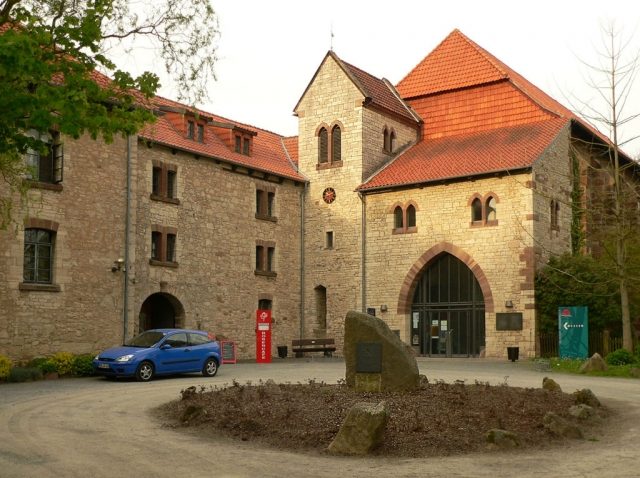
The former Brunshausen Monastery is located in Brunshausen, a district of the city of Bad Gandersheim. It was founded in the 9th century as a Benedictine nunnery. After a checkered history as a nunnery, a monastery for monks, and an evangelical convent, Brunshausen Monastery became an external camp of the Buchenwald concentration camp, known as KZ Bad Gandersheim, in 1944/1945. Today, the monastery church and parts of the monastery buildings house a museum dedicated to the history of Brunshausen and Gandersheim Abbey.
Founding of the Monastery
The site of Brunshausen was initially chosen by the Liudolfings as a seat of power because it was located in the center of their dominion and on the military road from Mainz via Fulda, Northeim, and Hildesheim to the North Sea. The manorial seat, from which wall remains dating back to around 840 have been excavated, was probably provided with a small private church in the first quarter of the 9th century. During the excavations, a piece of plaster with a runic inscription was found. The monastery was initially dedicated to St. John and St. Stephen; later, the patronage changed to St. Boniface. The abbey also possessed relics of this saint. The choice of Saint Boniface, an archbishop of Mainz, was rooted in the abbey's desire to distance itself from Hildesheim and align with the Archbishop of Mainz.
Establishment of Gandersheim Abbey
The convent of Gandersheim Abbey was housed in Brunshausen Monastery after its founding in 852 until the completion of the church and abbey buildings in Gandersheim. Even after the relocation in 881, Brunshausen remained a Benedictine nunnery. During this time, the abbey's founder Liudolf was buried in the monastery in 866, followed by Hathumod, Liudolf's daughter and the first abbess of the abbey, in 874. Liudolf's body was later transferred to the abbey church. After the founding of the abbey, Brunshausen became a proprietary monastery of the abbey, meaning that the abbess had secular oversight in the monastery. Spiritual jurisdiction lay with the Bishop of Hildesheim.
Brunshausen as a Monastery for Men
Brunshausen did not only house nuns in its history. It is recorded that in 1134, the first abbot of Clus Monastery also became abbot in Brunshausen. This means that the nunnery had become a monastery for monks. However, this period as a monastery for monks was only an interlude; by 1200, nuns were living in Brunshausen again. It had been recognized that two monasteries for men in such close proximity were not sensible.
Bursfelde Congregation
In the 15th century, the monastery was able to recover economically thanks to an increase in its monastic possessions. In 1448, Brunshausen was also affiliated with the Bursfelde Congregation from Clus. This congregation had its center in Bursfelde Monastery and demanded the observance of the Rule of Saint Benedict in its original strictness and purity.
Reformation
The next major turning point in the history of Brunshausen Monastery was the Reformation. The Principality of Brunswick-Wolfenbüttel was occupied by the troops of the Schmalkaldic League in 1542, and the Protestant faith was introduced for the first time. This also affected the imperial immediacy of Gandersheim Abbey, where Protestant worship was ordered. However, thanks to clever tactics, the canonesses were able to delay its implementation. In 1547, the returned Duke Henry the Younger of Brunswick-Lüneburg reintroduced the Catholic faith. It was not until 1568 that the Reformation was finally introduced by his son, Duke Julius of Brunswick-Lüneburg. On October 31, 1568, the visitation commission transformed Brunshausen into an evangelical monastery. Ducal officials were to take over the administration of the abbey, which Gandersheim Abbey resisted. This dispute over the monastery's affiliation was finally settled in 1593 in the treaty between the abbey and Duke Henry Julius, when the monastery fell to the Duke.
The Thirty Years' War
During the Thirty Years' War, the monastery suffered from marauding soldiers. Due to the Edict of Restitution for Catholicism of March 6, 1629, the five remaining Protestant conventuals were expelled and replaced by Catholic nuns. However, this phase ended as early as 1631, and the monastery became Protestant again. The destruction from the war, however, initially made a return of the Protestant conventuals impossible. It was not until 1655 that the old conditions were restored. But the purpose of the monastery increasingly changed. The vacant places of the conventuals were more and more frequently used for the provision of relatives of the abbey. In addition, a school was founded.
Return to the Abbey
In 1695, the dispute between the Dukes of Brunswick-Wolfenbüttel and the Abbey was decided, and the monastery reverted to Gandersheim Abbey. This transfer resulted from the Abbey's negotiations with Duke Anton Ulrich of Brunswick-Wolfenbüttel regarding the election of his daughter Henriette Christine as Abbess of Gandersheim and the associated conditions of the Abbey. The enthronement of the Abbess took place in April 1694, and in December 1695, the transfer of Brunshausen and Clus to the Abbey followed. At this time, only four people still lived in Brunshausen. From 1709 onwards, there was no longer any monastic life.
Baroque Flourishing
The monastery experienced a new use and flourishing under Abbess Elisabeth Ernestine Antonie of Saxony-Meiningen, who helped the entire Gandersheim Abbey to a Baroque heyday. She had the monastery converted into a Baroque summer residence between 1713 and 1726. However, after the death of the abbess in 1766, the monastery was only used as a workers' residence and storage facility for the Clus domain. The convent buildings no longer existed. In 1791, divine service in the monastery church also had to be discontinued due to dilapidation. The consequence was that the building was secularized in 1793. It was used as a barn, shed, and riding hall. In 1810, the abbey was secularized. The Brunswick Monastery and Study Fund became the owner of the monastic property, and the land was initially leased as part of the state domain of Clus and later sold.
Brunshausen in the Third Reich
During the Second World War, from the summer of 1944 until the end of the war, the western wing of the monastery housed a care facility for foreign children of Eastern European forced laborers. In the winter of 1944/45, the monastery church also served as an external camp of the Buchenwald concentration camp. The inmates worked in an armaments factory. On April 4, 1945, shortly before the end of the war, the external camp was evacuated, and 40 prisoners unable to march were shot in a nearby forest. A "authentic place" on the upper floor in the new monastery design commemorates this event.
Brunshausen Today
The monastery has been owned by the city of Bad Gandersheim since 1987 and was converted into a cultural center in 1989. Since May 2007, the monastery has housed the second part of the "Portal zur Geschichte" museum project, which presents the history of the abbey through the biographies of strong women. The third part of the exhibition will open this year. A café (Rosencafé) is located in the former Abbess's Hall.
Since the 1990s, a connection to Lamspringe Monastery has existed via the Lamspringe Sculpture Path. This is a section of the old Kreiensen - Hildesheim railway line, a total of twelve kilometers long between Lamspringe and Bad Gandersheim, which has been converted into a cycle path.
Building History+
The currently existing Gothic hall church with Romanesque remnants dates from the 14th/15th century. The Romanesque remains are located in the area of the west tower, at the entrance, and in the southern side apse. Four Romanesque predecessors have been excavated. They date back to the 9th century. It is known that the predecessor building was a three-aisled Romanesque basilica, which was larger than the current monastery church and was probably built in the 12th century. In 1300, the still existing rectangular choir was built because its predecessor had collapsed. The rest of the existing church dates from the mid-15th century. The new building was made possible by a short-term economic upswing. The western monastery wing was converted into a summer residence from 1713 to 1726. The private rooms of the abbess, the dining hall, and the castle chapel were on the first floor. The collections of Elisabeth Ernestine Antonie were housed on the second floor and in the attic. The rooms were organized according to the themes of the collections, e.g., architecture, abbey history, natural sciences, or coins. In 1810, the monastery complex was still largely intact. The north and east wings were demolished in the 19th century.
Take Mobile History with you
You are reading this text for free. Premium adds what matters on the road: descriptions read aloud, sites found through your camera, whole regions taken offline.
- Every description, including the ~17,700 Premium sites
- Audio guide: have descriptions read to you on location
- AR finder: see sites through your camera, with distance and bearing
- Unlimited saved sites
14 days free, then from €2.99 a month. Cancel anytime.
Location: 51.8828, 10.0319