Apartments
MonasteryHeide
Benden Abbey (Heide)
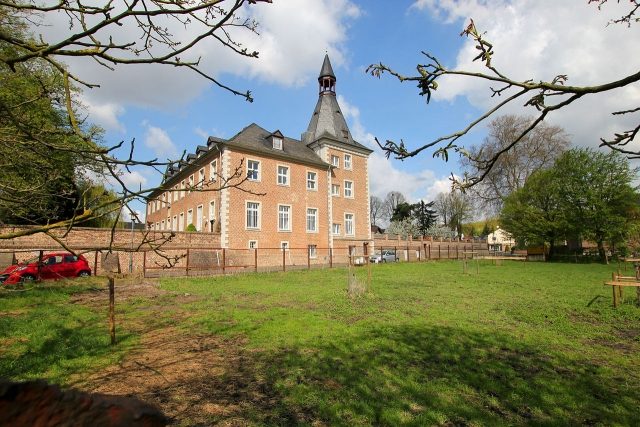
Kloster Benden was a Cistercian nunnery in what is now the Heide district of Brühl in the Rhineland.
The preserved parts of the complex have been restored and are now used for residential purposes.
Kloster Benden is located on the upper eastern slope of the Ville, the foothills, in the Benden, the meadows of the small valley of the mill stream formerly known as Siegesbach. Characteristic features for the choice of location for a new Cistercian monastery are also evident for this site. The pious nuns found seclusion here, fertile loess soil for cultivation, and, in contrast to urban convents, they had an abundant supply of clear, healthy water. Thus, later, the harvested grain and oilseeds could even be processed in their own mills.
The monastery and the adjoining western district of Heide can be reached via the B 265 (Luxemburger Straße) or from Brühl town center via the L 184 (Theodor-Heuss-Straße), turn-off Willy-Brandt-Straße.
Kloster Benden, with its former monastery church, was referred to in old documents of the order as "Conventus in prato beatae Mariae virginis," hence the monastery dedicated to the Virgin Mary was also called Marien-Benden. In further documents, this designation is supplemented by the location.
Foundation and Early Middle Ages
Kloster Benden is first mentioned in a document by Margareta von Hersel (Herzelle, Heerseel). She founded the Cistercian nunnery in 1207.
A document from 1231 also mentions Kloster Benden in connection with Knight Hermann, son of Lambert von Merreche. The same document also uses the designation Marienbenden near Merrege. Konrad von Hochstaden, Archbishop of Cologne, granted the venerable Marienbenden monastery (conventum Sanctimonialium beatae Mariae in prato prope Meregge) the privilege of immunity for its properties in June 1238. Merreche or Merrege later became Kirchberg, today's neighboring village of Kierberg.
Kloster Benden, with its church, burned down several times in its now eight-hundred-year history, first in 1388, and was then rebuilt by a Cologne canon and official.
In 1503, under the leadership of Abbess Dorothea Ruttenbach, it burned down again and remained abandoned for 30 years. Later, a reconstruction was begun by the succeeding Abbess Christina Ruttenbach, but it was only the later Abbess Christina Gebels who completed the new building in 1589.
The spiritual leadership and supervision of the monastery lay with the Abbot of Altenberg.
Late Middle Ages and Modern Era
Near the monastery, on the Villehöhe, probably referred to as Heide, a small hamlet of secular auxiliary workers dependent on the monastery developed. In a list from 1669 (Cologne State Description), the following possessions are listed for Kloster Benden: the small estate of Bendel with 25 Morgen, 290 Morgen cultivated by the monastery itself, the Bendermühle, the Theismühle in Kierberg, and the lignite mine near the monastery. According to a directory by Kierberg pastor Mauel, in 1747, Kierberg and Heide together had 36 houses with 37 families. One house is listed for the monastery itself.
Secularization
After the Napoleonic Wars, buildings, lands, and assets of monasteries and bishoprics passed into state ownership. Kloster Marienbenden was also affected by the dissolution of ecclesiastical institutions and the takeover of church property.
Around 1803, the Cologne broker Everhard Henner bought the monastery, including the church and buildings, and had all buildings demolished, with the exception of the abbess's house, which he converted into his country estate around 1806, and the farmyard. His heirs sold it in 1844 to Friedrich Giesler Sr. His son of the same name had the tower with the Baroque dome and probably also the gate built in 1889.
In 1802, the monastery church dedicated to Saint Bernhard was demolished. Parts of the interior furnishings went to the parish church of St. Margareten in Brühl and from there, after the construction of a church in Kierdorf in 1904, to that location. Inventory from the former monastery church, such as parts of the pews and the Baroque organ, can also be found in the parish church of St. Martin in Fischenich.
A tower was added in 1883 by the subsequent owner of the monastery buildings, a Mr. Giesler from Falkenlust.
The coat of arms still preserved today, located above the main entrance, bears the inscription:
In 1718, the venerable Lady Maria Anna Warts, Abbess (with) F. P. Constantin Schrils, erected this building. It thus serves as the last reminder of the nunnery.
The Present Complex+
The existing brick structure of the Baroque building dates from a new construction in the 18th century with remnants from the 16th century. Inside, original, partly painted stucco ceilings from 1719 are still preserved. Until 1988, the monastery courtyard, which had come into the possession of Rheinbraun via the Gruhlwerk briquette factory in 1907, was used for agriculture. Since then, the main building, renovated, has served as a representative seat for a law firm. The old surrounding farm buildings were demolished or converted into condominiums by a Cologne building contractor in 1988. With the new buildings, a courtyard complex was again designed. Today, 20 families live on the courtyard. Behind the former monastery, the ornamental garden of the nuns, converted into a lawn, extends to the adjacent Bergstraße. There are still some restored servants' quarters integrated into the massive monastery wall. The monastery wall, which extends several hundred meters uphill and is partially original, enclosed the monastery's kitchen garden adjoining the ornamental garden. This area was also sold and developed with single-family houses located in gardens.
Take Mobile History with you
You are reading this text for free. Premium adds what matters on the road: descriptions read aloud, sites found through your camera, whole regions taken offline.
- Every description, including the ~17,700 Premium sites
- Audio guide: have descriptions read to you on location
- AR finder: see sites through your camera, with distance and bearing
- Unlimited saved sites
14 days free, then from €2.99 a month. Cancel anytime.
Source: Wikipedia · Licence: CC BY-SA 4.0
This description draws on the facts documented in the linked Wikipedia article; Wikipedia content is licensed under CC BY-SA 4.0. Wording and editing: Mobile History.
Location: 50.8347, 6.8747