Youth Meeting Home
MonasteryNassau-Obernhof
Arnstein Abbey
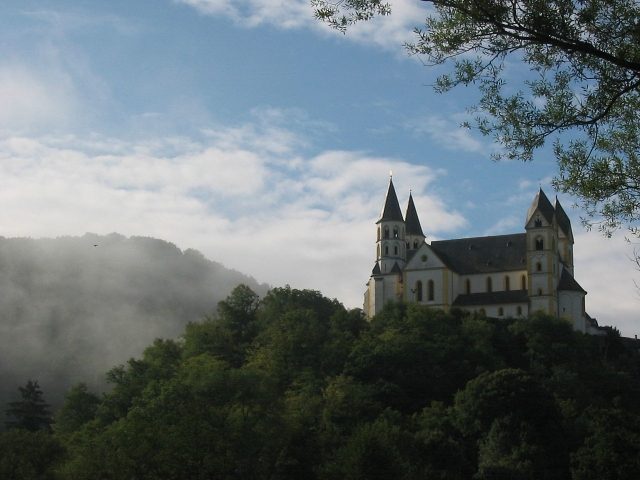
Arnstein Abbey is a former Premonstratensian abbey on the Lahn, south of Obernhof near Nassau. Today it is a monastery of the Congregation of the Sacred Hearts of Jesus and Mary (SSCC), known in Germany as the Arnsteiner Patres, and maintains a youth meeting center there.
The history of the monastery dates back to the second half of the 11th century: in 1052, Arnstein Castle on the Lahn was first mentioned as the seat of the Counts of Arnstein. This makes it the oldest mention of a castle on this river at all. No traces of this complex can be found today.
In 1139, Ludwig III, the last Count of Arnstein, converted his castle into a Premonstratensian monastery and entered it himself. His wife lived as a recluse near the monastery until her death. In the same year, the partial demolition of the castle began. In 1145, King Konrad III confirmed the abbey as an imperial immediacy. Since 1236, there was also a filial monastery under the patronage of the Nassau count or princely house, Keppel near Hilchenbach. In 1360, the monastery church was completed. It contains individual building components that can be dated to the 12th century.
From 1140 to 1478, the Palatine village of Bubenheim belonged to Arnstein Abbey, which had the present St. Peter's Church built there in 1163 by its cleric Gottfried von Beselich, which is considered the oldest Romanesque village church in the Palatinate.
With the conversion of the Princes of Nassau to Protestantism, the abbey, under its abbot Petrus Marmagen († 1604), placed itself under the protection of the Archdiocese of Trier. In 1803, the monastery was dissolved in the course of secularization. The secular rule fell to the Duchy of Nassau, and the ecclesiastical jurisdiction thus to the newly founded Diocese of Limburg. In 1817, the Nassau government sold the church and monastery for demolition, i.e., with the stipulation that the buildings would not be used for ecclesiastical purposes.
From 1869 to 1871, a Benedictine priory of the Beuron Congregation under Placidus Wolter briefly settled in Arnstein, but was closed again due to a lack of recruits and the dilapidated state of the complex.
In 1919, the first convent of the Arnsteiner Patres was established in Germany. The superior and vice-provincial Father Alfons Spix was condemned by the National Socialists in 1942 because he had repeatedly allowed Polish forced laborers to participate in community worship and had fed them. He died in Dachau concentration camp. Father Chrysostomus Lauenroth had already been sentenced to a prison term in 1936 for alleged currency offenses.
Since 1924, a pilgrimage to the Sacred Heart has developed, attracting numerous pilgrims annually.
Take Mobile History with you
You are reading this text for free. Premium adds what matters on the road: descriptions read aloud, sites found through your camera, whole regions taken offline.
- Every description, including the ~17,700 Premium sites
- Audio guide: have descriptions read to you on location
- AR finder: see sites through your camera, with distance and bearing
- Unlimited saved sites
14 days free, then from €2.99 a month. Cancel anytime.
Source: Wikipedia · Licence: CC BY-SA 4.0 · Image: http://de.wikipedia.org/wiki/Datei:Kloster_Arnstein_01.jpg
This description draws on the facts documented in the linked Wikipedia article; Wikipedia content is licensed under CC BY-SA 4.0. Wording and editing: Mobile History.
Location: 50.3102, 7.8516