The Castle can be visited
RuinKildrummy
Kildrummy Castle
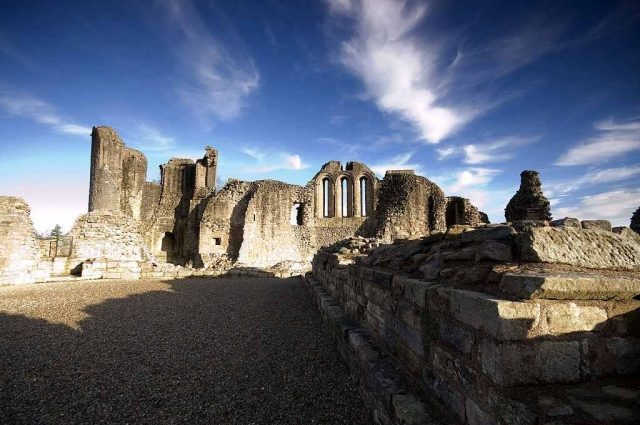
Kildrummy Castle is a ruined castle near Kildrummy, in Aberdeenshire, Scotland. Though ruined, it is one of the most extensive castles of 13th century date to survive in eastern Scotland, and was the seat of the Earls of Mar.
The castle was likely built in the mid-13th century under Gilbert de Moravia. It has been posited that siting of Kildrummy Castle was influenced by the location of the Grampian Mounth trackway crossings, particularly the Elsick Mounth and Cryne Corse Mounth. Kildrummy Castle underwent siege numerous times in its history, first in defence of the family of Robert the Bruce in August-September 1306 (leading to the executions of Nigel Bruce and many other Scots), and again in 1335 by David of Strathbogie. On this occasion Christina Bruce held off the attackers until her husband Sir Andrew Moray came to her rescue. In the reign of David II, Walter Maule of Panmure was warden of Kildrummy Castle.
In 1374 the castle's heiress Isobel was seized and married by Alexander Stewart, who then laid claim to Kildrummy and the title of Earl of Mar. In 1435 it was taken over by James I, becoming a royal castle until being granted to Lord Elphinstone in 1507.
The castle passed from the Clan Elphinstone to the Clan Erskine before being abandoned in 1716 following the failure of the Jacobite rebellion.
Kildrummy Castle is "shield-shaped" in plan with a number of independent towers. The flat side of the castle overlooks a steep ravine; moreover, on the opposite side of the castle the walls come to a point, which was once defended by a massive twin-towered gatehouse. The castle also had a keep, called the Snow Tower, taller than the other towers, built in the French style, as at Bothwell Castle. Extensive earthworks protected the castle, including a dry moat and the ravine. Most of the castle foundations are now visible, along with most of its lower-storey walls. Archaeological excavations in 1925 uncovered decorative stone flooring and evidence of battles.
The castle property now owned by Historic Scotland, and Kildrummy Castle gardens, in the quarry used to excavate stone for the castle, are both open to the public. A hotel (the Kildrummy Castle Hotel) has been built on the old estate, overlooking the ruins.
Kildrummy Castle was the venue for the Scottish Sculpture Open, sometimes known as the Kildrummy Open, organised by the Scottish Sculpture Workshop from 1981 to 1997.
Take Mobile History with you
You are reading this text for free. Premium adds what matters on the road: descriptions read aloud, sites found through your camera, whole regions taken offline.
- Every description, including the ~17,700 Premium sites
- Audio guide: have descriptions read to you on location
- AR finder: see sites through your camera, with distance and bearing
- Unlimited saved sites
14 days free, then from €2.99 a month. Cancel anytime.
Source: Wikipedia · Licence: CC BY-SA 4.0
This description draws on the facts documented in the linked Wikipedia article; Wikipedia content is licensed under CC BY-SA 4.0. Wording and editing: Mobile History.
Location: 57.2349, -2.9049